8 of 8
questions without a basis declined instead of guessed
eight questions deliberately outside the material; the wording of every answer is in the measurement file
XICBOT is trained on your website, your documents, PDFs, FAQ and price lists. Its answers are built from numbered excerpts of exactly those sources; if no excerpt carries the answer, the assistant says that nothing is on file rather than guessing, and the question is recorded as a gap.
The assistant learns from your content. This includes your website, documents, PDFs, common questions and price lists. It builds its answers from parts of these sources. If it finds no answer there, it is meant to give none. Then it says that nothing is on file for this. So it usually does not guess. You can test this free of charge with your own content.
Request a free demo View pricing
Visitor:From what quantity does your volume pricing apply?
Assistant:The tier starts at 50 units. The figure is stated that way in the price list — I pass it on unchanged and do not convert it.
Visitor:And if I mix two variants — do they count together?
Assistant:There is nothing on this in the stored knowledge base. When no excerpt carries the answer, I say exactly that; an estimate would be a guess here.
Visitor:Does the business get to hear about that?
Assistant:Yes. An answer without a single used source reference is recorded as a knowledge gap and reported onwards. The wording of your question is not stored a second time, and below twelve characters no entry is created at all.
Ask it yourself, Assistant of this website
Automated assistant8 of 8
questions without a basis declined instead of guessed
eight questions deliberately outside the material; the wording of every answer is in the measurement file
An AI chat assistant is only as good as the knowledge it answers from. A generic building-block bot with rigid menu trees knows nothing about your business and quickly sends visitors into a dead end. XICBOT does the opposite: we train the assistant on your own content so it knows your specific offering, your prices, your opening hours and your frequent questions. This trained knowledge base is the foundation for everything else, from the website assistant that answers visitor questions to the support assistant that resolves enquiries from FAQ and help articles. And because its answers are bound to your sources, the assistant answers from your content rather than making things up.
Before the assistant answers a single question, we gather your existing content and make it usable for it. The more complete the knowledge base, the fewer questions remain open and the less often a handover to a human is needed. The following sources typically feed into the training, and more can be added at any time.
Your homepage, service pages, about page and contact details. The assistant knows your offering the way it appears on the website and guides visitors to the right subpage.
Manuals, data sheets, brochures and internal documents. The assistant summarises what is in your documents and answers detailed questions from the PDF, without visitors having to search it themselves.
Your frequent questions, guides and help articles. Recurring questions are answered directly from your FAQ, around the clock and in the visitor's language.
Prices, tariffs, availability, locations and opening hours. This way the assistant answers exactly the questions that would otherwise lead to a phone call or email, reliably from your current details.
On request we connect an internal knowledge base or help centre. The assistant then answers from the same body of content your team uses and stays close to your official information.
Its answers are bound to your own content. The assistant answers from what your sources say instead of formulating freely and can point to the origin so visitors can trace where an answer comes from.
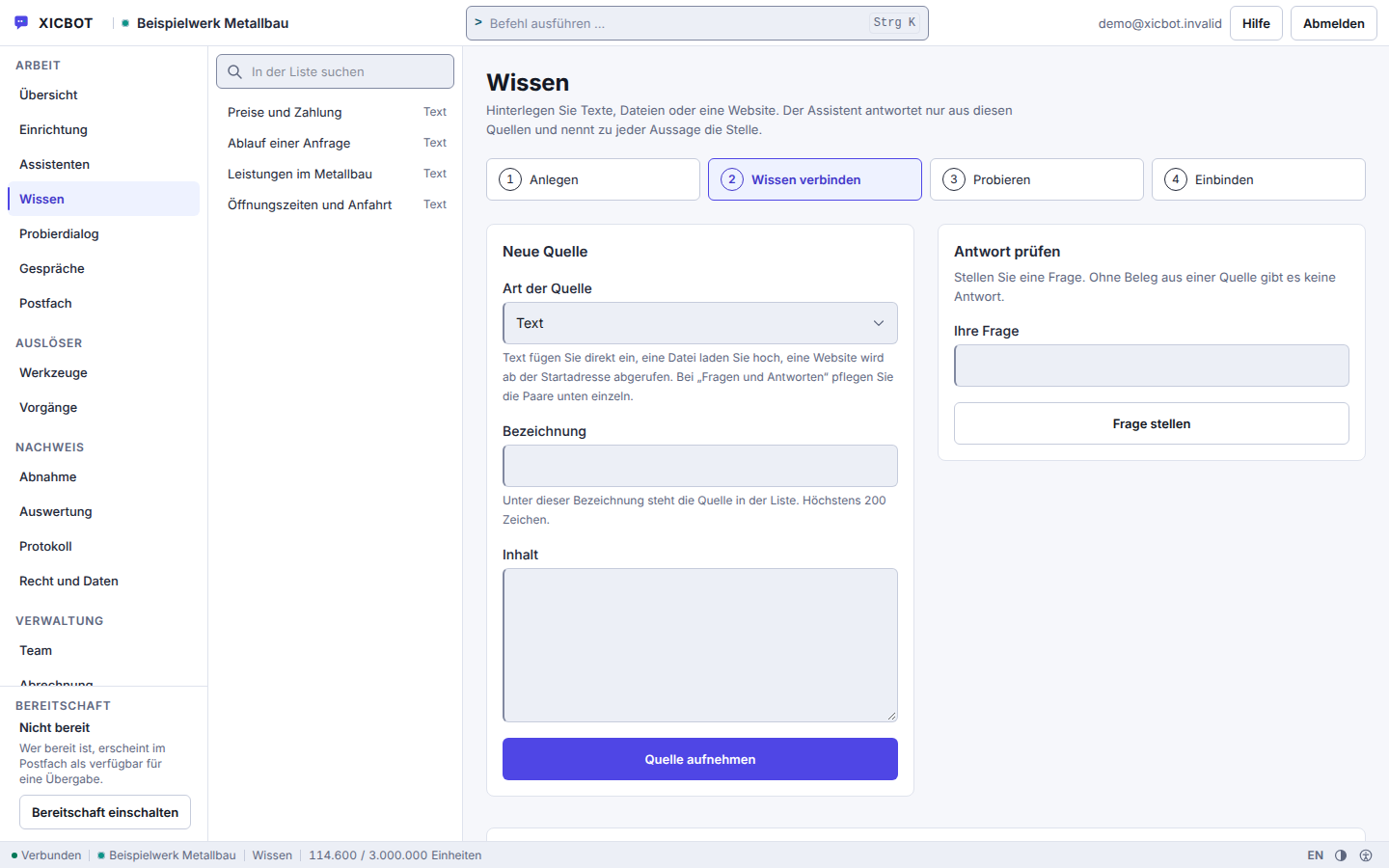
Six rows, but four source kinds at heart: text, file, website and FAQ. Anything else that counts as a source comes in through one of those four — a dedicated connector per external system is not implied. We put it this precisely because otherwise the difference only surfaces during setup.
2,670
sections from 70 documents in our own knowledge base
the corpus of the assistant answering on this site
Type, label and content are the fields of a source; uploaded files follow the period that applies to your account.
The answer check asks a question and shows which source covers it.
Question-and-answer pairs fix the wording wherever it must not drift.
A language model writes fluently even when the basis is missing. So at XICBOT the run before it sets the material: five excerpts from your sources go into the request numbered, each in a frame of its own with the document title. The instruction demands the number in square brackets, and a source reference counts as used only once its number appears in the answer text. If an answer comes back without a single used number, it is recorded as a gap. If no excerpt carries the answer, the assistant usually tells the visitor that there is nothing on this in the stored knowledge base. That is not evasion but precisely the point at which an assistant without source binding would start to guess.
Numbered Excerpts Instead of Free Formulation
A second check runs after the model. Hard statements in the draft are read back against the excerpt material; whatever stands nowhere there is replaced by a placeholder, and the correction reaches the visitor as an event of its own. If there was no excerpt material at all, the text is left untouched — a statement about an empty shelf would not be a check but an assertion. An assistant can still err. The binding to your sources, the source reference it names and the handover to your team, available at any time, keep the room for that small.
42 of 48
answers carrying a source reference
questions whose answer is in the knowledge base; six carried no source reference
The trained knowledge base is not just a reference work. It is the foundation for the assistant to advise visitors, forward them and act on your behalf. From the same knowledge it reads (Read) and acts (Actions), always within the permissions you define. Which actions are possible is shown under tool control.
Visitor:Do you come out to the surrounding area as well?
Assistant:There is nothing on this in the stored knowledge base.
Visitor:But the website has a section on the service area.
Assistant:The section exists but shares no word with your question. The search runs over words, not over meanings — so “surrounding area” does not lead me to it. And coverage is measured per section: two hits each carrying one half do not add up to full coverage.
Visitor:Can that be fixed?
Assistant:For exactly such cases the business stores a maintained question-and-answer pair using the words visitors actually use. Its wording goes out unchanged, without a model call.
A changed price list does not take effect in the same moment, and we do not write it that way either. A website source carries a fetch interval — seven days in-house, adjustable from one day up to a year, and the value zero means: never. A daily run picks out what is due. A source only counts as stale once more than twice its interval has passed, but at least fourteen days. On fetching, the service asks with ETag and modification date: if your server reports no change, nothing is split anew. And anyone who receives an answer from a stale source thereby triggers a refresh in the background, without the running answer waiting for it.
A Run Writes into the Next Version, Not into the Live One
Writing does not go into the body that is currently answering but into the next version; the switch happens only at the end, and only if it differs from the previous state. If the run fails, the pointer stays put and the old state keeps answering. If a run has written nothing, it deletes nothing either — otherwise a maintenance page would empty your knowledge base and report success. Five versions are kept; a rollback discards everything above it and is lossy going forward. A document that has not changed is skipped, recognised by the digest of its text rather than by its date, and a page that has become a draft loses its sections.
You do not have to prepare knowledge or write any scripts. We handle the setup and guide you through the training in manageable steps, from the first gathering of sources to keeping everything current. It starts with a look at your existing content: which sources exist, how much of that carries text and which questions they already answer today.
We review your existing content: website and subpages, PDFs and data sheets, FAQ, price lists, opening hours and, if available, your internal knowledge base. You decide which sources feed in and which stay out. Additional knowledge you can give us informally as text or a file.
From these sources we train your assistant. We structure the content so it finds suitable answers, links related topics and can point to the right origin. The assistant learns your offering, your terms and your frequent questions.
We test typical questions from your customers, check the answers against the sources and refine wording and tone. Together we define when the assistant hands over to a human and which topics it deliberately does not answer itself. This way the assistant fits your organisation.
Before going live a probe set runs: up to 50 questions, each in a conversation of its own and along the same path as a real conversation. Judgement happens without a model on three recalculable feet — mandatory terms, forbidden terms and literal overlap with the answer. A row that received no answer at all is recorded as an error and is kept out of every quota.
When prices, opening hours, services or documents change, we update the knowledge base without rebuilding the assistant. New sources are added, outdated ones removed. This keeps the assistant on the same footing as your website and your team.
A new assistant starts as a draft, including the one the setup assistant proposes: the machine proposes, the human accepts. A proposal counts as adopted only once you accept it, and promotional absolutes drop out of a machine proposal and appear in the report instead.
A word on the limit of this acceptance: it measures, it does not block. There is no condition that ties the switch to active to a probe-set result. That is why the result belongs before the switch and not after it — the decision stays with you.
The way from an address to the first answer consists of five steps, and none of them runs in the visitor's browser. It is set out here not because it looks neat but because every step has a cap you should know about before you add a large source.
When a source is created, a guard checks the target before anything is fetched: names that do not resolve, foreign schemes and targets that are not publicly reachable are rejected, and every redirect target is checked again. A website is then not read within the running request but queued as a job; text and file are split by the same request straight away, and an FAQ collection is ready without any fetch.
The crawler works through a queue: start address, sitemap, the stock from the last run, then links in the page text. Only HTML and plain text are read, the body in pieces — the length the other server claims is a claim, not a measurement. Once the cap is reached the run stops and records how many links were left open.
The text is first separated at headings, then at sentence boundaries. The target is 800 characters with 120 characters of overlap, 1400 with 200 for files; per source this can be set between 200 and 4000 characters. At 1600 characters a hard cut applies so that no section grows without bound. A changed section size only takes effect with the next run, because nothing about the content has changed.
Every section receives up to 14 keywords and up to 4 questions, which are written back into the search text together with the heading. No model takes part in this: every keyword stands in the section itself, and questions are only formed where a heading exists and the language has been recognised.
Finally each section gets a profile of 256 slots, formed from words, word pairs and character sequences — no neural method, no external service, no graphics card. Until this step is through, the assistant searches over the full text alone. After that the new version switches in, and only if it differs from the previous state.
Two caps are the ones you actually run into: at most 25 pages per run and 200 sources per refresh run. Neither stops silently; both record that a cap was hit. A source that still has a job running is skipped rather than read twice.
The price depends on the volume and the condition of your sources, not on the number of questions visitors ask. A well-kept website with clean headings is taken in faster than a folder of scanned PDFs: without a text layer those yield nothing and have to be replaced first. That is why the look at what exists comes before the choice of package.
from 49 € per month net
Minimum term: none, cancellable monthly
All prices net, plus VAT Source: XICBOT price list, as of 11 September 2026
An assistant with its own knowledge base starts in the Start package from 49 € per month net for ongoing operation, including hosting in Germany, care and updates. The one-off setup with individual training and integration begins from 990 € net. Larger bodies of knowledge, shop integration or an internal knowledge base are covered in the Pro or Custom package; you will find an overview of all packages under pricing. Ongoing services are booked individually and can be cancelled monthly; there is no minimum term.
We review your website, PDFs and FAQ and tell you factually which questions they already answer and where gaps remain.
The difference between a generic chatbot and an assistant trained on your knowledge base shows in everyday use as soon as a question deviates from the intended path. The comparison makes clear where the line runs between a dead end and a genuine answer.
Make Knowledge Gaps Visible and Close ThemQuestions for which the assistant does not yet find an answer in your knowledge base are valuable knowledge for you. Via conversation analytics you see which topics are asked frequently and where content is missing, and you extend the knowledge base in a targeted way. How your content is protected and where it is processed is covered under privacy & hosting.
Which content belongs in the knowledge base and how it stays current is described in detail in building a knowledge base. Why source binding is technically the most effective lever against wrong answers is explained in preventing hallucinations. How the assistant keeps your tone of voice while doing so is shown in AI assistant with its own brand voice.
The questions here revolve around where the knowledge comes from and how it is maintained. What the assistant may do beyond answering is covered under tool control; where your content is processed, under privacy & hosting.
Nothing is trained: your content goes into a knowledge base from which the answer is searched at runtime. Four source kinds are available — free text, file, website and maintained question-and-answer pairs. A website run reads at most 25 pages, obeys robots.txt, takes only HTML and plain text and follows no link to an external address; pages marked noindex count as a draft and yield no sections at all. Files up to 10240 KB are split into sections, a PDF via its existing text layer. Which source feeds in and when it is read again is your decision per entry. More under knowledge base.
For each answer the conversation run fetches five hits from your knowledge base and builds from them the excerpts the assistant may rely on. If none of the hits carries the question, it is instructed not to guess but to say that the deposited knowledge base holds nothing on the subject. In parallel the question is recorded as a knowledge gap; from the Pro package the list of knowledge gaps shows up to 50 cases and is the working stock for your next round of maintenance. On request the assistant hands over to a human: state change, mailbox entry and notification happen in one go, with the transcript attached. An open question therefore stays visible instead of disappearing into the conversation. More at the support assistant.
The room for that is drawn tight. For every question at most five search hits from your knowledge base, plus your text blocks, go to the model, numbered, and sourced answers name the excerpts they rely on. Figures, prices and deadlines that are not in your sources are replaced with a notice. If the search finds nothing or the model declines, the assistant says that nothing on this is held in the knowledge base — and the case is logged as a knowledge gap, as is an answer without a used excerpt. Its rules forbid it to invent contact details, file numbers or appointments, or to pose as a human being. An error cannot be ruled out entirely with any language model; hence the binding to sources, the visible citation and the handover to a person.
Every source has its own refresh interval: the house interval is 7 days, adjustable between 1 and 365, and the value 0 explicitly means never. A daily run queues the due sources and reads them again; the fetch is conditional via ETag and Last-Modified, so an unchanged page costs no new build. A source counts as stale only once more than twice its interval has passed since the last check, and at least 14 days. Every index run writes into a new version and switches over only at the end, with five versions kept. On request we take over the upkeep as part of ongoing operation. More under knowledge base.
Yes, as long as the document has a text layer. The knowledge base accepts files up to 10240 KB and splits them into overlapping sections so a passage does not end mid-sentence; a PDF is read through its existing text layer. A scanned sheet without a text layer deliberately yields nothing — there is no text recognition from the image, and the reason is shown as a message on the source instead of silently missing. For the question, at most five search hits plus your text blocks then go to the model, numbered, and sourced answers name the excerpts they rely on. For prices, terms or deadlines that have to be exact, the maintained question-and-answer pair is the better place: it goes out verbatim. More under knowledge base.
Ongoing operation starts in the Start package from 49 € per month net including hosting in Germany, care and updates, and the one-off setup with individual training from 990 € net. Start holds ten knowledge sources and 200 documents, Pro from 2,900 € net setup and 149 € per month net holds 50 sources and 2,000 documents, Custom from 4,900 € net setup holds 250 sources and 20,000 documents. A source can be text, a file, a website or a question-and-answer collection. Sourced answers name their source; an answer without a used excerpt is recorded as a gap. Details under knowledge base and pricing. All services can be cancelled monthly; there is no minimum term.
Under Knowledge in your account, per source with a timestamp. It also states whether a crawl was capped and how many links were left open — without that figure the source would afterwards read as finished, as if it had been read in full. As long as nothing has been measured the field stays empty and is not reported as zero. Every source also carries its refresh interval; it counts as stale only once more than twice that interval has passed since the last check, and at least 14 days. A conditional fetch via ETag and Last-Modified may well conclude that nothing has changed. All of this is independent of product changes and the most frequent explanation for changed answers.
Yes. One website is enough for the first answers. The crawler follows the rules in your robots.txt and takes in a limited number of pages per run; from these come the sections the assistant cites in its answers. You can add more at any time: there are four source types — text, file, website and question-and-answer collection. The assistant does not have to be rebuilt for that: every index run writes a new version and only switches over at the end, and a failed run leaves the previous state answering instead of creating a gap.
You do, if you want to: the interface shows sources, documents and conversations, and a changed source is read in again. Every source has its own refresh interval — preset to 7 days, adjustable between 1 and 365, and the value 0 explicitly means: not automatically. A run in the early morning works through the sources that are due; a source only counts as stale once more than twice its interval has passed since the last check, and at least 14 days. Unchanged pages are skipped, and a run that wrote nothing deletes nothing — otherwise a maintenance page would clear out your knowledge base. The analytics show which questions come up often and where an answer is missing. If you would rather not do it yourself, you hand it to us.
One question that often follows is answered by the system itself: when a source was last read is shown per source with a timestamp in the Knowledge area of your account. That is the most common explanation for an answer having changed, and it is closer at hand than any guess about the model.
Free Demo with Your Content
We train XICBOT on your website, your documents and your FAQ and show you how the assistant answers bound to your own sources. Without obligation and without sales pressure. Discuss a Demo
Tell us your website address and which questions your customers ask most often. On request we train a test assistant on your content so you can experience the source binding yourself. You can reach us by phone at +49 5123 9579000.