1.3 s
to the first character of the answer, median
64 questions to our own assistant, not to customer projects
XICBOT builds an AI chat assistant that knows your house and answers from your own material: menu, hours, directions.
This page is for restaurants and hotels. The assistant knows your menu, your opening hours and the way to you. It names free times for a table. It first shows a table request as a draft. The table is only fixed once your team confirms it. It is not meant to judge questions about allergens. It passes such a question on to your team.
Request a demo for your venue View pricing
It names free times and puts a table request forward as a proposal. Only after the guest confirms does it take it as a request, for your house to confirm. It also captures catering, event and room enquiries with every key detail. Around the clock and in the language the question is asked in. On allergies and intolerances it does not answer freely: a fixed lock sits in the program there, and the conversation goes to your team.
Assistant:Welcome. I can name free times, take table requests and answer questions about the menu, the opening hours and how to get here. How can I help?
Guest:Do you have a table for four on Friday at 7:30 pm?
Assistant:Friday at 7:30 pm is inside the released window and free. I am putting the request forward; it is taken only once you confirm, and the table becomes binding when the house confirms it.
Guest:Confirmed. One of us does not tolerate gluten. Which dishes would work?
Assistant:I can tell you which dishes our menu marks as free from gluten. Whether a dish is tolerable for you is not something I judge, that is a fixed limit. I am passing your question to the service team so the kitchen can settle the preparation with you.
Ask it yourself, Assistant of this website
Automated assistantIn hospitality, enquiries rarely arrive when someone has time. The guest wants to book on a Friday evening while the service team is flat out. They ask about the menu long after the kitchen has closed. They want to know whether anything is free on Sunday, and nobody can pick up the phone. Every one of those enquiries is a table that stays taken or stays empty. The assistant sits on your website, names free times from your appointment types, reads your stored material and answers exactly these questions without anyone in the service team looking up.
It is not a form with fixed fields; it answers freely worded questions from your sources. What it does splits into two classes: reading and writing. Reading runs without asking back, because it changes nothing. Anything that creates something is first put to the guest as a proposal. That split runs through every one of the tasks below.
The assistant calculates free times from your appointment types and the reservations already requested or confirmed at XICBOT; that is a read access and runs without a confirmation step. A table request is a write access: it is shown as a proposal, carrying exactly the details about to be taken, only the guest's click creates it, and it becomes binding when your house confirms it. A time outside your released window, too short a lead time or an unknown appointment type do not get through at all.
Questions about dishes, drinks and labelling are answered from your stored menu. If it finds no excerpt carrying the question, it usually does not guess; it says the detail is not on file. Allergies and intolerances are separated from this once more: there it is instructed not to judge, even when a label is on file; when a question names the topic, the service appends a fixed notice and hands over to your team.
Opening and kitchen hours, closing days, holiday arrangements, directions and parking sit in the knowledge base as a source and are answered from there instead of being hunted for in the imprint. When something changes, the source changes: a website source is picked up by a daily run, a file you swap out.
A celebration, a company dinner or a larger group is not a question but a procedure. The assistant captures occasion, desired date, party size and contact and turns them into a lead, with the same preview as a table request, so the guest reads beforehand what is being transmitted. The hospitality industry template hands groups of ten and more and event enquiries to the house explicitly, instead of negotiating them to the end in the chat.
Once your house confirms a table request, the guest receives a confirmation email, if an email address was given. For every confirmed reservation with a stored address, an hourly run queues a reminder. What decides is the state the reservation has at that moment, not the time it was requested; a rescheduled or cancelled reservation therefore produces no reminder for a time that no longer exists. Whether that lowers the number of missed reservations in your house depends on your house, and we make no promise about it.
Which language a guest speaks is recognised by our own code from function words and characteristic characters, with no outside service and no extra model call. Where the picture is not clear, the field stays empty instead of guessing a German: a guessed value would sit in the database like a measured one. The answer follows the language of the sentence currently there, so a switch mid-conversation takes effect with the next answer. What that means for the menu, the confirmation and the handover is set out under multilingual assistant.
Which of these carries weight in your house depends on the house: a restaurant with a changing lunch menu needs something other than a hotel with room enquiries or a function room that lives on celebrations. How the answers are bound to your material is set out under knowledge base; which tools an assistant is given at all, and who approves them, under tool control.
1.3 s
to the first character of the answer, median
64 questions to our own assistant, not to customer projects
For the assistant to work dependably it reads first: the free times from your appointment types, your opening and kitchen hours, the menu with its labelling and the rules you have set - lead time, group size, blocked days. On that basis it names times that are free under your rules instead of plausible-sounding ones. Reading turns into acting, and the confirmation sits exactly on that edge.
The assistant names free times, shows the guest the proposal and creates the request after that click, for your house to confirm. Against the double click stands no coincidence but a one-time key: conversation, tool and the sorted input form a fingerprint that is locked in the database. The same proposal confirmed twice stays the same request. On top of that, the button in the widget locks itself after the first click.
Questions about dishes, drinks and labelling are answered bound to your own menu, with vegetarian, vegan and gluten-free options as far as your menu marks them. On the subject of allergies that stops: there it is not meant to give binding information but to point to settling it with your service team. The guest gets a usable answer quickly without anyone making a commitment they cannot keep.
A special wish, a complaint or a question the assistant cannot carry does not end in an excuse. The handover tool sets the conversation to the escalated state, creates a lead and notifies a human; the history goes with it, so your team does not start from zero. If you have registered a form on your site for such requests, the assistant pre-fills it once the guest has confirmed the details; it is submitted only if you allow submission and the guest agrees. Otherwise what it leaves behind is a callback request or, in the Custom package, a record in your customer management.
At most five tool calls lie between question and answer; anything needing more ends with a human rather than in a long chain. The assistant takes no money: there is no separate safeguard level for irreversible steps; the directory of build forms knows reading, writing and irreversible, and irreversible steps, like writing ones, run only after confirmation. Which tools an assistant is given and how they are approved is set out under tool control.
Whether restaurant, cafe, bar, country inn or hotel: the pattern is the same everywhere, the questions differ. In the restaurant it is about tables, the menu and the changing lunch offer. In cafe and bar about opening hours, breakfast and groups. The country inn lives on celebrations and on the question of how to get there, the hotel on room and availability enquiries, check-in and breakfast times. In catering and events what counts is that occasion, date, party size and contact arrive complete before anyone writes a quote. Which of these cases carries the largest share in your house is seen fastest in the calls of an ordinary week.
Several Houses, Several Assistants Every assistant carries its own key, through which the widget addresses it, and is created with a name, a template and a language. A second house therefore gets an assistant of its own with its own knowledge base and its own rules, rather than a shared one that knows both menus and can mix them up.
The most important mechanism for this trade
Four subjects are locked in the program: medicine, law, finance and allergens. The lock does not sit in a tenant field but in the code, because a tenant field would be overwritable - and that is exactly what it must not be. For a house with a kitchen it is the most important of the four: the assistant names what your menu marks, but it is not meant to judge tolerance or give binding allergen information.
When the limit is touched, the product itself appends a mandatory notice to the answer, not the model. The reason is sober: the model cannot know which limit was just touched, and a doubled notice under the same answer reads like a fault. The notice then says that this assistant is a program, that it can be wrong and that it does not replace binding allergen information or personal advice from the people who work there. In the inbox the case carries its reason, so nobody has to guess why the conversation was passed on.
The hospitality industry template draws the same line at set-up time. Its topic boundary reads: only food and drink, opening hours, reservations, rooms and directions, no allergen information without a stored detail. Its handover rule names groups of ten and more, event enquiries and allergy questions without a stored detail. You can adapt the template to your house; the four locked subjects stay untouched by that.
8 of 8
questions without a basis declined instead of guessed
eight questions deliberately outside the material; the wording of every answer is in the measurement file
Guest:We would like to hold a celebration for 30 people in the autumn. Is that possible with you?
Assistant:Groups of that size are decided by the house itself, not by me. I will capture the key details and pass them on. What is the occasion, on which day, and how can we reach you?
Guest:A company anniversary, a Saturday in October. You can reach me at feier@example.invalid.
Assistant:Thank you. I am putting the enquiry forward, exactly as it will go to the house.
Assistant:Confirmed. The enquiry now sits with the house, together with the whole conversation. I cannot commit to a date or a room; the house decides that and will get back to you.
A second assistant for the house next door comes out of a name, a template and a language; the hospitality template already brings role, topic boundary and handover rule with it.
The key beside the assistant is what stands in the embed code of your website; a new menu does not change it.
The current month allowance sits on the same page as the assistants, which is where you look before the Christmas season.
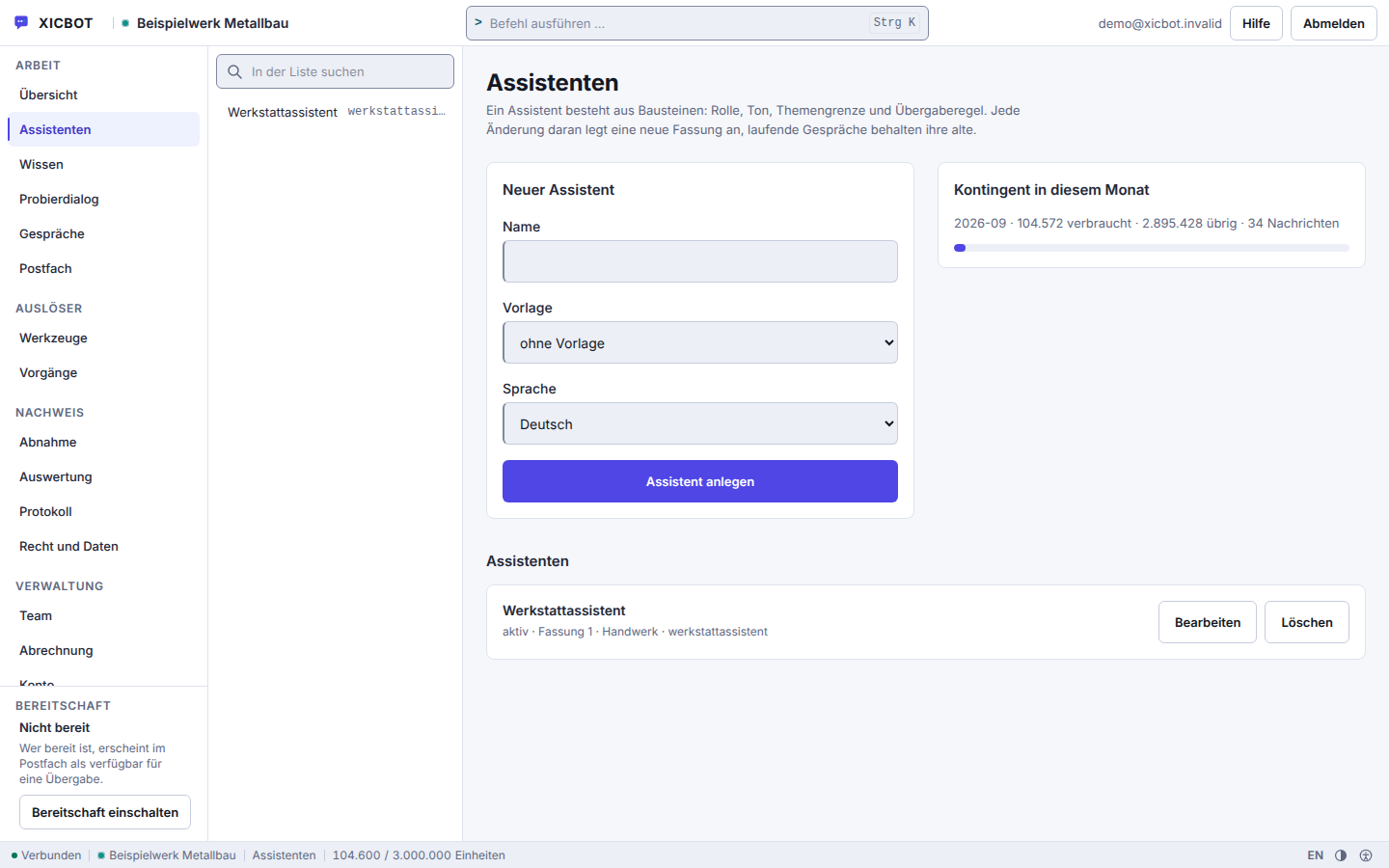
The path to your own assistant does not begin with technology but with the calls of an ordinary week: what is really being asked, which of it costs the service team the most time, and which of it is already written down somewhere? You do not have to program anything for it.
We set up, train, integrate and operate. You decide which questions the assistant may take, where its limit lies and to whom it hands over.
We look at which enquiries reach you and into which of three classes they fall: information from existing material, a procedure that writes something, a case for a human. That classification later decides what the assistant may do itself and what it passes on.
Food menu, drinks menu, opening and kitchen hours, directions, house rules: everything that answers are to come from becomes a source. The product reads PDF through its text layer; a scanned or photographed sheet carries none and is declined with a reason instead of being half recognised. Text recognition deliberately does not run along, because text read from a scan is wrong in places - and a misread label would be exactly the kind of error nobody here can use.
Appointment types, lead time, released windows, group size: which requests the assistant may take stands in your rules and not in the model's discretion. In the same step we set which enquiries go straight to the house - for groups and events that is the normal case.
Integration happens with a short code snippet that fits into any website and any common system. The assistant adapts to your design and runs first-party on request, that is through a path on your own domain instead of our widget domain.
Before go-live we run your real questions through and check whether the answer hangs on an excerpt or is freely worded. In operation a daily run per tenant repeats that and measures retrieval quality, so a drop is noticed before a guest notices it.
After go-live we take over hosting in Germany, operation, care and updates. Website sources are refreshed by a daily run; every index run writes a new version and switches over only at the end, and a failed run lets the old state keep answering. Every scheduled run writes a heartbeat, and an overdue heartbeat is recorded as a critical message, exactly once per name.
How long it takes depends above all on how ordered the menu and the hours already are: a maintained page with the menu as text is gathered faster than a stack of photographed daily specials. We do not name a deadline in advance.
What an assistant costs for a house with a kitchen depends on three things: how many sources have to be maintained, whether it only informs or also writes, and whether a calendar is connected. An assistant that answers on the menu, the hours and the directions is something other than one that writes bookings, sends reminders and captures event enquiries.
from 149 € per month net
Minimum term: none, cancellable monthly
All prices net, plus VAT Source: XICBOT price list, as of 11 September 2026
The assistant for restaurants and hotels is usually the Pro package: a one-off setup from 2,900 € net (individual training, table times and menu, integration) plus operation from 149 € per month net (hosting in Germany, care, updates, data protection). Included are the table request and the write with confirmation, the reminder before the date, questions on menu and labelling, event and lead features and the conversation analytics. An assistant that only informs and writes nothing starts as the Start package from 49 € per month net. Ongoing services are booked individually and can be cancelled monthly; there is no minimum term.
The difference shows less in a single feature than in everyday practice: in the table request during the service rush, in the guest asking about labelling in the evening, in the phone ringing for the same piece of information a third time. The comparison takes six situations that occur in every house.
Further reading: AI assistant for restaurants covers bookings, menu and allergens, appointment requests via chat describes how an appointment request comes about in conversation without a double entry, and handover to human agents shows what a handover fails on when the history does not travel with it.
Six questions come up in almost every conversation with a host: whether the assistant really writes or only collects, how it handles allergies, whether it can do rooms and events, whether it speaks other languages, what happens with special wishes and complaints, and what the whole thing costs.
It takes reservation requests, through the same tool type as an appointment request; a table is set once your service team confirms the request. Creating the request writes and runs with a confirmation: party size, time and special wishes stand in plain text in the proposal, and only the visitor's click creates the request; if they gave an email address, they receive a confirmation email after your service team has confirmed. A request is only possible if the kind is known to your house, the lead time fits and the time falls into an approved window; occupancy is checked under a lock, and a double click creates no second request. On request the assistant names free times from your stored kinds — time windows, duration, lead time and buffer — minus the reservations already requested or confirmed in XICBOT; it does not compare them with your reservation book, and it enters them straight into a calendar only with a calendar connection set up in the Custom package. More at the booking assistant.
It gives information from the labelling stored in your menu, for example on vegetarian, vegan or gluten-free dishes, and exclusively from there: sourced statements carry the excerpt they come from, and an answer without a used citation is recorded as a gap. Where the menu says nothing about an ingredient, the assistant says so instead of guessing. For serious allergies it makes no promises into the blue but refers to personal coordination with your service team and hands the conversation to a human; the transcript goes along. That way the guest quickly gets information that holds. You keep the menu itself current through the knowledge base, each source with its own refresh interval.
Yes. For hotels the assistant takes room and availability enquiries, states check-in and breakfast times and forwards concrete booking wishes to your team in a structured way. For catering, celebrations and larger groups it collects occasion, date, party size and contact, so a clean enquiry lands in your inbox, ready for a quote. Before sending, the guest reads in plain text what will be handed over and confirms it themselves; clicked twice, no second enquiry is created. How much the assistant completes itself and what it forwards is set through the actions you have approved.
Yes. Guests write the way they speak and get the answer in the same language — even when it changes mid-conversation, because detection happens per sentence, not per conversation. Detection works in our own code with function words and characteristic characters, without an external service; word lists exist for nine languages, among them English, French, Spanish, Italian, Dutch, Polish, Portuguese and Turkish. Your menu and your pages may stay German: the knowledge base is not filtered by language, language only acts as a ranking bonus. How this runs in detail is described under multilingual assistant.
What is in your sources — opening hours, services, processes, prices — the assistant answers itself, naming the excerpt it relies on. For special wishes and complaints it is not the final stop: complaint words form one of the eight topic lists in the mood detection and count towards the handover threshold. Once that is reached, the conversation moves into the handed-over state, the responsible place is set and a message with the transcript goes into your mailbox. This detection runs without a language model and therefore still works when something is currently stuck at the model. Like a website assistant it first answers what is certain and passes on the rest instead of guessing.
Usually it is the Pro package: a one-off setup from 2,900 € net plus operation from 149 € per month net, including hosting in Germany, care, updates and GDPR. Reservations run through the appointment function: the chat takes a request, your business confirms it, and only after that does a reminder go to the stored e-mail address. A pure info assistant for the menu, opening hours and directions starts as the Start package from 49 € per month net and 990 € net setup. We name a binding price after a free initial consultation; all packages are listed under pricing. All services can be cancelled monthly; there is no minimum term.
Further questions on set-up, data protection and operation are gathered under frequent questions. If one is missing we answer it directly - and if the answer is useful for other houses too, it goes there afterwards.
Free and Without Obligation
In a demonstration we connect a test assistant to a sample menu and sample appointment types and go through your own questions: where it answers from the menu, where it puts a proposal forward and where it stops and hands over to a human.
Tell us your website and your house - restaurant, cafe, country inn or hotel. We will show you, with no obligation, how the assistant puts a table request forward, explains the menu and captures an event enquiry. You can reach us by phone at +49 5123 9579000.