When Your AI Assistant Should Hand Off to a Human
When an AI chat should hand off to a human: the four triggers, full context transfer without repetition and a clearly visible option to reach your team.
In plain language
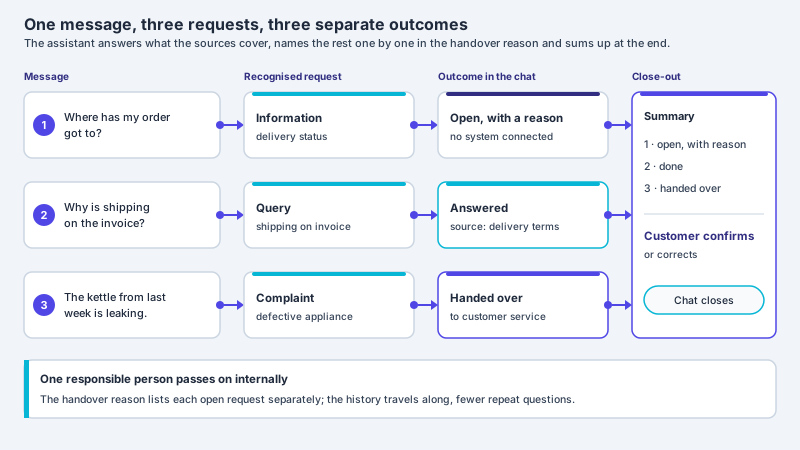
In the default setting a request for a person starts the handover, and anger or the same question asked twice add points towards it. If the material has no fitting passage, the assistant is meant to hand over. The team then gets the whole chat with everything already cleared up. So the customer does not have to tell the story again. The chat shows a button to the team when the assistant offers a contact. A staff member can take over the chat in the inbox and reply in person. Complaints, goodwill, legal matters, health and money trouble belong with a person. Each handover shows a gap in the knowledge that can be closed.
An AI assistant that insists on answering every question itself, at any cost, is not a good assistant but a dead end with a friendly voice. The value of a chat assistant is decided not only by how much it resolves on its own, but just as much by how cleanly it recognises the moment a human has to take over. Around 81 percent (Harvard Business Review) of customers try to solve their issue themselves first, yet for the hard cases they want a reliable way through to a person. With complex questions in particular, a chatbot quickly reaches its limits. That is exactly why the handover is not a side note but the core of a good assistant. This article shows which signals should trigger a handover, how the assistant passes on the full context so the customer does not have to repeat everything, and why a visible option to reach your team decides the entire experience.
%3C%2Ftext%3E%3Crect%20x%3D'512'%20y%3D'300'%20width%3D'248'%20height%3D'92'%20rx%3D'10'%20fill%3D'%23ffffff'%20stroke%3D'%23cbd5e1'%20stroke-width%3D'1.2'%2F%3E%3Ctext%20x%3D'534'%20y%3D'346'%20font-family%3D'system-ui%2C%20sans-serif'%20font-size%3D'30'%20fill%3D'%230891b2'%20font-weight%3D'800'%20text-anchor%3D'start'%3E62%25%3C%2Ftext%3E%3Ctext%20x%3D'534'%20y%3D'366'%20font-family%3D'system-ui%2C%20sans-serif'%20font-size%3D'8.5'%20fill%3D'%23475569'%20text-anchor%3D'start'%3Ehad%20to%20make%20contact%3C%2Ftext%3E%3Ctext%20x%3D'534'%20y%3D'379'%20font-family%3D'system-ui%2C%20sans-serif'%20font-size%3D'8.5'%20fill%3D'%23475569'%20text-anchor%3D'start'%3Emore%20than%20once%20(HBR)%3C%2Ftext%3E%3Crect%20x%3D'40'%20y%3D'406'%20width%3D'720'%20height%3D'36'%20rx%3D'10'%20fill%3D'%234f46e5'%2F%3E%3Ctext%20x%3D'400'%20y%3D'429'%20font-family%3D'system-ui%2C%20sans-serif'%20font-size%3D'10'%20fill%3D'%23e0e7ff'%20font-weight%3D'600'%20text-anchor%3D'middle'%3EHand%20over%20cleanly%20the%20moment%20a%20human%20is%20needed%20%E2%80%94%20with%20full%20context%3C%2Ftext%3E%3C%2Fsvg%3E)
Labels in the illustration
- Explicit request
- Frustration detected
- Two failed answers
- No supporting source
- Handover
- to the team
- Agent takes over
- Context packet — no repetition
- Question and chat history
- Order number 4821
- Already clarified: shipping
- Open point: complaint
- The team steps in informed
- Why the handover matters
- Points
- Frustration score
- Adjustable threshold
- 56%
- had to re-explain
- their issue (HBR)
- 62%
- had to make contact
- more than once (HBR)
- Hand over cleanly the moment a human is needed — with full context
Why a Clean Handover Decides the Whole Experience
The most common source of frustration in chat is not the wrong answer but the missing way out. An assistant that cannot answer a question with confidence and still builds no bridge to a human leaves the customer stuck in a loop. That effect is expensive: 62 percent (Harvard Business Review) of customers have had to make contact more than once to resolve a single issue, and anyone who cannot find a way to a person after exhausting every chatbot answer is left alone with their issue. What was meant as relief becomes a barrier. An assistant with a clear handover path turns this experience around: it absorbs the routine and passes everything else smoothly to the team.
A good handover is therefore not an admission of weakness but a mark of quality. It signals to the customer that they are not trapped in an endless loop but have a reliable route to a person. And it protects your team, because only the cases that genuinely require judgement arrive. How an assistant first handles as much as possible itself and passes on only the rest is shown on our page about a 24/7 support assistant.
The Four Triggers for a Handover
Whether and when a handover happens must not be left to chance but should follow clear rules. Gartner expects agentic AI to resolve around 80 percent (Gartner) of common service issues without human intervention by 2029. The decisive question is therefore not whether an assistant handles a lot itself, but how reliably it recognises and passes on the remaining cases. In practice, four triggers have proven their worth for prompting a handover. They should apply independently of one another, so no concern falls through the gaps between the rules.
-
Explicit request for a human
If a customer asks for a person with phrases such as real person, human agent or speak to a human, the handover happens without detour in the default setting. If they ask in other words, the assistant is meant to forward them directly.
-
Signs of frustration
Repeated follow-up questions, blunt wording or a noticeably irritated tone are warning signs. A fixed detection counts points for them, such as angry words or capitals, and hands over above the set threshold.
-
Two failed answers
Whether a concern is resolved is not measured by XICBOT. The same question asked a second time, or two replies in a row without a real answer, do add points, and the assistant is meant to hand over rather than try a third time.
-
No supporting source
If the assistant finds no supporting source, it is meant not to guess into the blue but to pass the case on. Better an honest handover than an invented answer.
These triggers can be fine-tuned per project. An online shop may hand over earlier on a complaint, a law firm on every individual legal question. What matters is that the rules are set and documented deliberately rather than left to chance. The last trigger in particular, the missing supporting source, is closely tied to the quality of your content: the better the sources, the less often the assistant has to hand over for lack of a basis. Which content is especially important for that is described in our article on what belongs in your knowledge base.
Pass on the Full Context Instead of Making People Repeat
The biggest difference between a good and a bad handover lies in the context. If a conversation is passed to the team without any backstory, the customer has to explain everything again and the frustration starts anew. 56 percent (Harvard Business Review) of customers report having had to re-explain their issue, and 57 percent (Harvard Business Review) had to switch from the website to the phone. A clean handover prevents exactly that: the assistant should pass on a complete context packet so the human steps in informed.
- The original question and the entire conversation so far
- What the assistant has already clarified and what remains open
- References mentioned, such as an order, customer or case number
- The specific point at which the customer is now stuck
- The language and tone of the conversation, so the reply fits
With this packet your staff member does not start from scratch but already knows the concern in detail. That noticeably shortens handling and prevents the tedious back and forth in which customers give the same details several times. The prerequisite is that the assistant is allowed to read connected systems in a governed way, for example to look up an order number. How this works with clear permissions is shown on our page about tool control.
A handover is not a restart
The customer should experience the switch from assistant to human as a flowing transition, not a rupture. Everything already said is preserved and passed along. So escalation becomes not a step back but the next step of the same conversation, only now with a person at the other end.
The Visible Option to Reach Your Team
Customers will not settle for an assistant that keeps them in a loop. That is why every good implementation includes a clearly visible option to reach the team, whether as a Talk to the team button, as an offer after an uncertain answer, or as a clearly named route in the menu. This visibility does not contradict the goal of resolving as much automatically as possible; it is its precondition: those who know they can switch to a human at any time will engage with self-service in the first place.
Balance matters. An option that is too intrusive distracts from fast self-service, a hidden one leaves customers out in the rain. In practice (project experience) a calm, permanently reachable route to the team works best, one that only steps to the foreground when the automation reaches its limit. That keeps the assistant helpful without ever becoming a trap. With XICBOT the “Talk to a person” button appears when the assistant offers a contact route; the visitor can write at any time that they want to speak to a person, and in the default setting exactly that starts the handover.
Dead End or Seamless Transition: the Comparison
The difference between a bad and a good handover is not cosmetic but measurable. A seamless handover spares the customer repetition and repeat contacts, and that is exactly where their experience of the service is decided. The following comparison shows how the two approaches differ.
| Aspect | Assistant as a dead end | Assistant with a clean handover |
|---|---|---|
| Route to a human | Hidden or not available at all | Visible as a talk-to-team option |
| Trigger | No defined trigger, endless loop | Four clear triggers for the handover |
| Context on handover | Lost, the customer re-explains | Full context packet is passed along |
| Uncertain answers | The assistant guesses into the blue | Honest handover instead of an invented answer |
| Outside office hours | Customer left without a reply | Ticket or email with the full history |
| Customer experience | Rupture and frustration | Flowing transition, one conversation |
What Happens After the Handover
A handover does not always mean a human is sitting at the chat immediately. With XICBOT every handover places the conversation in your team's inbox, assigns it to a responsible unit where one of your rules matches, and sends an email with the history to the stored handover address. If someone is there, they can take over the conversation and reply in the same chat in person; the visitor then sees that a staff member is writing. There is no switch by office hours, and the assistant does not on its own promise by when the team will reply. This way no dead point arises at night or on weekends either.
-
Takeover in the inbox
If a staff member is there, they take over the conversation in the inbox and reply in the same chat; the full history is in front of them, so support continues without a break.
-
Email to the team
Every handover sends an email with the entire history to the stored handover address; a ticket in your ticketing system only comes from a connection in the Custom package.
-
Transparent expectation
The customer should learn what happens next instead of waiting in the dark and following up several times. XICBOT does not promise a deadline on its own; decide by when your team will reply and put that in your material.
This route makes the handover reliable without demanding round-the-clock standby. The assistant stays reachable at all times and absorbs the first response, while personal handling follows once a human is available. For many concerns that is entirely enough, because the customer already has information and a clear perspective instead of facing a silent wall.
What Deliberately Belongs in Human Hands
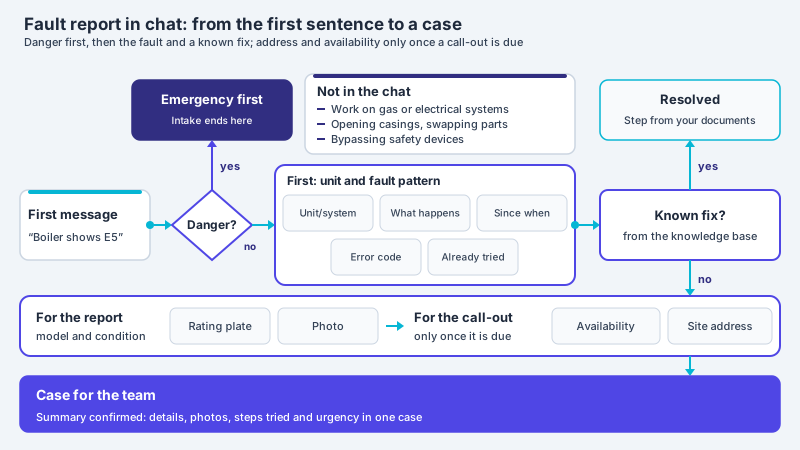
Not every case should even be solved automatically. Some concerns belong to a human from the outset, and a good assistant recognises this and hands over early. These include complaints, goodwill and special cases, legal or contractual questions, and anything that requires empathy and responsibility. That the human stays central is how the leaders see it too: 95 percent (Gartner) of service leaders plan to retain human agents, and Gartner expects that by 2027 around half of the organisations that wanted to cut their service workforce because of AI will abandon those plans (Gartner).
- Complaints and emotional conversations where care counts
- Goodwill decisions and special cases that require discretion
- Legal and contractual questions with binding effect
- Sensitive topics such as health or financial hardship
- Anything a human judges better than a machine
An assistant takes the repetition off the team, not the decision. Its value lies in creating room for the moments when good service truly counts.
Measure the Handover and Improve It Step by Step
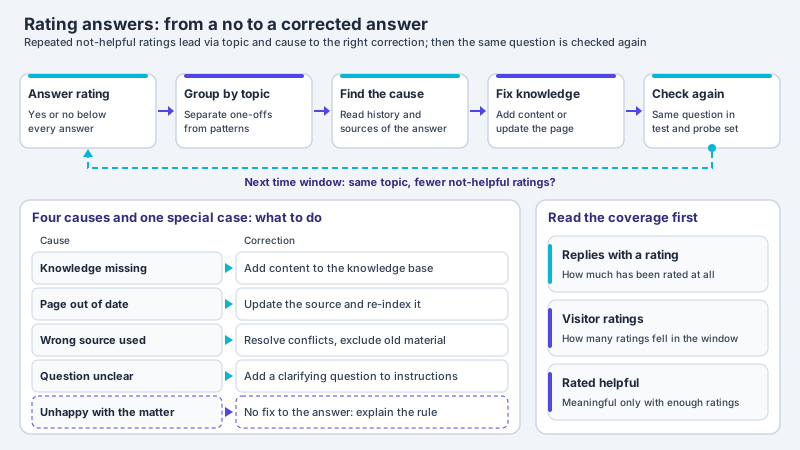
A handover is not a one-off setup but learns as it goes. Every handed-over conversation shows where the assistant reached its limit and which content was missing. From this analysis you can close knowledge gaps in a targeted way, so the share of self-resolved concerns rises week by week. The economic lever is considerable: Gartner puts low-effort interactions for the customer at around 37 percent (Gartner) cheaper than high-effort ones, because they lead to fewer repeat contacts and escalations. How conversations can be analysed in a privacy-compliant way is shown on our page about conversation analytics.
At the same time, an honest handling of numbers matters. How much an assistant relieves depends on the sector, the offering and the quality of the knowledge base, and cannot be assured as a fixed value. Gartner does expect agentic AI to resolve a large share of standard requests automatically by 2029, with operational costs falling by around 30 percent (Gartner), but this direction only materialises when triggers, context handover and knowledge base are cleanly aligned. How an individually trained assistant differs from a standard chatbot is explained in our article on an individually trained assistant instead of a standard chatbot.
Setting the Handover Right per Industry
When a handover happens differs from industry to industry. In the online shop the assistant usually clarifies availability and shipping itself, and order status too once your inventory system is connected in the Custom package, and can even recover abandoned carts in the chat, while it hands over mainly for complaints and special cases. A service provider uses the handover to route qualified enquiries with full context to the right team member, instead of letting every call interrupt the day's work; what that looks like is shown on the page about the assistant for service providers.
In sensitive areas the limits are drawn more tightly. A medical practice lets the assistant answer opening hours and appointment requests but has medical questions handed over to the team. A law or tax firm clarifies process and responsibility automatically but has individual legal questions forwarded to a human. Which triggers and limits make sense in your industry is best clarified together in an initial conversation via the contact page.
Honest Limits of a Handover
Honesty means naming the limits clearly. An AI assistant can be wrong, which is why it is bound to your sources, gives its answers traceably and is meant to pass sensitive cases deliberately to humans. A handover is only as good as the people behind it: without a reachable team and a well-maintained knowledge base, even the best trigger runs into nothing. Data protection is the foundation here, because a handover passes on personal data. Hosting in Germany, a data processing agreement and a deletion concept therefore belong in from the start, as our page on data protection and hosting describes.
- Define four clear triggers: request, frustration, two failed answers, no supporting source
- Keep the talk-to-team option visible at all times and offer it actively when needed
- Pass on a complete context packet so no one has to repeat themselves
- Decide who takes over handovers in the inbox and by when the team replies
- Deliberately leave sensitive cases to humans and escalate early
- Review handovers, close knowledge gaps and ensure data protection
Frequent questions
When should an AI assistant hand off to a human agent?
When the customer explicitly asks for a human, when signs of frustration appear in the conversation, when a concern has not been resolved twice, or when there is no supporting source. At XICBOT a fixed detection counts points for the request, for signs of frustration and for the same question asked a second time, and hands over above an adjustable threshold; where a source is missing, the assistant is meant to hand over under its handover rule. In addition, certain topics belong to a human from the outset, such as complaints, goodwill cases and legal or contractual questions. Chatbots often reach their limits with complex questions, which is why a reliable handover path is part of the core of a good assistant.
How does the assistant detect frustration in a conversation?
From fixed signals: the same question asked again, angry words, capitals or piled-up question and exclamation marks. A detection without a language model counts points for them, and above the set threshold the conversation goes to the team instead of the assistant insisting further. This limit is set deliberately: a third failed attempt usually only deepens the frustration. 62 percent (Harvard Business Review) of customers have had to make contact more than once to resolve an issue, which shows how important a timely exit from the loop is.
What does a handover with full context mean?
The human should receive a complete context packet: the original question, the entire conversation history, what has already been clarified, references mentioned such as an order number, and the specific open point. With XICBOT, the reason for the handover, the known contact details and the conversation history go to your team for this; your staff member finds what was clarified, the numbers and the open point in the history. This way they do not start from scratch but step in informed. That is decisive, because 56 percent (Harvard Business Review) of customers have had to re-explain their issue at some point. A clean context handover prevents exactly this repetition and makes the switch seamless.
What happens during a handover outside office hours?
XICBOT has no separate switch by office hours: every handover places the conversation in your team's inbox and sends an email with the complete conversation history to the stored handover address. If someone is there, they can take over the conversation and reply in the same chat; otherwise the case waits in the inbox. The assistant does not on its own promise by when the team will reply; decide on that time and state it in your material. So the first contact remains possible around the clock, while personal handling follows as soon as a human is available.
Does an AI assistant with handover replace my team?
No. The assistant takes the repetition off the team, not the decision. It resolves routine and status questions itself and creates room for the cases that require empathy, discretion and responsibility. That the human stays central is how the leaders see it too: 95 percent (Gartner) of service leaders plan to retain human agents. Sensitive topics such as complaints or legal questions belong deliberately to a human, and that is exactly where a good assistant routes them early.
How much does a clean handover actually relieve?
That depends on your industry, your offering and the quality of the knowledge base, and cannot be assured as a fixed value. What is reliable is the direction: low-effort interactions for the customer are around 37 percent (Gartner) cheaper, because they lead to fewer repeat contacts and escalations. The better triggers, context handover and knowledge base work together, the larger the share the assistant handles itself and the smoother the rest runs. Reviewing the handovers continually shows where you can sharpen things up.
Ask it yourself, Assistant of this website
Automated assistant