Custom AI Assistant vs. Standard Chatbot
Custom-trained AI assistant or kit-based chatbot? Answer quality, source binding, upkeep and conversion compared side by side. Find the approach that fits you.
In plain language
A chatbot from a kit follows fixed keywords and click paths. If someone words things differently, it gets stuck. A custom assistant reads the website, catalogue and knowledge base. It answers open questions in full sentences. It is meant to answer only from your content. If an answer is missing, it says so and hands over to a person. It can also act, for example fill a cart or, in the Custom package, create a ticket. If a price changes in the catalogue, the answer changes with it.
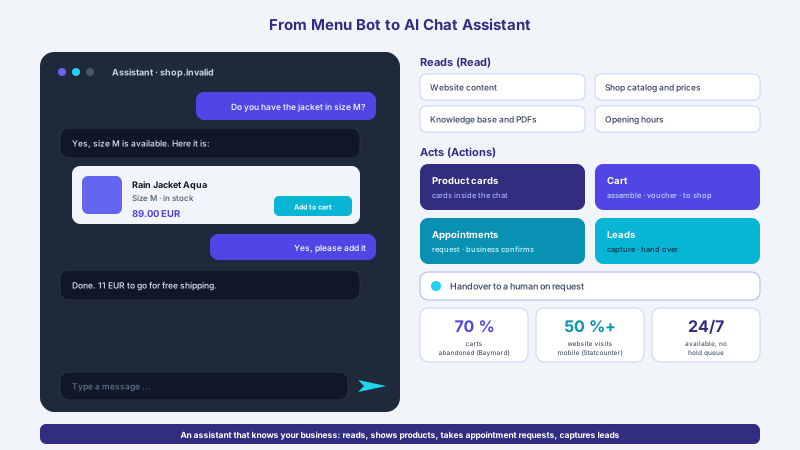
A chatbot is not just a chatbot. Between a standard kit-based bot that works through rigid menu trees and a custom-trained AI assistant that knows the specific business lie worlds of difference, felt in every single conversation. The kit-based bot only knows the click paths someone set up in advance. As soon as the visitor deviates from them, they quickly land in a dead end. A custom assistant, by contrast, reads the website content, the shop catalog and the knowledge base, replies in full sentences bound to its own sources and performs real actions, from taking an appointment request to putting together a cart. Around 70 percent (Baymard Institute) of online carts are abandoned, and some of these abandonments come down to a question that goes unanswered at the decisive moment. This article compares both approaches along the five criteria that matter day to day: answer quality, source binding instead of hallucination, real actions instead of dead ends, upkeep and conversion.

Labels in the illustration
- Custom XICBOT assistant
- yourshop.invalid
- Please choose a topic:
- Opening hours
- Contact
- Other
- Do you have the vase in blue?
- Sorry, I did not understand that.
- Dead end
- Message ...
- Menu
- XICBOT Assistant
- Do you have the vase in blue?
- Yes, the blue vase is in stock —
- 3 available right now.
- Source: shop catalog
- Blue vase
- Ceramic, 22 cm
- 24.90 €
- Add to cart
- Action: added to chat cart
- Your question ...
- Send
- Individually trained: knows your content, cites sources and acts
- instead of ending in dead ends
Kit-based Bot and Custom Assistant: the Core Difference
A standard kit-based chatbot is rule-based at its core. Someone sets up questions, keywords and click paths in advance, and the bot follows those rules. As long as the visitor stays exactly within the intended lanes, it works reasonably well. The moment they phrase a question differently, want to know several things at once or ask something no one planned for, the concept reaches its limit. The bot recognises no matching keyword, falls back on no rule and resorts to a generic follow-up or the familiar dead-end reply. Upkeep grows with every special case, because every additional path has to be built by hand.
A custom-trained AI assistant works fundamentally differently. It is not stocked with rigid click paths but with the real content of the business: the website, the shop catalog, opening hours, documents, PDFs and a structured knowledge base. On this basis a modern AI language model understands the intent behind a freely worded question and phrases a fitting answer in full sentences. It is no longer about hitting the one correct keyword but about being understood. That is precisely the difference XICBOT builds individually for every project: an assistant that knows the specific business, instead of a generic off-the-shelf script.
Answer Quality: Full Sentences Instead of Click Paths
The most noticeable difference in everyday use is answer quality. A kit-based bot replies with pre-written text blocks and pushes menu buttons for the visitor to choose between. That quickly feels mechanical and forces people to translate their question into the bot's language. A custom assistant turns this around: the visitor asks in their own words, even with typos, colloquial phrasing or several things in a single sentence, and the assistant answers concretely and in context. Especially on the smartphone, through which more than half of website visits happen (Statcounter), this free-text input is far more pleasant than clicking through long menu trees with a thumb.
On top of that comes conversational context. A good assistant remembers what was just discussed and understands follow-ups like and in blue? or what does delivery there cost?, without the visitor having to explain everything again. A rigid menu bot practically starts over with every new selection. This continuity decides whether a conversation feels natural or like filling in a form. Quality depends directly on how well the assistant is trained, on which content it was fed and how cleanly the knowledge base is maintained. How this training works is described on our page about the knowledge base.
-
Understands free questions
Visitors ask in their own words, even with typos or several requests in one sentence. The assistant interprets intent instead of rigid keywords.
-
Knows your content
Trained on website, shop catalog, FAQ and documents, it answers about the specific business, not with generic off-the-shelf phrases.
-
Stays in context
The assistant remembers the conversation and understands follow-ups, so visitors do not have to restate their request with every reply.
Source Binding Instead of Hallucination
The most common concern about AI in customer contact is: does the assistant simply make something up when it does not know the answer? A free-running language model without a link to its own data can indeed produce plausible-sounding but wrong statements. That is exactly why source binding is the central quality feature of a serious assistant. With XICBOT the assistant does not answer from general world knowledge but bound to the company's stored sources: the website content, the product catalog, the price list, the FAQ and approved documents. What is not written there is not claimed.
If the assistant finds no reliable answer in its sources, it usually does not guess blindly but says so honestly and offers the next step: a handover to a member of staff, a contact form or a callback, each with the full conversation context. That keeps the assistant dependable without claiming to know everything. An AI assistant can be wrong, which is why source binding, honest limits and the handover to humans are not an add-on but the foundation. How closely answers are coupled to your own content can be defined precisely during training and updated at any time via the knowledge base.
Answers with evidence
A custom-trained assistant bases every statement on stored sources and, in case of doubt, names their origin, such as the product catalog or an FAQ. That builds trust and makes answers verifiable. Instead of a bot that capitulates on every unfamiliar question or invents freely, you get an assistant that answers confidently within its knowledge and honestly hands over to a human beyond it.
Real Actions Instead of Dead Ends
The second big difference is what happens at the end of a conversation. A kit-based bot can at best display information and link to a page. The actual step, ordering, booking, enquiring, is left to the visitor, who then has to work through forms and categories themselves. The conversation often ends in a dead end: the question was answered, but the path to completion stayed open. A custom assistant, by contrast, acts itself. Through defined actions it puts together a cart, applies a voucher, shows shipping costs, takes an appointment request, captures a lead or creates a ticket, each with clear confirmation.
Technically this happens through so-called function calling: functions are connected to the assistant, which it calls when needed, with the appropriate permissions and logged transparently. So it does not only read the shop catalog but shows product cards with image, title, price and an add-to-cart button right in the chat, turning the chat itself into a sales channel. It likewise controls systems connected in the Custom package, such as calendar, inventory or ticket system. Which actions are concretely possible we define per project, from standard cases to custom logic, described under custom functions and tool control.
| Criterion | Kit-based chatbot | Custom XICBOT assistant |
|---|---|---|
| Answer quality | Text blocks and menu buttons | Full sentences on freely worded questions |
| Sources | Fixed standard answers | Bound to website, catalog and knowledge base |
| When unknown | Dead end or follow-up | Honest, then handover to a human |
| Actions | Linking at most | Cart, appointment request, lead, ticket (Custom package) right in the chat |
| Languages | Rebuilt for each language | Detects the language, answers consistently |
| Upkeep | Every path by hand | Update the source, the answer follows |
Product Cards and Cart: the Chat as a Sales Channel
In commerce especially, it shows what real actions are worth. Instead of just sending a link to a product, a custom assistant displays a product card right in the chat: with image, title, price, a short description and an add-to-cart button. The answer becomes an offer the visitor can accept without the detour through search and category pages. If she asks for alternatives, the assistant shows a row of recommendations or compares two variants; if accessories fit, it suggests a sensible bundle. The chat thus turns from a pure information channel into a showcase with product cards, where advice and purchase happen in the same window.
The cart assistant goes the last step along. It adds the chosen item, changes the quantity on request, applies a voucher and shows shipping costs. Used well, it also points out the threshold for free shipping — that a small amount is still missing, say — and then leads on into the shop with “Continue”. It is precisely here that many purchases break off, often because a question about availability, shipping or suitability stays open at the decisive moment. If it is answered right in the cart and the next step is carried out straight away, the thread breaks off less often. A kit-based bot can at best link to the cart page here — it cannot act.
Two Journeys, One Question: Examples from Practice
How big the gap between the two approaches is becomes tangible in everyday situations. A prospect on a service provider's page asks: do you also take small jobs, and roughly what does that cost? A kit-based bot finds no matching keyword and offers the contact form — the question stays open, the prospect clicks on or away. A custom assistant explains from the service pages which jobs come into question, states the stored key facts on pricing, asks a short follow-up about scope and finally captures a structured lead with the most important details. An open-ended question becomes a qualified enquiry that lands in the inbox — the job of the lead assistant.
Different industries, different tasks, the same technology. At a trades business, someone asks at ten in the evening for an appointment for a broken heating system. A rigid menu bot shows the opening hours and ends there; a booking assistant captures the request, suggests free times from the stored appointment types and takes an appointment request or a callback request; the business finds both in the morning. In a medical practice, in turn, someone asks about preparing for an examination: the assistant answers organisational questions from the knowledge base but is deliberately not meant to give information on anything medical, instead pointing to the team and handing over the conversation. This way a support assistant relieves the load around the clock without overstepping professional limits.
Timing matters too. If a filled cart is left sitting in an online shop, an assistant can gently ask whether anything is still missing for the purchase decision — information on shipping costs, delivery time or returns — and clear the open question right in the chat, instead of letting the visitor quietly slip away. A kit-based bot, by contrast, stays passive until someone opens a menu on their own. A custom assistant uses such proactive nudges in a targeted and restrained way, privacy-compliant and without becoming intrusive. Which questions most often tip the balance is later made visible by the analysis of conversations.
Upkeep: Who Keeps the Assistant Current
One point often underestimated in the selection is the ongoing upkeep. With a kit-based bot every conversation path, every answer and every branch has to be built and maintained by hand. When a new product, a changed opening hour or a new frequent question comes along, the menu tree grows further, becomes less clear and harder to maintain. That is exactly why many kit-based bots age over time and eventually give information that is no longer correct. The effort then lies not in the build but in the endless upkeep of the branches.
A custom assistant shifts upkeep to where the content already lives. If something changes about products, prices or texts, the source is updated and the assistant answers accordingly, without a branching dialogue tree having to be rebuilt. With XICBOT, operation, upkeep, updates and hosting in Germany are part of the monthly scope, so the assistant stays current and functional without tying up internal resources. From the ongoing support, the assistant can also be improved in a targeted way when the analysis of conversations shows where knowledge gaps remain.
Data Protection and Hosting: Where Standard Widgets Reach Their Limit
One criterion quickly overlooked in the selection concerns data protection. Many standard kit-based bots are third-party widgets that send conversation data to servers outside the EU and whose processing can hardly be controlled. For companies subject to the GDPR, that is a real matter — from the data processing agreement to data sovereignty. A custom-built assistant can be set up fundamentally differently here: hosting in Germany, a data processing agreement, a clear deletion concept and no passing on of conversation data for external purposes.
With XICBOT this is part of the foundation, not an add-on option. European or self-hosted language models are possible as a separate project by arrangement; they are not included in standard operation. Just as important is restraint in operation: the assistant greets in a way that fits the page and helps when needed, but does not track visitors without a basis. How hosting, contracts and data sovereignty are handled in detail is described on the page about data protection and hosting. For many companies it is precisely this point that tips the decision against an arbitrary third-party widget.
Conversion: What the Difference Means in Results
In the end, what matters is the effect the difference has on results. An assistant that answers questions at the decisive moment prevents abandonment. Around 70 percent (Baymard Institute) of online carts are abandoned, and part of that goes back to open questions, about availability, shipping costs, delivery time or the suitability of a product. If that question is answered right in the chat and the next step is carried out straight away, the intent to buy is preserved instead of trickling away. A context-aware approach tailored to the concrete situation is more engaging than a generic standard phrase, because it meets people where their question currently stands.
Reach adds to this. A custom assistant detects the visitor's language and answers consistently in it, which is relevant because around 76 percent (CSA Research) of online buyers prefer information in their native language. A rigid menu bot would have to be rebuilt in each language for that. And because every conversation can be analysed, the conversation analytics show which questions come up often, where knowledge gaps exist and which products are in demand, a basis for improving assistant and website from data. That can turn support from a pure cost factor into a measurable contribution to enquiries and completions. The entry point is a website assistant that first answers questions and captures contacts, and can later be extended with shop and action functions.
- Enable free questions in one's own words instead of clicking through rigid menu trees
- Bind answers to your own sources so nothing is invented freely
- Hand over honestly to a human when knowledge is missing, with full context
- Offer real actions: cart, appointment request, lead, ticket instead of mere linking
- Focus upkeep on the content sources, not on branching dialogue trees
- Analyse conversations in a privacy-compliant way and keep improving the assistant
Frequent questions
What sets a custom AI assistant apart from a kit-based chatbot?
A kit-based chatbot is rule-based: it follows keywords and click paths set up in advance and reaches its limit as soon as someone deviates from them. A custom-trained assistant, by contrast, knows the real content of the business, understands freely worded questions and answers in full sentences. It binds its answers to its own sources, stays in the conversation context and performs real actions instead of only showing menus. In short: one works through a script, the other knows the specific business.
Does an AI assistant simply make up answers (hallucination)?
A free-running language model without a link to its own data can produce wrong but plausible-sounding statements. That is why XICBOT relies on source binding: the assistant answers bound to stored content such as website, product catalog, price list and FAQ. If it finds no reliable answer there, it usually does not guess blindly but says so honestly and hands over to a human. An AI assistant can be wrong, which is why honest limits and the handover are a fixed part of it.
Can a custom assistant really act, not just inform?
Yes. Through so-called function calling, functions are connected to the assistant, which it calls with the appropriate permissions and logs. With this it puts together a cart, applies vouchers, shows shipping costs, takes appointment requests, captures leads or, in the Custom package, creates tickets, each with confirmation. Product cards with price and cart button appear right in the chat. Which actions are concretely possible we define per project, from standard cases to custom logic and tool control.
Is the upkeep higher than for a kit-based bot?
As a rule it is lower. With a kit-based bot every path and every answer has to be maintained by hand, and the menu tree grows with each change. With a custom assistant you maintain the actual source: if a price or a text changes, the answer follows automatically. With XICBOT, operation, upkeep, updates and hosting in Germany are part of the monthly scope, so the assistant stays current without tying up internal resources.
Is a custom assistant worthwhile even for small websites without a shop?
Yes. The entry point is a website assistant that answers visitor questions from the website content and knowledge base, guides visitors to the right pages, captures contacts and hands over to a human when needed. It relieves phone and inbox around the clock and qualifies enquiries. Later the assistant can be extended with shop connection, product cards, cart as well as appointment and tool functions, without starting from scratch.
Does a custom assistant improve conversion?
It works on several conversion levers at once. Questions answered at the decisive moment prevent abandonment, and around 70 percent (Baymard Institute) of online carts are abandoned. Context-aware prompting is more engaging than generic prompting, and around 76 percent (CSA Research) of online shoppers prefer to buy products with information in their native language; a multilingual assistant can provide such information. A fixed conversion rate cannot be promised, but the measurable factors improve in a transparent way.
Ask it yourself, Assistant of this website
Automated assistant