1.3 s
to the first character of the answer, median
64 questions to our own assistant, not to customer projects
The figures on response time, source binding and refusals come from a series run against our own assistant — not against customer projects and not from an industry estimate. What is stated here holds for this assistant, on this knowledge base, in this period. A measurement says no more than that.
Our website shows key figures. This page shows where they come from. We only measure our own assistant. We do not measure at clients. Some of the questions are not in the knowledge base on purpose. This shows us whether the assistant stops or makes something up. You can repeat the measurement yourself.
Request a demo with your documents Features in detail
Visitor:How fast does an assistant like this answer?
Assistant:There is a measurement series against our own assistant for that. The figure is on this page with its period, the number of conversations and a verbatim quote.
Visitor:And for us?
Assistant:I cannot promise that. Your figure depends on your sources and your traffic and is measured in operation, not estimated beforehand.
Ask it yourself, Assistant of this website
Automated assistant1.3 s
to the first character of the answer, median
64 questions to our own assistant, not to customer projects
12 requests per minute
cap per visitor on the public widget interface
applies per visitor and assistant; that allows one question every 5 seconds, and the series waits 5.5 seconds to keep clear of our own brake
Method
The series asks 32 questions through the same public interface a widget on a customer site uses. 24 of them lie inside the knowledge base, eight deliberately outside — that is the only way to tell whether the assistant stops or invents something.
Each question gets its own conversation. A long history would fold an ever larger context into every further question and would therefore measure something other than the first question did.
There is a 5.5 second pause between questions. The throttle allows twelve requests per minute; without the pause, from the thirteenth question onwards the series would only be measuring our own brake.
Measurement happens character by character on the live stream. The first value is the time to the first character of the answer — measuring only at the end would fold the length of the answer into the number.
Source binding
An answer counts as covered only when the assistant sends the passages it rests on in the same stream. An answer that is factually right but names no passage counts as not covered in this series.
The value is below the number of in-scope questions. That is not a defect we argue away: these are questions the assistant assembles from several passages, or answers with a question of its own without naming a single passage.
The second figure counts the out-of-scope questions that ended without a handover to a person. The lower it is, the more reliably an uncovered question reaches somebody who can answer it.
42 of 48
answers carrying a source reference
questions whose answer is in the knowledge base; six carried no source reference
43 of 48
questions without a handover to a person
measured on a single assistant on our own knowledge base, not on customer projects; a figure from live operation is not yet available
Limits
Eight questions in the series are chosen so that they cannot appear in any document: turnover figures, a private phone number, a forecast, a rating of a competitor. A measurement that only counts events could not tell, at this point, whether the assistant honestly declined or invented something.
That is why the answer text is recorded and read. A refusal counts as a refusal only when the text says the information is missing — not merely when no citation event arrived.
This is the most important figure on the page. An assistant that answers ninety-nine percent of questions quickly and invents something in the remaining one percent is worse in daily operation than one that hands over more often.
8 of 8
questions without a basis declined instead of guessed
eight questions deliberately outside the material; the wording of every answer is in the measurement file
Scope and weight
The size of the knowledge base is not asked about, it is counted: the number of sections our own material was split into. It says how much substance sits behind an answer, and nothing about how good that substance is.
The weight of the loader script is measured on the delivered file, not on the source. What is measured is the file that arrives in the browser, with the transfer compression the web server actually sends.
Both figures apply to our own installation. On a customer site the size depends on the material that was indexed and the weight on that web server's compression — which is why every figure states what it refers to.
2,670
sections from 70 documents in our own knowledge base
the corpus of the assistant answering on this site
24.1 KB
loader on your page, compressed
only the file that runs on the host page, measured with the compression the web server actually sends; the chat window lives in its own frame and loads only once your page has finished loading
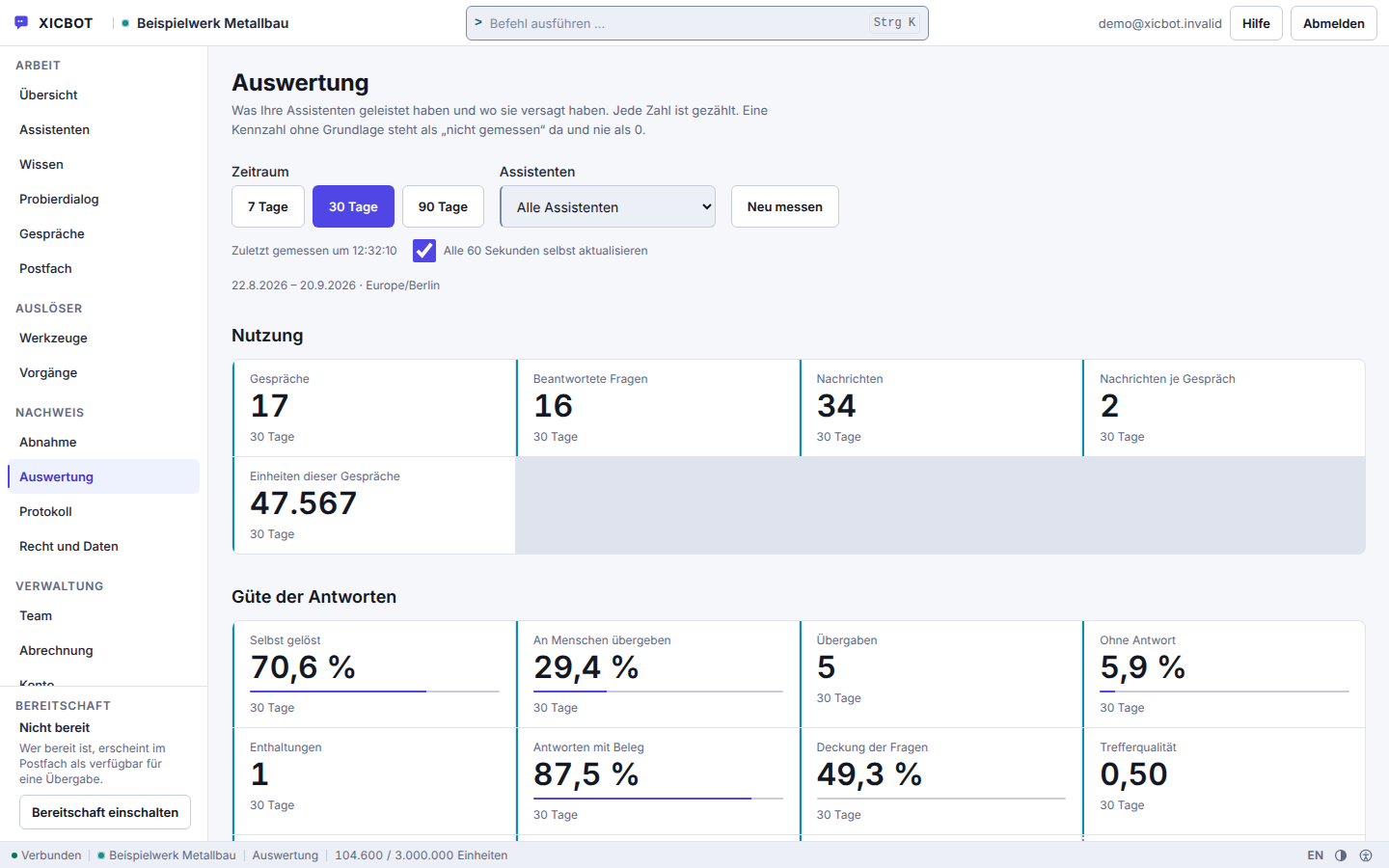
Seven, thirty or ninety days are the windows the figures are computed over.
Answers with a citation, question coverage and hit quality each stand as their own figure.
Where there is no basis, it reads not measured and shows no number.
A number nobody can reproduce is an assertion with a citation attached. So what follows is not only the result but the route to it — in the order we take it ourselves.
Nothing is needed that you do not already have: the publicly reachable assistant on this website, the question list from the output file, and some patience while reading the answer texts.
The series uses the same path a widget on a website uses: open a conversation, send a question, read the stream. No account of your own is needed.
An answer depends on the version that was active at the moment of the question. Every index run writes into a new version and only switches over at the end — a series from yesterday and one from today may therefore have used different excerpts. Note the time and the state, otherwise a deviation cannot be classified later.
All 32 questions are listed in full in the series output file, separated into in-scope and out-of-scope questions.
Half of the significance sits in the questions that must not get an answer. Asking only in-scope questions measures whether the assistant finds something — not whether it stays quiet when there is nothing. That second part is exactly where an assistant usually gives itself away.
Without the text, an honest refusal cannot be told apart from an invention. The output file carries the first 1,200 characters of each answer.
Response times vary with load and time of day. That is why this page states the median rather than the best run, with the measurement period beside it.
If your result differs from ours, that is not a contradiction to begin with but a finding with two possible causes: a different state of the knowledge base, or different load at the time of measurement. Both can be told apart given the time and the version — and not without them.
If your series produces a number that is wrong here, we replace the number and name the new measurement, not the old explanation. A number that does not survive a question does not belong on this page.
If you recalculate a figure on this website and arrive at something else, write to us. We will withdraw the figure or measure again — either is better than leaving it standing.