Agentic Commerce: When AI Agents Shop in Your Store
AI traffic to retail sites grew 393 percent in Q1 2026 (Adobe). What that means for your online store and which product data you should check now.
In plain language
Not only people visit your shop. AI agents come too. They search and compare for a user. An agent mostly reads clear data. It can hardly see what is only in the layout. So price, stock, shipping and returns should be clear and the same everywhere. Your own assistant is still there for people. Look at the visits of agents instead of blocking them.
Two kinds of visitors now arrive at online stores. One clicks, scrolls and compares with their eyes. The other fetches the page, breaks it down into text and looks for hard facts: price, variant, delivery time, right of return. AI-driven traffic to US retail sites in the first quarter of 2026 was 393 percent (Adobe Analytics) above the previous year. More remarkable than that growth rate, though, is what happens after arrival: a channel that closed noticeably worse than the rest a year ago has become the best pre-qualified traffic many stores have. That is good news — provided the page this traffic lands on can answer.
%3C%2Ftext%3E%3Cline%20x1%3D'48'%20y1%3D'346'%20x2%3D'752'%20y2%3D'346'%20stroke%3D'%23cbd5e1'%20stroke-width%3D'1.2'%20stroke-dasharray%3D'4%203'%2F%3E%3Ctext%20x%3D'48'%20y%3D'340'%20font-family%3D'system-ui%2C%20sans-serif'%20font-size%3D'7'%20fill%3D'%2394a3b8'%20text-anchor%3D'start'%3ENon-AI%20traffic%20%3D%20baseline%3C%2Ftext%3E%3Crect%20x%3D'102'%20y%3D'346'%20width%3D'104'%20height%3D'34.2'%20rx%3D'4'%20fill%3D'%2394a3b8'%2F%3E%3Ctext%20x%3D'154.0'%20y%3D'366.3'%20font-family%3D'system-ui%2C%20sans-serif'%20font-size%3D'9'%20font-weight%3D'700'%20fill%3D'%23ffffff'%20text-anchor%3D'middle'%3E-38%25%3C%2Ftext%3E%3Ctext%20x%3D'154.0'%20y%3D'393.2'%20font-family%3D'system-ui%2C%20sans-serif'%20font-size%3D'8'%20font-weight%3D'700'%20fill%3D'%23312e81'%20text-anchor%3D'middle'%3EMarch%202025%3C%2Ftext%3E%3Crect%20x%3D'594'%20y%3D'308.2'%20width%3D'104'%20height%3D'37.8'%20rx%3D'4'%20fill%3D'%230891b2'%2F%3E%3Ctext%20x%3D'646.0'%20y%3D'330.3'%20font-family%3D'system-ui%2C%20sans-serif'%20font-size%3D'9'%20font-weight%3D'700'%20fill%3D'%23ffffff'%20text-anchor%3D'middle'%3E%2B42%25%3C%2Ftext%3E%3Ctext%20x%3D'646.0'%20y%3D'302.2'%20font-family%3D'system-ui%2C%20sans-serif'%20font-size%3D'8'%20font-weight%3D'700'%20fill%3D'%23312e81'%20text-anchor%3D'middle'%3EMarch%202026%3C%2Ftext%3E%3Ccircle%20cx%3D'206'%20cy%3D'363.1'%20r%3D'2'%20fill%3D'%23a5b4fc'%2F%3E%3Cline%20x1%3D'206'%20y1%3D'363.1'%20x2%3D'588.0'%20y2%3D'327.7'%20stroke%3D'%23a5b4fc'%20stroke-width%3D'1.4'%2F%3E%3Cpolygon%20points%3D'594%2C327.1%20588.4%2C331.3%20587.7%2C324.0'%20fill%3D'%23a5b4fc'%2F%3E%3Ctext%20x%3D'400.0'%20y%3D'320'%20font-family%3D'system-ui%2C%20sans-serif'%20font-size%3D'7.5'%20fill%3D'%2364748b'%20text-anchor%3D'middle'%3EThe%20curve%20flipped%20within%20twelve%20months%3C%2Ftext%3E%3Crect%20x%3D'48'%20y%3D'400'%20width%3D'704'%20height%3D'22'%20rx%3D'7'%20fill%3D'%23eef2ff'%20stroke%3D'%23c7d2fe'%20stroke-width%3D'1.2'%2F%3E%3Ctext%20x%3D'400.0'%20y%3D'413.9'%20font-family%3D'system-ui%2C%20sans-serif'%20font-size%3D'8'%20font-weight%3D'600'%20fill%3D'%233730a3'%20text-anchor%3D'middle'%3ERevenue%20per%20visit%3A%20%2B37%25%20versus%20non-AI%20traffic%3C%2Ftext%3E%3C%2Fsvg%3E)
Labels in the illustration
- Who arrives at the store
- People
- classic channels, baseline
- AI agents
- +393% traffic, Q1 2026
- Source: Adobe Analytics
- What agents can read
- 66%
- Product page
- machine-readable
- Homepage · 75%
- Category page · 74%
- Homepage, top tier: 82.5%
- Homepage, bottom tier: 54.2%
- About a third of the product page stays invisible
- Your own assistant
- Which size ships by Friday?
- Model A · Size 42
- 129.00 EUR
- In stock · delivery Thu–Fri
- Add to cart
- 1 item · 129.00 EUR
- AI traffic conversion versus non-AI traffic (Adobe Analytics)
- Non-AI traffic = baseline
- -38%
- March 2025
- +42%
- March 2026
- The curve flipped within twelve months
- Revenue per visit: +37% versus non-AI traffic
The second audience in your store
For its quarterly report, Adobe analyses transaction data from more than one trillion visits (Adobe Analytics) to US retail sites. For the first quarter of 2026 the analysis shows a 393 percent (Adobe Analytics) increase in traffic from generative AI sources; in March 2026 alone it was 269 percent (Adobe Analytics) year on year. The peak comes from the holiday season: in November and December 2025, traffic from generative AI tools to retail sites rose 693.4 percent (Adobe Analytics) against the prior-year period.
These numbers describe a US market, and they describe growth from a small base. Both belong in the interpretation: a few hundred percent sounds more dramatic than the absolute share of total traffic is today. For a mid-sized store in Germany this does not mean half of tomorrow's orders will come from agents. It means a type of traffic is emerging that barely existed two years ago, that grows faster than anything else in the channel mix — and that places different demands on the page than a human with a mouse.
Conversion has flipped
The real finding is not in the volume but in the quality. In March 2025, AI-driven traffic still converted 38 percent worse (Adobe Analytics) than other channels. Twelve months later, in March 2026, it converted 42 percent better (Adobe Analytics) — according to Adobe a new high. Revenue per visit turned around alongside it: in March 2026 it was 37 percent higher (Adobe Analytics) than for non-AI traffic, whereas a year earlier non-AI traffic had been 128 percent (Adobe Analytics) more valuable the other way round.
That reversal within a single year needs explaining, and the explanation is unspectacular: pre-qualification. Someone arriving via an assistant has the selection behind them. The question „Which washing machine fits a 60-centimetre recess and arrives by Friday?“ is largely answered by the time the store link is clicked. The March 2026 measurements support this: visitors from AI sources show a 12 percent higher (Adobe Analytics) engagement rate, stay 48 percent longer (Adobe Analytics) on the site and view 13 percent more pages (Adobe Analytics) per visit.
The same effect was visible over the holidays: AI referrals converted 31 percent better (Adobe Analytics) than other sources, on Thanksgiving the lead was 54 percent (Adobe Analytics) and on Black Friday 38 percent (Adobe Analytics). In the companion survey to the April 2026 quarterly report, covering more than 5,000 US consumers (Adobe Analytics), 39 percent (Adobe Analytics) said they had used AI for online shopping before; 85 percent (Adobe Analytics) of those said it had improved their shopping experience.
The core in one sentence
AI traffic is no longer a side channel with weak quality; it is a small channel with strikingly good quality. Treating it as bot noise and filtering it out means filtering out your best pre-qualified visitors.
A quarter of your content is invisible
The second part of the Adobe report is the uncomfortable one. In April 2026 Adobe published benchmark figures on how readable retail pages are for language models. Across the US retail sector, homepages averaged 75 percent (Adobe Analytics) machine-readable visibility, category pages 74 percent (Adobe Analytics) and individual product pages only 66 percent (Adobe Analytics). Roughly a quarter of homepage content and roughly a third of product page content was therefore not accessible to models. An analysis extended in July 2026 to a broader set of US retail sites found an even lower average for homepages (Adobe Analytics).
In the April analysis, the spread was wider than the average suggested: the homepages of the best-performing US retail sites reached 82.5 percent (Adobe Analytics), those of the lowest-performing sites 54.2 percent (Adobe Analytics). Of all places, the product page — the page where an agent looks for the answer — performed worst on average. That is no accident: in many stores product pages are the most dynamically assembled pages, with thousands of article numbers, variant widgets and lazily loaded components.
The concrete causes are rarely exotic. Typical ones from projects (project experience): prices loaded only via JavaScript; variants and sizes that exist only inside an interactive widget; delivery times in a tooltip; shipping costs shown only in the cart; technical data in a PDF datasheet; and text delivered as an image. All of that is visible to a human. To a model reading the delivered page, it simply is not there.
| Page type | Machine-readable visibility, as of April 2026 | What is typically missing |
|---|---|---|
| Homepage | 75 percent on average (Adobe Analytics) | Range overview, positioning of the seller, navigation depth |
| Category page | 74 percent on average (Adobe Analytics) | Filter logic, boundaries between product groups, sort criteria |
| Product page | 66 percent on average (Adobe Analytics) | Variants, price detail, delivery time, shipping costs, returns |
| Homepage, best-performing sites | 82.5 percent (Adobe Analytics) | Even there about a sixth of the page stays unreadable |
| Homepage, lowest-performing sites | 54.2 percent (Adobe Analytics) | Almost half the page does not exist for models |
What agents actually need
An agent researching on behalf of a person has a short list of questions — and it will answer them by estimating if the page stays silent. That is exactly where the risk sits. In practice, the following six data points decide whether an offer is classified correctly or dropped from the shortlist.
-
Variants and availability
Which sizes, colours and versions exist, and which of them ship now? Anything that cannot read the variant matrix recommends either nothing or the wrong thing.
-
Price with context
Gross or net, at which VAT rate, in which currency, from which quantity? A price without context is not a price to a machine, just a number.
-
Shipping costs and delivery time
Both belong to the purchase decision, and both often appear only in the cart. What is not found there is missing from the comparison — or gets estimated.
-
Returns and deadlines
Withdrawal period, return shipping costs, condition of the goods: when comparing several sellers this is frequently the tiebreaker.
-
Solid product attributes
Dimensions, weight, material, compatibility, standards. What sits only in a PDF does not exist for the model. What sits in body text does.
-
Identity and commitment
Who is the seller, which payment methods exist, what applies legally? Offers that can be attributed unambiguously have an easier time.
Why contradictions get expensive
A human who reads „2 to 3 days“ on the product page and „5 to 7 working days“ in the cart pauses and asks. An agent usually does not. It takes the value it finds first and most clearly and carries it onward — into a comparison, into a recommendation, possibly into a statement to the user. The contradiction does not disappear; it merely moves to a place where it costs more.
That the responsibility stays with the operator is no longer merely a commercial question. In May 2026 the Higher Regional Court of Hamm ruled that an AI chatbot is not a third party but a technical means of the company (OLG Hamm, case no. 4 UKl 3/25); what it says, the company says. The ruling is not final, and appeal to the Federal Court of Justice was permitted (Legal Tribune Online). The decision directly concerns your own chat — but the logic behind it, that nobody hides behind a model's unpredictability, deserves attention wherever third-party agents pull statements from your pages too. We covered the ruling and its consequences in our article on liability for chatbot statements.
In practice this means: a single maintained source per statement. If delivery time, price and shipping costs are maintained in three places, three truths will eventually appear — and one of them ends up in a recommendation. Where that source sits is an architecture question; part of it is how an assistant is connected to existing systems and which system it pulls its numbers from.
Open standards for agent checkout
Alongside the traffic development, technical standards are emerging for how an agent not only reads but completes a purchase. The Agentic Commerce Protocol was published as an open specification under the Apache 2.0 licence on 29 September 2025 (Agentic Commerce Protocol). It describes three building blocks: a specification for product data, one for agentic checkout and one for delegated payments (Agentic Commerce Protocol). The core idea: the agent collects the buyer's payment selection and hands the merchant a narrowly scoped token; the merchant charges that token through its own payment service provider and remains the merchant of record (Agentic Commerce Protocol).
The International Monetary Fund examined the same question from the perspective of payment systems and named a tension that shapes the whole field: payment infrastructures are built on deterministic logic, while agentic AI works probabilistically and can produce different outcomes under similar conditions (IMF Notes 2026/004). The authors propose a three-layer model: intent and orchestration on top, where planning and comparison happen probabilistically; control and authorisation in the middle, where mandates covering scope, limits and identity are checked deterministically; settlement below, where payments execute with legal finality (IMF Notes 2026/004).
Agentic AI systems work the other way, relying on probabilistic reasoning and adaptive decision making that can produce different outcomes under otherwise similar conditions.
For a mid-sized store, the message of this debate is less technical than it sounds. The standards are young, and responsibilities for consent, authentication, authorisation and disputes are only beginning to be worked out (Forrester). Committing to one particular specification today would be premature. The groundwork that helps in every scenario is a different one: unambiguous, contradiction-free, machine-readable product data. It is the prerequisite for every one of these protocols — and it pays off regardless of which one prevails.
Keep the two levels separate
In practice, two things that belong apart get constantly mixed up. One level sits outside your store: third-party agents read your content, compare it and decide whether your offer appears in the recommendation. You influence that only indirectly — through the quality of what you deliver. The other level sits inside your store: what happens when the pre-qualified visitor arrives? Both levels need work, but different work.
| Aspect | Level 1: outside the store | Level 2: inside your own store |
|---|---|---|
| Who acts | Third-party agents on behalf of users | Your own assistant on behalf of your store |
| Goal | Being read correctly and classified accurately | Answering the pre-qualified question and closing |
| Lever | Structure, clarity and completeness of the data | Advice, product cards, cart, handover to humans |
| Metric | Machine-readable visibility, mentions, referrals | Conversion, revenue per visit, abandonment rate |
| Control | Indirect: you deliver, others decide | Direct: you set the rules and boundaries |
| Time horizon | Ongoing data maintenance, slow to show | Effective as soon as the visitor is there |
Your own assistant as the closing layer
The second level gets underestimated. A visitor arriving via an assistant has just had a conversation. They asked questions and got answers. Then they land on a product page that says nothing back. The break is noticeable, and Adobe's March 2026 numbers suggest the potential sits precisely here: someone who stays 48 percent longer (Adobe Analytics) and views 13 percent more pages (Adobe Analytics) is visibly still searching — usually for the one detail that stayed open in the conversation. In the analysis for May 2026 both gaps were even larger (Adobe Analytics).
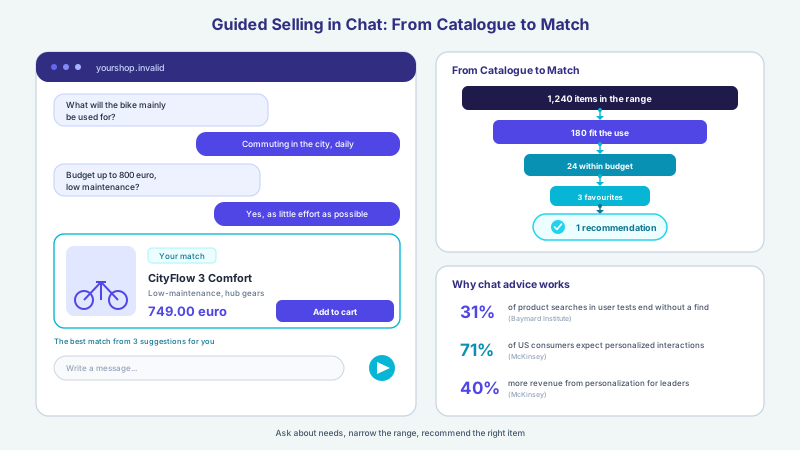
An assistant in your own store closes that gap if it can do three things: answer from a maintained knowledge base rather than from general model knowledge, show products as product cards with image, price and add-to-cart button directly in the conversation, and put together a cart in the chat without throwing the user out of the dialogue. How that plays out for concrete advisory questions is described in our article on guided selling in chat.
The boundary matters. An assistant that sells makes statements about prices, deadlines and availability. That is exactly where hard rules belong: what comes from the knowledge base gets said; what is not in it is not guessed but handed to a human. That such a boundary should be demonstrable before go-live is not a formality — our article on acceptance testing an AI assistant before go-live shows which test cases are suitable.
The part that already costs money remains alongside it: a substantial share of carts does not get completed. How to bring abandoners back in conversation instead of via an email sequence is covered in our article on cart abandonment in chat; the sector-specific view is summarised on our page about the assistant for online shops.
Measure agent traffic, don't filter it out
When a channel converts 42 percent better (Adobe Analytics), as AI traffic did in March 2026, you should be able to see it. In many setups you cannot — because it lands in „direct“ or „other“, or because bot detection sorts it out. The distinction that matters does not run between human and machine, but between purchase intent and no purchase intent.
- Separate referral traffic from AI applications from crawlers collecting content — one has a customer behind it, the other does not.
- Check whether your bot filters also discard visits with purchase intent; a filtered-out channel cannot be optimised.
- Measure this channel separately: conversion, revenue per visit, time on site, pages per visit.
- Look at the landing pages: do visitors from AI sources arrive on product pages or on the homepage?
- Evaluate which questions get asked in your own chat after arrival — that is where the gaps on the page are listed.
- Treat this as an ongoing process: the curve flipped within twelve months, and it can flip again.
The second-to-last point is the most valuable and the least used. The questions visitors ask your own assistant are a list of the gaps in your product pages — written by your customers, without a survey and without interpretation. How to evaluate that systematically is described on our page about conversation analytics.
How mature this really is
An honest picture needs the counter-number. In April 2026 Forrester surveyed online adults in the US, UK and Canada: three quarters (Forrester) of them are uncomfortable letting an AI agent complete a purchase and pay — even if they could set spending limits and rules in advance. Four reasons are named: loss of control, errors and liability questions, distrust of agentic decision-making, and data security and privacy (Forrester).
Forrester places the mid-2026 state soberly: most agentic experiences remain conversational. Chat-based discovery and comparison are widespread, while decision and checkout stay with humans in most cases. True autonomy is rare, and the hype runs ahead of actual behaviour (Forrester). Autonomous agent payments are likely to take root in B2B first, where workflows are highly repeatable (Forrester).
Together this gives a clear picture, and it is not the one from the headlines. The agent that orders fully automatically is the exception today. The agent that researches, compares and leads a human to a store link is already everyday reality — and it is the one producing the 393 percent (Adobe Analytics) and the 42 percent (Adobe Analytics). The work worth doing today addresses that second case. It consists of readable data and a page that answers, not of a protocol integration.
What is concretely due now
Getting started is unspectacular and takes an afternoon. Take your three highest-revenue product pages and check which facts actually appear in the delivered text — not what a human sees in the browser.
- Open the source of your most important product page: do price, variant and delivery time appear there as text?
- Check for contradictions: does the product page state the same delivery time as the cart?
- Look for details that exist only in a PDF, an image or a tooltip — and bring them into the text.
- Clarify per statement type where the one maintained source sits: price, shipping, returns, availability.
- Check your analytics for whether referrals from AI applications are visible as their own channel.
- Test your own chat with the most obvious question about your range and read the answer literally.
- Define what happens when the knowledge base has nothing — a guess is the wrong answer.
- Decide whether the chat may show products and put together a cart, and within which boundaries.
If more than two points stay open, that is no reason for a project with a protocol roadmap. It is a reason to sort out the data before the next growth stage arrives. Where your data sits and who processes it is answered on our page about privacy and hosting. And if you want to know what your range can actually do in a chat, talk to us and we will look at your product data together.
Frequent questions
Do AI agents already order in online stores on their own?
Broadly, not really. Forrester describes the mid-2026 state as one in which most agentic experiences remain conversational: chat-based discovery and comparison are widespread, while decision and checkout stay with humans in most cases (Forrester). Three quarters of surveyed online adults in the US, UK and Canada are uncomfortable letting an agent pay autonomously (Forrester). What is widespread instead is the case where an agent researches and leads a human to your page — that traffic grew 393 percent in the first quarter of 2026 (Adobe Analytics).
Is preparation worth it at all for a mid-sized store already?
It depends what you mean by preparation. Integrating a checkout protocol is premature for most stores today, because responsibilities for consent, authentication and disputes are still being worked out (Forrester). Unambiguous, machine-readable product data, by contrast, is useful regardless: it is the prerequisite for every one of these protocols and pays into classic conversion at the same time. Given an average of 66 percent machine-readable visibility on product pages (Adobe Analytics), there is room in many stores.
How do I tell whether my product pages are readable for models?
A pragmatic start is looking at the delivered source rather than the rendered browser view: do price, variant, delivery time and shipping costs appear there as text? Common causes of gaps are prices loaded only via JavaScript, variants inside interactive widgets, delivery times in tooltips and technical data in PDF datasheets (project experience). In Adobe's April 2026 analysis, product pages across US retail averaged 66 percent machine-readable visibility and homepages 75 percent (Adobe Analytics).
What happens if the product page and the cart state different information?
A human asks; an agent usually does not — it adopts the value it finds first and most clearly and carries it into comparison and recommendation. The contradiction thereby moves to a place where it costs more. For statements made by your own chat, the Higher Regional Court of Hamm also held that the bot is a technical means of the company and its statements can be attributed to it (OLG Hamm, case no. 4 UKl 3/25); the ruling is not final and appeal was permitted (Legal Tribune Online). The practical consequence is one maintained source per statement.
Should I treat AI traffic as bot traffic in my analytics?
In many cases that would be counterproductive. The useful distinction does not run between human and machine, but between visits with purchase intent and crawlers collecting content. In March 2026, visits from AI sources showed a 12 percent higher engagement rate, 48 percent longer time on site and 13 percent more pages per visit (Adobe Analytics). Filtering them out wholesale means losing sight of the channel that converted 42 percent better than other sources in March 2026 (Adobe Analytics).
What good is my own shop assistant if agents decide outside my store?
The two levels deserve separate consideration. Outside your store you only influence the quality of what you deliver. Inside your store you decide what happens to the pre-qualified visitor who arrives. An assistant that answers from a maintained knowledge base, shows products in the conversation and fills the cart answers the question that stayed open in the dialogue — instead of leaving it to a silent product page. What is technically possible is described on our page about the shop assistant.
Ask it yourself, Assistant of this website
Automated assistant