Recovering Cart Abandonment With a Shop Chat
Around 70 percent of carts are abandoned (Baymard). How an AI chat spots hesitation, answers shipping questions in the chat and keeps buyers from leaving.
In plain language
Many online carts do not make it to the checkout. Only some of them can be won back. Hesitation shows, for example, when someone stays on the cart page for a long time. The chat reacts to this without building a profile of the person. Extra costs or having to create an account often get in the way. So the chat names shipping costs and guest checkout right in the cart. Someone about to buy needs a clear answer, not other products. Payment runs as usual at the shop's own checkout.
A full cart is a promise that online often goes unfulfilled. Around 70 percent (Baymard Institute) of online shopping carts are not carried through to purchase, on average across many analysed studies. In German e-commerce, which reached a goods revenue of 83.1 billion euro (bevh) in 2025, that rate hides a sum that is left behind at the last moment day after day. The good news: an abandonment is rarely a firm decision. Behind it stand concrete, recurring doubts, mostly about shipping costs, delivery time, availability or returns. This is exactly where an AI chat assistant comes in. It spots hesitation, answers the open question at the right moment and keeps the buyer in the conversation instead of letting them quietly slip away. This article shows which signals an assistant can read, how it catches the most common abandonment reasons, where the line between helpful intervention and being pushy runs and how to make the effect measurable. It is not about presenting products in the chat, but about saving an already filled cart from being abandoned.
%3C%2Ftext%3E%3Ctext%20x%3D'560'%20y%3D'168'%20font-family%3D'system-ui%2C%20sans-serif'%20font-size%3D'7.5'%20fill%3D'%230e7490'%3EAn%20assistant%20catches%3C%2Ftext%3E%3Ctext%20x%3D'560'%20y%3D'180'%20font-family%3D'system-ui%2C%20sans-serif'%20font-size%3D'7.5'%20fill%3D'%230e7490'%3Epart%20of%20it%3C%2Ftext%3E%3Crect%20x%3D'436'%20y%3D'234'%20width%3D'328'%20height%3D'178'%20rx%3D'12'%20fill%3D'%23ffffff'%20stroke%3D'%23cbd5e1'%20stroke-width%3D'1.3'%2F%3E%3Ctext%20x%3D'452'%20y%3D'258'%20font-family%3D'system-ui%2C%20sans-serif'%20font-size%3D'10.5'%20font-weight%3D'700'%20fill%3D'%23312e81'%3ECommon%20reasons%3C%2Ftext%3E%3Ctext%20x%3D'452'%20y%3D'272'%20font-family%3D'system-ui%2C%20sans-serif'%20font-size%3D'7'%20fill%3D'%2394a3b8'%3E(Baymard%20Institute)%3C%2Ftext%3E%3Crect%20x%3D'556'%20y%3D'286'%20width%3D'108'%20height%3D'12'%20rx%3D'3'%20fill%3D'%234f46e5'%2F%3E%3Ctext%20x%3D'452'%20y%3D'295'%20font-family%3D'system-ui%2C%20sans-serif'%20font-size%3D'7.7'%20fill%3D'%23475569'%3EExtra%20costs%3C%2Ftext%3E%3Ctext%20x%3D'752'%20y%3D'295'%20font-family%3D'system-ui%2C%20sans-serif'%20font-size%3D'8'%20font-weight%3D'700'%20fill%3D'%23312e81'%20text-anchor%3D'end'%3E40%25%3C%2Ftext%3E%3Crect%20x%3D'556'%20y%3D'312'%20width%3D'49'%20height%3D'12'%20rx%3D'3'%20fill%3D'%236366f1'%2F%3E%3Ctext%20x%3D'452'%20y%3D'321'%20font-family%3D'system-ui%2C%20sans-serif'%20font-size%3D'7.7'%20fill%3D'%23475569'%3EForced%20account%3C%2Ftext%3E%3Ctext%20x%3D'752'%20y%3D'321'%20font-family%3D'system-ui%2C%20sans-serif'%20font-size%3D'8'%20font-weight%3D'700'%20fill%3D'%23312e81'%20text-anchor%3D'end'%3E18%25%3C%2Ftext%3E%3Crect%20x%3D'556'%20y%3D'338'%20width%3D'46'%20height%3D'12'%20rx%3D'3'%20fill%3D'%23818cf8'%2F%3E%3Ctext%20x%3D'452'%20y%3D'347'%20font-family%3D'system-ui%2C%20sans-serif'%20font-size%3D'7.7'%20fill%3D'%23475569'%3ELong%20checkout%3C%2Ftext%3E%3Ctext%20x%3D'752'%20y%3D'347'%20font-family%3D'system-ui%2C%20sans-serif'%20font-size%3D'8'%20font-weight%3D'700'%20fill%3D'%23312e81'%20text-anchor%3D'end'%3E17%25%3C%2Ftext%3E%3Crect%20x%3D'556'%20y%3D'364'%20width%3D'33'%20height%3D'12'%20rx%3D'3'%20fill%3D'%23a5b4fc'%2F%3E%3Ctext%20x%3D'452'%20y%3D'373'%20font-family%3D'system-ui%2C%20sans-serif'%20font-size%3D'7.7'%20fill%3D'%23475569'%3ECost%20shown%20late%3C%2Ftext%3E%3Ctext%20x%3D'752'%20y%3D'373'%20font-family%3D'system-ui%2C%20sans-serif'%20font-size%3D'8'%20font-weight%3D'700'%20fill%3D'%23312e81'%20text-anchor%3D'end'%3E12%25%3C%2Ftext%3E%3Ctext%20x%3D'452'%20y%3D'398'%20font-family%3D'system-ui%2C%20sans-serif'%20font-size%3D'7.5'%20fill%3D'%2364748b'%3EThe%20assistant%20clears%20these%20in%20the%20chat%3C%2Ftext%3E%3Ccircle%20cx%3D'436'%20cy%3D'332'%20r%3D'2'%20fill%3D'%2306b6d4'%2F%3E%3Cline%20x1%3D'436'%20y1%3D'332'%20x2%3D'422'%20y2%3D'332'%20stroke%3D'%2306b6d4'%20stroke-width%3D'1.5'%2F%3E%3Cpath%20d%3D'M422%20328%20L416%20332%20L422%20336%20Z'%20fill%3D'%2306b6d4'%2F%3E%3Ctext%20x%3D'400'%20y%3D'436'%20font-family%3D'system-ui%2C%20sans-serif'%20font-size%3D'8.5'%20fill%3D'%23475569'%20text-anchor%3D'middle'%3ESpot%20hesitation%2C%20answer%20instantly%2C%20keep%20buyers%20in%20the%20cart%3C%2Ftext%3E%3C%2Fsvg%3E)
Labels in the illustration
- How much is shipping?
- We ship free from 50 euro —
- you are just 8 euro away.
- In stock · delivery in 2 days
- And if it does not fit?
- 30-day returns, free of charge.
- Kept in the cart
- Questions cleared, no drop-off
- Write a message...
- Carts without purchase
- 70%
- abandoned
- Approx. 70% across
- many studies
- (Baymard Institute)
- An assistant catches
- part of it
- Common reasons
- (Baymard Institute)
- Extra costs
- 40%
- Forced account
- 18%
- Long checkout
- 17%
- Cost shown late
- 12%
- The assistant clears these in the chat
- Spot hesitation, answer instantly, keep buyers in the cart
Where the Revenue Leaks Away in the Shop
Cart abandonment is the most expensive moment in online retail, because interest has already been proven at this point. Someone who puts a product in the cart has decided to seriously consider buying. If they abandon afterwards, it is not a cold contact that is lost but a warm one. At around 70 percent (Baymard Institute) of abandoned carts, this loss is the rule, not the exception, and it affects shops across sectors. On mobile devices the abandonment rate is usually even higher than at the desk, because a small screen, distraction on the go and tedious input amplify every doubt.
What this means in money becomes clear when you look at the market. German e-commerce turned over 83.1 billion euro (bevh) in goods in 2025, up 3.2 percent (bevh) on the previous year, and a growing share of that runs through marketplaces, which now account for around 56 percent (bevh) of online retail. For the individual shop this means: the competition for the visitor who is already there has become tougher, and every abandoned cart is likely to wander off to a larger provider. All the more reason to lift the potential that already sits in your own traffic instead of buying new traffic at a high price. This is exactly where a cart assistant works: it does not start before the visit, but at the moment when the purchase intent is already there and only a single doubt stands in the way.
Spotting Hesitation Before the Tab Closes
Before a cart is abandoned, there are almost always signs. The visitor slows down, jumps back and forth between product page and cart, opens the shipping information, lingers on the cost summary or visibly turns towards leaving the page. On its own none of these signals means much, but together they form a recognizable pattern: someone is hesitating here. A chat assistant can pick up on such moments without prying into the visitor. It reacts to what arises in the normal flow anyway, such as longer inactivity on the cart page or a repeatedly asked question about shipping, and offers help at the right moment instead of addressing everyone at random.
The difference from a rigid pop-up is context. A banner that appears after five seconds for everyone is experienced as a disruption and clicked away. An assistant, by contrast, chooses the moment and the wording by context: someone lingering on the shipping page is offered a concrete answer on cost and delivery time, not a generic discount voucher. This restraint is decisive so that a helpful offer does not turn into a nuisance. Which signals it evaluates and how it reacts can be defined precisely through tool control, so the assistant only intervenes when it really fits.
-
Longer inactivity
If a filled cart sits unusually long, the assistant offers targeted help instead of waiting until the tab closes.
-
Jumping back and forth
Someone switching repeatedly between product, shipping and cart is usually looking for an answer the assistant can give directly.
-
Looking at shipping
If the shipping page is opened repeatedly, the question of cost and delivery time is often the real bottleneck.
-
Repeated question
If the same uncertainty comes up more than once, the assistant picks it up before it leads to abandonment.
-
Small screen
On the smartphone every input is tedious; here a short conversation helps more than another form field.
-
Intent to leave
If the behaviour points to an exit, it is the last moment to clear an open question.
Catching the Most Common Abandonment Reasons
Cart abandonments seem random but rarely are. Research has shown the same patterns for years. Setting plain browsing aside, extra costs are by far the most common reason: around 40 percent (Baymard Institute) of surveyed US online shoppers who abandoned an order cite excessive costs for shipping, taxes or fees. Other reasons include being forced to create a customer account at around 18 percent (Baymard Institute), a checkout perceived as too long or too complicated at around 17 percent (Baymard Institute) and the fact that the total cost cannot be seen in advance at around 12 percent (Baymard Institute). Almost all of these reasons can be defused earlier when someone is ready in the conversation to give an answer.
An assistant acts at exactly these points, and it does so before the cart is left, not after. It states shipping costs and the free-shipping threshold openly instead of revealing them at the last step. It points to the guest checkout instead of putting registration before the purchase. It sums up the total cost including shipping so no nasty surprise waits at checkout. And if someone is unsure about delivery time or returns, it answers directly instead of making the visitor hunt for the information. How much room there is in completion is shown by a figure from Baymard: through better checkout design alone a large shop can raise its conversion rate by around 35 percent (Baymard Institute). An assistant does not replace this design, but it smooths the friction that becomes visible in the conversation.
| Common abandonment reason (Baymard Institute) | What happens without an assistant | How the chat counters |
|---|---|---|
| Extra costs too high (40%) | Shipping and fees surprise at the last step | Names costs and the free-shipping threshold already in the cart |
| Forced account (18%) | Registration is required before buying | Points to the guest checkout instead of requiring registration |
| Checkout too long (17%) | Many steps and fields tire the buyer | Clears open points in advance so the checkout stays short |
| Total cost unclear (12%) | The final amount appears only late | Sums up subtotal, shipping and final price transparently |
| Uncertainty over delivery time or returns | The information is hidden or missing | Answers questions on delivery, availability and returns right in the chat |
Prevention Instead of a Shop Window: the Distinction
A selling chat can do two things: show products and keep buyers. Both belong together but are not the same. When the assistant displays fitting items as cards in response to a question, with image, price and add-to-cart button, that is active product display, as the product cards in the chat deliver and as the article on product cards and cart in the chat describes in detail. There the point is to turn interest into an offer and to let a cart come about in the first place. Abandonment prevention starts one step later: the cart is already filled, the decision almost made, and it is only about clearing the last doubt.
This distinction matters because the two tasks call for a different approach. When showing products the assistant may actively recommend and compare; when keeping a buyer, restraint is needed, because a further offer at the wrong moment distracts from completion instead of encouraging it. Someone close to buying needs no alternative products but a clear answer to their open question. A good assistant recognizes which phase the conversation is in and switches tone: first advise and show, then clarify and confirm. It is precisely this sense of tact that decides whether the chat is experienced as help or as sales pressure.
Do not refill the cart, secure it
In prevention, less is more. Flooding an almost decided buyer with new product suggestions risks having them reopen the decision they already made. The task is not to make the cart bigger but to bring it across the finish line. An answered question about delivery time works more strongly here than any additional offer.
The Right Moment: Proactive, but With Measure
Whether an intervention helps or disturbs is decided by timing. Addressed too early, the visitor feels followed; too late, they are already gone. The right moment is the one in which a recognizable doubt arises and there is still time to clear it. An assistant that stands ready around the clock does not miss this moment, not in the evening, not at the weekend and not when many visitors hesitate at once. Because it handles any number of conversations in parallel, the response stays equally fast in every single case. And speed matters: an analysis of online sales leads at US companies shows that firms that tried to reach prospects within an hour were nearly 7 times (Harvard Business Review) as likely to have a meaningful conversation with a key decision maker as firms that tried only an hour later.
Part of measure is choosing the message to fit the occasion. A hint about the amount missing until free shipping is welcome because it solves a concrete problem. A pushy discount pop-up, by contrast, trains customers to use abandonment as a bargaining tactic and erodes the margin. Those who personalize well achieve measurably more: companies that excel at personalization generate around 40 percent (McKinsey) more revenue from these activities than average players. What matters is the balance between actively helping and respectful restraint, which can be tuned differently for every shop.
Reading Shipping, Stock and Cost in Real Time
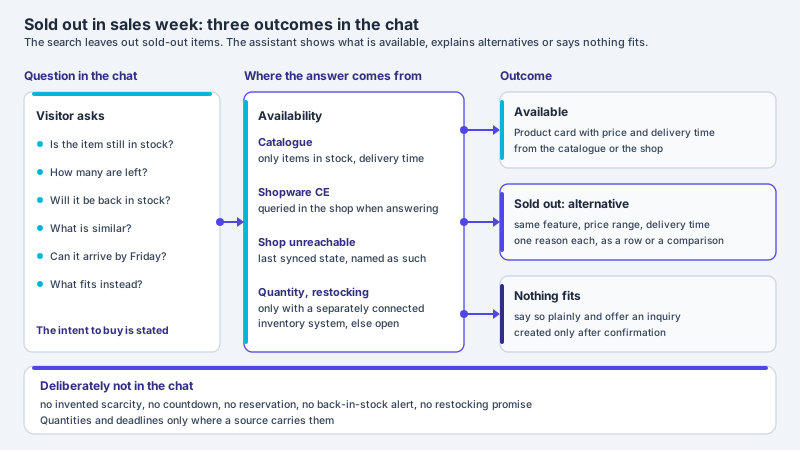
So that the assistant can give the right answer at the decisive moment, it has to know the shop's real data. An answer on delivery time is only as good as how current it is, and a note on availability only helps if it is correct. That is why the assistant relies on delivery times, availability and prices from the shop and on stored shipping and return details instead of relying on a hand-maintained script. If someone asks whether an item will arrive by the weekend, the assistant draws on the stored delivery times instead of guessing. Where this knowledge comes from and how it is maintained is described on the knowledge base page; how to structure the content for it is shown by the article building a knowledge base: what content belongs in it.
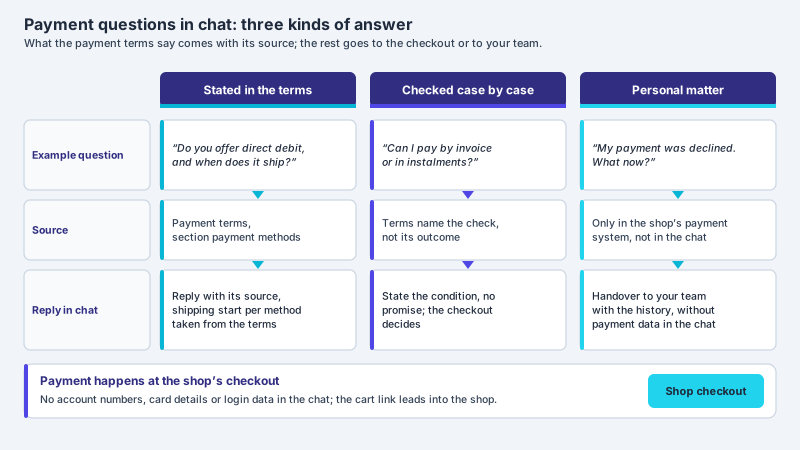
For Shopware in the freely available Community Edition the assistant takes products, prices and availability from the shop, knows shipping and return rules from the stored settings and the knowledge base and can carry out defined actions, such as calculating the free-shipping threshold or assembling a cart in the chat. The actual purchase, including payment and legal texts, stays with the shop's regular checkout; the assistant never works past the checkout. How such an assistant fits into website and shop at all is explained by the article embedding an AI assistant in website and shop, and which actions make sense and are permitted is defined during the connection. This keeps the shop assistant lean and lets it fit in rather than replace the shop.
- State shipping costs and the free-shipping threshold openly in the conversation
- Answer delivery time and availability from the real shop data, not from a script
- Sum up the total cost including shipping transparently before checkout begins
- Point to the guest checkout instead of demanding registration
- Answer questions on returns directly from the stored rules
- Assemble a cart in the chat
Helping Without Secretly Watching
An assistant that reacts to hesitation immediately raises the question of data protection. The answer lies in restraint. The assistant reacts to signals that arise in the normal flow anyway, such as inactivity on the cart page or a question that was asked, and does not build a covert behavioural profile. It does not track visitors across pages and gathers no data on a hunch. Hosting and storage take place in Germany, complemented by a data processing agreement, a deletion concept and clear data sovereignty; the answers are generated by a specialised model provider, also outside the EU on the basis of standard contractual clauses. The details are set out on the privacy and hosting page.
This frugality is not an obstacle but a selling point. In German retail in particular, a visibly data-sparing approach creates trust, and trust at the moment of purchase is worth hard money. An assistant that openly says what it needs a detail for, and only asks for what is required to complete the order, is more likely to be experienced as help than as surveillance. Where a case becomes sensitive or the assistant reaches its limits, it is meant to hand over to a human, with the full conversation as context. How this handover succeeds cleanly is described by the article AI assistant: handover to staff, and in daily use it meshes closely with the support assistant.
What the Chat Saves Becomes Measurable
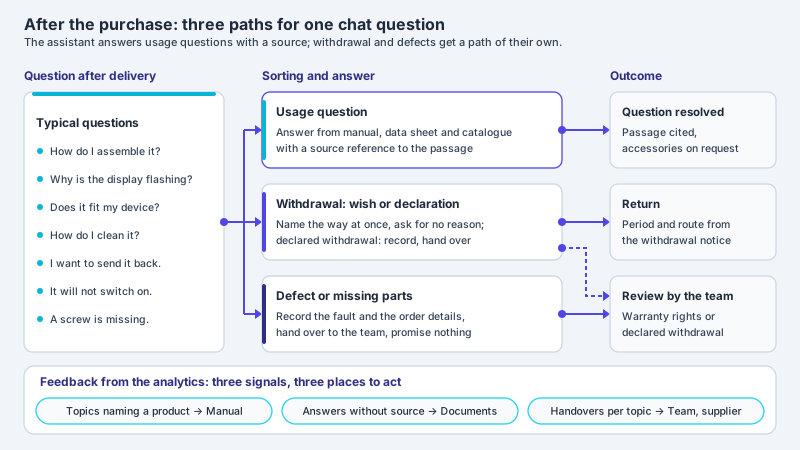
An assistant against cart abandonment is only as good as what you learn from it. Conversation analytics evaluates where conversations tip over, which questions come up most often just before the purchase and which answers keep the buyer. From these patterns concrete improvements emerge: if questions about delivery time pile up, that information belongs more prominently on the product page; if many stumble over shipping costs, the free-shipping threshold is worth a test. In this way not only the assistant improves but the whole path to purchase, because it becomes visible where visitors get stuck. How to use this evaluation is deepened by the article evaluating and optimising chats.
For all its effect, an honest expectation is part of it. An assistant can err, which is why it ties its statements to the shop's own catalogue and knowledge data, hands over to a human in cases of doubt and is continuously evaluated. A fixed increase in revenue or conversion cannot be assured, because it depends on range, prices, target group and competition. What can be influenced are the factors that demonstrably work: less friction, clear answers at the right moment and intervening with measure. Because a growing share of retail runs over the smartphone and abandonment rates are especially high there, a chat that clears questions without a form or page change pays off particularly on mobile. How such an assistant works in the online shop is shown by the relevant industry page; the cart assistant bundles the matching scope of functions.
Frequent questions
How many carts are abandoned in the first place?
On average across many analysed studies, around 70 percent (Baymard Institute) of online shopping carts are not carried through to purchase. On mobile devices the rate is usually even higher. Not every abandonment is a lost customer, because some are only comparing or saving for later. Realistically, a share of these abandonments can be won back by having an assistant answer open questions about shipping, cost and availability at the right moment.
How does a chat assistant recognize that someone is hesitating?
By signals that arise in the normal flow anyway: longer inactivity on the cart page, repeated jumping back and forth between product and cart, a repeated look at the shipping information or a question asked more than once. On its own none of these signs means much, but together they form a pattern. The assistant does not build a covert profile but reacts to what is visible anyway and offers help at the fitting moment.
Is this not the same as product cards in the chat?
No. Product cards actively show items with image, price and add-to-cart button so that a cart comes about in the first place. Abandonment prevention starts one step later: the cart is already filled, and the point is to clear the last doubt rather than to offer new products. The two tasks belong together but call for a different approach. Someone close to buying needs a clear answer to their question, not alternative products.
Is an assistant that speaks up on its own annoying?
That depends on the timing and the message. A hint that answers an open question or removes a real hurdle, such as the amount missing until free shipping, is experienced as a service. A blanket discount pop-up at every hesitation, by contrast, disturbs and trains customers to use abandonment as a tactic. The assistant can be set up so that it only intervenes when there is a recognizable doubt and with a fitting message.
Does this work with Shopware?
Yes, with Shopware in the freely available Community Edition. The assistant takes prices and availability from the shop, knows shipping and return rules from the stored settings and the knowledge base and can carry out defined actions, such as calculating the free-shipping threshold or assembling a cart in the chat. The purchase including payment stays with the shop's regular checkout. Because the assistant works on the real shop data, its answers on delivery time and availability stay current.
Can a specific increase in revenue be assured?
No. A fixed increase in revenue or conversion depends on range, prices, target group and competition and cannot be assured. What can be influenced are the factors that demonstrably work: less friction, clear answers at the right moment and intervening with measure. The assistant ties its statements to its own data, hands over to a human in cases of doubt and is continuously improved through conversation analytics, so that a share of the abandonments can be won back.
Ask it yourself, Assistant of this website
Automated assistant