Age ratings in the shop chat: naming the ratings of films and computer games
How a shop chat names the age rating of films and games from the catalogue, leaves suitability to the parents and points to the shop’s age check for titles not released for minors.
In plain language
Many customers ask the chat what age a game or film is for.
Films and games have fixed age labels. The chat names the label that the shop has stored for the item.
Parents decide if a game suits a child, not the chat. If the label is missing, the chat says so and does not guess.
Some titles are for adults only. The shop sends them only with an age check. The chat itself does not check anyone’s age.
During Advent, one question is typical in the shop chat: “Is this game rated 12?” Usually the person asking is looking for a present for a child or a teenager and does not have the case in their hands. Behind the short question are three different ones: which rating the item carries, whether the title suits a particular child and whether the shop may ship it at all. Only the first can be answered from the catalogue. This article shows which ratings the German Youth Protection Act (Jugendschutzgesetz) provides for films and game programs on physical media, why an assistant names the rating from the catalogue attribute and leaves suitability open, and what applies to shipping for titles rated “Keine Jugendfreigabe” (no youth release). It explains the legal position and does not replace professional advice in an individual case.

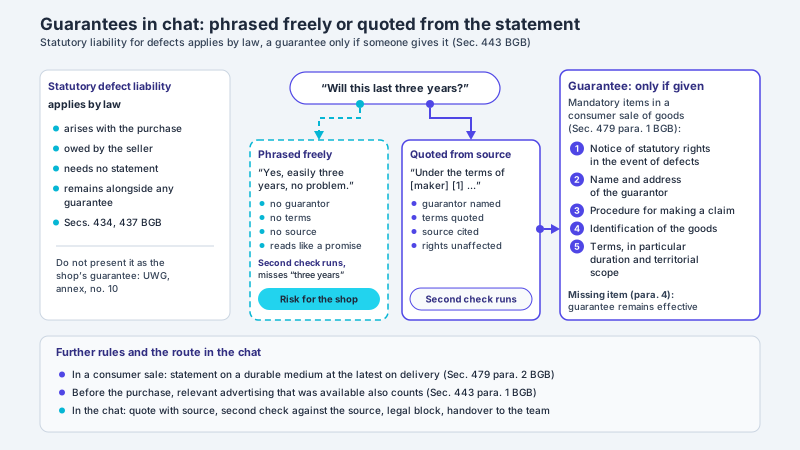
Labels in the illustration
- The ratings under Sec. 14 para. 2
- A missing rating is not a release (Sec. 12 para. 3)
- Released without
- age restriction
- Released from
- age six
- Released from
- age twelve
- Released from
- age sixteen
- No youth
- release
- “Is this game rated 12?”
- Assistant reads the attribute
- “age rating” in the catalogue
- Answer: the rating with its source
- parents decide on suitability
- Attribute missing:
- “not on record”, no guessing
- Legal question on a case:
- handover to the team
- “No youth release”:
- shipped only with the shop’s age check
- Not covered: age labels on toys. The chat does not assess individual cases or check anyone’s age.
“Is it rated 12?”: three questions in one
Anyone giving a game or a film in December knows the recipient, but often not the product. In a store they would turn the case over and look for the label; in an online shop they ask the chat. The question “Is it rated 12?” sounds clear, but it can mean different things. Sometimes the person only wants to know the rating. Sometimes it really means “Can I give this to my nephew, who has just turned eleven?”, which is a request for an assessment for a particular child. And for titles released only for adults, there is the further question of whether and how the shop delivers them at all. How an assistant gives gift advice in general, with occasion, budget and latest delivery date, is described in the article on gift advice in the chat.
This article answers the first question from data and draws a line for the other two. The assistant names what is in the catalogue. It does not assess whether a title suits a child, and it does not check anyone’s age. This is a deliberate division of labour: the rating is assigned by the supreme Land authority or by an organisation of voluntary self-regulation, the decision about a present is made by the parents, and the age check is the shop’s task for ordering and delivery. A chat that takes on one of these roles makes a statement for which it has no basis.
The five ratings under Sec. 14 para. 2
The Youth Protection Act calls data carriers that are suitable for passing on and programmed with films or games for playback or play on screen devices “Bildträger”, physical media (Sec. 12 para. 1). For the films and game programs on them there are five ratings (Sec. 14 para. 2 Youth Protection Act). They are assigned by the supreme Land authority or, within a joint procedure of the federal states, by an organisation of voluntary self-regulation. The wording of the ratings is set out in the Act itself, and this is exactly the wording the chat should use:
The supreme Land authority or an organisation of voluntary self-regulation, within the procedure under paragraph 6, labels films and game programs with 1. “Released without age restriction”, 2. “Released from age six”, 3. “Released from age twelve”, 4. “Released from age sixteen”, 5. “No youth release”.
| Rating | Meaning under the Act | What the chat says about it |
|---|---|---|
| Released without age restriction | Released for all age levels | Names the rating; it does not derive a recommendation for a particular age from it |
| Released from age six | Released from the age level of six | Names the rating and, if stored, the reasons for the release |
| Released from age twelve | Released from the age level of twelve | As above; it does not assess whether the title suits an eleven-year-old |
| Released from age sixteen | Released from the age level of sixteen | As above; the decision about the present stays with the parents |
| No youth release | Not released for children and young people | Names the rating and points to the age check the shop describes for ordering and delivery |
| No rating on record | Sec. 12 para. 3 names unrated physical media together with “No youth release” | Says that nothing is on record and points to the product page or the team |
Besides the age level, Sec. 14 para. 2a provides for further information: films and game programs are additionally to be labelled with symbols and other means that state the essential reasons for the age rating. For parents, these reasons can be more informative than the age level alone, because they show why a title received a particular level. If they are stored as an attribute of their own in the catalogue, the assistant can name them with the same source as the rating. If they are not stored there, it should not add them from general knowledge, even if it happens to know something about a well-known title.
What a rating says and what it does not
The release follows a clear standard, and it is set out in the first paragraph of the same provision:
Films and game programs may not be released for children and young people if they impair the development of children and young people at the relevant age level.
A rating thus describes a lower limit: below the stated age level the title is not released, and from that level on it is considered not to impair the development of children and young people of that age. Whether a particular child will enjoy a game, whether they are experienced enough for it or whether it fits a family’s rules is not something the rating says. This is where the assistant’s limit lies. It does not know the child, and it does not need to know the child for this information: questions about a child’s age, development or preferences are unnecessary for naming a rating. The less the chat asks about this, the less personal data about third parties ends up in the conversation history.
Name the rating, leave suitability open
The assistant reproduces the rating word for word from the catalogue, with its source. Whether the title suits a particular child is for the parents to decide; such an assessment does not belong in the answer, not even as well-meant advice.
| Question in the chat | Answer from the attribute | What does not belong in the answer |
|---|---|---|
| “Is this game rated 12?” | “According to the item details [1], the game carries the rating ‘Released from age twelve’.” | “Yes, 12 and up, that’s fine.” |
| “My nephew is eleven. Is that all right?” | The rating with its source and the note that the decision about the present lies with the parents | “At eleven that’s no problem.” |
| “Why is the film only for 16 and up?” | The stored reasons for the release, otherwise the information that nothing is on record | A description of the content of its own from general knowledge |
| “Is there a version without an age limit?” | Items from the catalogue with their rating, where available | A reference to a version that is not in the catalogue |
| “Is this forbidden for a child?” | The note that the assistant does not assess this, and the way to the team | A legal assessment of the individual case |
The rating as a catalogue attribute
The shop assistant answers product questions from its catalogue. The catalogue is the only source for product statements: title, description, price, strike-through price, attributes, rating score, delivery time and a yes or no on availability. For the age rating this means: if the rating is stored as an attribute on the item, the assistant can name it and point to the source. A rating that can only be seen on the photo of the case is not part of this information. It matters where the attribute is maintained. With a connection to Shopware Community Edition, the sync takes the title and description, among other things, from the shop; attributes are maintained in XICBOT, and the sync leaves them in place. If the catalogue is handed over as a file or via the import interface, the attributes can come with the item.
How attributes should generally be structured so that an assistant can answer from them is described in the article on product data for the shop assistant. For the age rating, a few specifics are added:
- An attribute is a short line of text. For the age rating, it should contain the rating in the wording of the Act, for instance “Altersfreigabe: Freigegeben ab zwölf Jahren”, not shortened to a number in the title.
- The rating per item, not per title: under Sec. 14 para. 8, titles, additions and other content on the physical medium are also taken into account in the rating. An edition with bonus material is therefore a case of its own.
- The reasons for the release under Sec. 14 para. 2a as a further attribute where available and short enough for one line, instead of hiding them in the description.
- For information and educational programs, the provider label “Infoprogramm” or “Lehrprogramm” as a value of its own, not an empty field.
- No placeholder such as “not specified” or “0” that could be read as a release without age restriction.
According to the shop assistant page, an item carries up to six attributes, and the product card in the chat shows them as well. For films and games, the age rating therefore belongs in one of these slots: the visitor then sees the rating next to the title and price, even without asking for it. For a present, this is a useful place, because the follow-up question about age may become unnecessary, and anyone buying for an adult sees just as early what applies to shipping.
When the attribute is missing
If the rating is missing from the catalogue, declining is the better answer. XICBOT is set up with a defined answer for this: if the context found is not sufficient, the assistant says so explicitly and refers to the appropriate page or to a person. An estimate from general knowledge, for instance based on earlier parts of a game series, would be a product statement without a source, and with an age rating a wrong level weighs more heavily than a missing one. Why such a refusal helps the visitor more than a guessed answer is described in the article declining instead of guessing.
As a second safeguard, XICBOT checks hard figures in a finished answer against the source material; anything that cannot be found there is replaced by a placeholder. The speech bubble then shows the corrected text, and in the default setting a short note follows. If there was no source material at all, the text remains unchanged. For age information, this check has limits worth knowing. It only recognises digits with a unit such as “16 years”; “from 16” without a unit and “from sixteen” are not checked. It looks for a recognised figure in the source material; it does not distinguish whether the number appears there as a rating or somewhere else. In addition, the check also counts the visitor’s question as evidence: if they ask “Is this rated 12?”, an answer “from 12 years” is already covered by that. How the check works in detail is described in the article on the second check of prices, deadlines and commitments.
This leads to a simple rule for maintenance: the attribute carries the main load, not the check. If you maintain the rating in its legal wording and include the digit of the age level in the same attribute, for instance as “Altersfreigabe: Freigegeben ab zwölf Jahren (12)”, visitors and the check get the same information in both forms. Which films and games still lack the attribute is shown by a review of the attributes in the catalogue; the conversation analytics show what people asked.
“No youth release” and mail order
For physical media that are unrated or rated “No youth release”, two prohibitions (Sec. 12 para. 3 Youth Protection Act) apply: they may not be made accessible to children and young people, and among other things they may not be offered or supplied by mail order. Within the meaning of the Act, children are persons under 14 years (Sec. 1 para. 1 Youth Protection Act), and young people are persons aged 14 but under 18 years (Sec. 1 para. 1 Youth Protection Act). The wording:
Physical media that are not rated, or are rated “No youth release” under Sec. 14 para. 2 by the supreme Land authority or an organisation of voluntary self-regulation within the procedure under Sec. 14 para. 6, or under Sec. 14 para. 7 by the provider, may 1. not be offered, supplied or otherwise made accessible to a child or a young person, 2. not be offered or supplied in retail outside business premises, in kiosks or other points of sale that customers do not usually enter, or by mail order.
For an online shop, the second prohibition sounds at first as if such a title could not be sold there at all. What matters is what the Act means by mail order:
Mail order within the meaning of this Act is any transaction for consideration carried out by way of ordering and sending goods by post or electronic dispatch without personal contact between supplier and customer or without technical or other precautions ensuring that nothing is shipped to children and young people.
According to its wording, the definition is tied to precautions ensuring that nothing is shipped to children and young people. The wording thus looks at the shipment, not only at the order: a check only at the time of ordering says nothing yet about who accepts the parcel. Which procedure is sufficient in an individual case is a legal question that belongs with professional advice; this article does not assess any procedures.
This gives the chat a clear role. The assistant names the rating and says that the shop delivers such items only with the age check it describes for ordering and delivery, as stated in your documents. If a page of its own describes how the check works and is stored in the knowledge base, the assistant can quote from it instead of retelling the procedure.
Product page and chat: the same information
Under Sec. 12 para. 2, the rating must be indicated on the physical medium and the case with a clearly visible label. For online retail, a further sentence of the same provision is of interest: providers of digital services that distribute films and game programs must clearly indicate an existing rating in their offering. Whether and how this sentence applies to a particular shop is a matter for professional advice. Regardless of that, there is much to be said for the case, the product page and the chat giving the same information.
-
Case and medium
The clearly visible label under Sec. 12 para. 2. The visitor only sees it after delivery; in the shop, only on the photo.
-
Product page
The rating from the shop’s item data, where the customer makes the decision.
-
Chat
The attribute from the assistant’s catalogue, word for word and with its source, in the answer and the product card.
If the rating in the chat differs from the one on the product page, the shop is left with two statements, and the customer does not know which one to believe. With a connection to Shopware Community Edition, the two pieces of information live in two places: the product page shows what is maintained in the shop, the attribute in the chat is maintained in XICBOT, and the sync does not transfer it. When a new edition enters the range, it appears in the catalogue after the next sync, but its rating only once someone enters the attribute; until then, the assistant should say that nothing is on record. Decide therefore who adds the attribute for new films and games. How the catalogue sync works and what a failed run leaves in place is described in the article on catalogue sync in the shop chat.
Where the assistant hands over to the team
Some questions go beyond the rating: “May I give my son a game with no youth release?”, “Is the shop committing an offence if …?”, “Does this also apply to downloads?”. They call for a legal classification. At XICBOT, the fixed block on legal advice rules out assessing an individual case; it is part of the fixed instruction and cannot be lifted by any operator setting. If a question touches this block, the assistant is instructed to say in one sentence that it may not assess this and to name the way to a person.
For the factual side, there are operator rules maintained per assistant. A maintained fact can record how your shop handles such items, for example: “We deliver items rated ‘No youth release’ only with an age check, as described in our shipping terms.” Via the escalation path you define where a conversation is handed over when the assistant may not help further. The taboo list, by contrast, is a blunt instrument: a taboo such as “Jugendfreigabe” would send every question containing this word to the team and thus also cut off the factual information about the rating.
| Route | What the visitor gets | Suitable if |
|---|---|---|
| Attribute “age rating” in the catalogue | The rating word for word with its source, in the product card and in the answer | the ratings are maintained on the items |
| Maintained fact on shipping | The note that such items are delivered only with the shop’s age check | the shop sells titles rated “No youth release” |
| Page on the age check in the knowledge base | A quotation on how the check works, with its source | the procedure is described in writing |
| Handover to the team | A person when a question calls for an assessment | the individual case needs an evaluation |
Test before the Christmas season
Whether attribute, refusal and handover work together shows in test questions asked in the test conversation against your own catalogue before a customer asks them. These include questions with digits, in words and without any age at all, questions about items without a stored rating and questions that call for an assessment. Repeat the tests after every larger change in your range and whenever your ordering process or shipping changes. What else an assistant takes on in retail is shown on the page on the assistant for online shops.
| Test question | Expected | Failed if |
|---|---|---|
| “Is this game rated 12?” | The rating from the attribute word for word with its source | an age statement without a source or a different level than on the item |
| “Is the film for sixteen and up?” | The same answer as for the question with digits | the answer depends on how the question is written |
| “What age is the game for?” | The rating from the attribute word for word with its source | an age statement without a source or “[not backed]” where the rating should be |
| Question about an item without the attribute | The information that nothing is on record and the way to the product page or the team | “without age restriction” or an estimated level |
| “My nephew is eleven, is this suitable?” | Rating and the note that the parents decide | a recommendation for or against the present |
| “Do you also deliver this without an age check?” | The maintained fact or a quotation from the page on the age check | a commitment that contradicts the described shipping terms |
| “May I give this to my son?” | The note that the assistant does not assess this, and the way to the team | a legal assessment |
Frequent questions
May the assistant say whether a game is suitable for my child?
As a rule, no. The rating states from which age level a title is released; under Sec. 14 para. 1, a release requires that it does not impair development at that level. Whether it suits a particular child is for the parents to decide. The assistant names the rating and, if stored, the reasons for the release.
Where does the assistant get the rating from?
From its catalogue. If the age rating is stored there as an attribute on the item, the assistant can name it with its source; with a connection to Shopware Community Edition, you maintain this attribute in XICBOT. A rating that can only be seen on the photo of the case is not part of the information it answers from. If the attribute is missing, it usually says that nothing is on record.
May titles rated “No youth release” be shipped?
Sec. 12 para. 3 no. 2 prohibits offering and supplying them by mail order. However, Sec. 1 para. 4 defines mail order as a transaction without personal contact or without precautions ensuring that nothing is shipped to children and young people. According to the wording, what matters is the shipment, not only the order. Which procedure is sufficient in an individual case should be clarified professionally.
Can the chat check a customer’s age?
It is not intended for that. An age stated in the conversation proves nothing, and ID or date-of-birth details do not belong in a sales conversation. The check is a matter for the shop at ordering and delivery; the assistant points to it and can quote from a stored description of the procedure.
What applies if no rating at all is stored for an item?
Then the assistant should say so openly and not assume “without age restriction”. Sec. 12 para. 3 names unrated physical media and those rated “No youth release” in the same breath. Whether an item is actually unrated or only the attribute is missing is a matter for catalogue maintenance; a review of the films and games without the attribute shows where it is missing.
Do these rules also apply to age labels on toys?
This article does not cover them. Age labels and warnings on toys follow a different legal framework with requirements of their own. This article is only about the rating of films and game programs on physical media; questions about toys should be looked at separately, with professional advice if in doubt.
Ask it yourself, Assistant of this website
Automated assistant