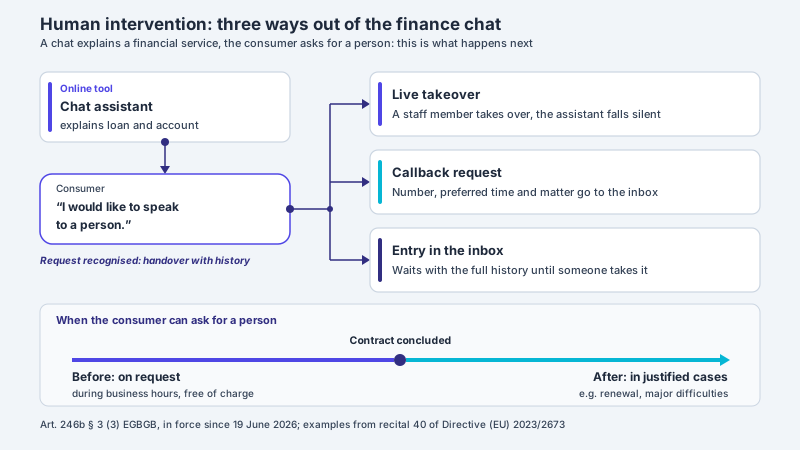
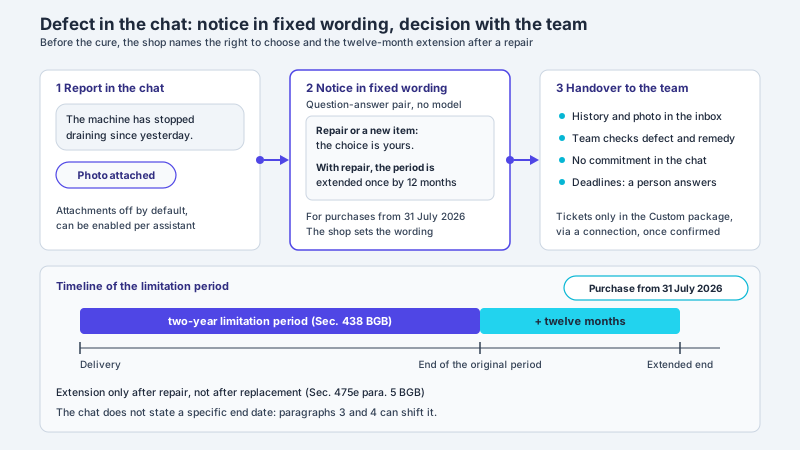
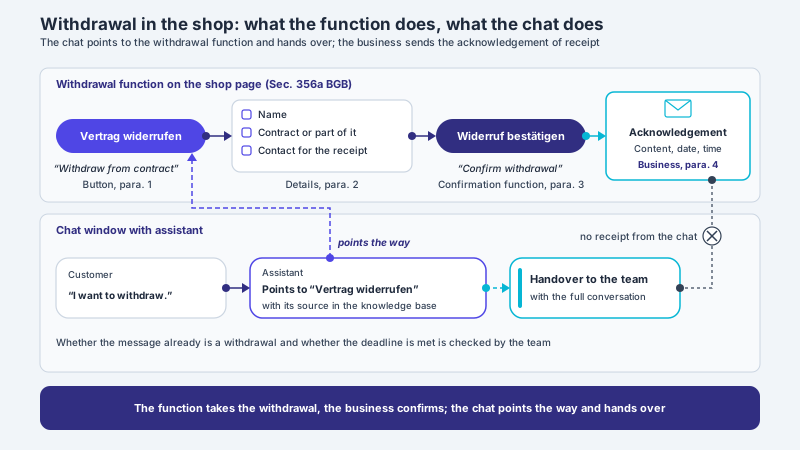
Guarantees in the sales chat: when an answer becomes a commitment under Section 443 BGB
When a chat answer before a purchase can act like a guarantee under Section 443 BGB, what Section 479 BGB requires and how the assistant quotes the terms.
In plain language
Before they buy, many people ask the chat about the guarantee.
A guarantee is a promise that comes on top of the rights the law gives. Even a line in an ad can be such a promise.
So the chat should not make up a promise of its own. It should show the rules that the shop or the maker wrote down. It also says where it found them.
If there is no such text, the chat says so. A person in the team checks if a fault is covered by the guarantee.
In the gift season, one question comes up in the chat particularly often before a purchase: “How long is the guarantee on this?” or “Will this last three years?”. Anyone choosing a present wants to be sure it will not break shortly after the holidays. An assistant that answers freely can quickly phrase a commitment that appears nowhere in the shop. Under Sec. 443 para. 1 BGB, a guarantee can arise from a statement or relevant advertising that was available before or at the conclusion of the purchase contract. This article shows what the law understands by a guarantee, which five items Sec. 479 para. 1 BGB requires in a guarantee statement for a consumer sale of goods, why a freely phrased chat answer is therefore a risk and how an assistant quotes from the stored guarantee terms instead. It explains the legal position and does not replace professional advice in an individual case.

Labels in the illustration
- Statutory defect liability
- applies by law
- arises with the purchase
- owed by the seller
- needs no statement
- remains alongside any
- guarantee
- Secs. 434, 437 BGB
- Do not present it as the
- shop’s guarantee: UWG,
- annex, no. 10
- “Will this last three years?”
- Phrased freely
- “Yes, easily three
- years, no problem.”
- no guarantor
- no terms
- no source
- reads like a promise
- Second check runs,
- misses “three years”
- Risk for the shop
- Quoted from source
- “Under the terms of
- [maker] [1] …”
- guarantor named
- terms quoted
- source cited
- rights unaffected
- Second check runs
- Guarantee: only if given
- Mandatory items in a
- consumer sale of goods
- (Sec. 479 para. 1 BGB):
- 1
- Notice of statutory rights
- in the event of defects
- 2
- Name and address
- of the guarantor
- 3
- Procedure for making a claim
- 4
- Identification of the goods
- 5
- Terms, in particular
- duration and territorial
- scope
- Missing item (para. 4):
- guarantee remains effective
- Further rules and the route in the chat
- In a consumer sale: statement on a durable medium at the latest on delivery (Sec. 479 para. 2 BGB)
- Before the purchase, relevant advertising that was available also counts (Sec. 443 para. 1 BGB)
- In the chat: quote with source, second check against the source, legal block, handover to the team
The question before the purchase
Questions about guarantees reach the chat at two points. After the purchase, when something does not work, it is a complaint; how an assistant takes it in and why the statutory warranty and a guarantee have to be kept apart is described in the article on complaints and warranty in chat. Before the purchase the situation is different. The customer does not yet have any rights under a contract; they are collecting reasons for a decision. In the gift season further questions are added: someone buying for another person wants to know whether the present will last, whether the recipient can use a guarantee and whom to contact if something goes wrong.
Before the purchase in particular, an answer carries weight. It is part of the information on which the customer decides, and afterwards it stays in the conversation history. Two earlier articles touch on the subject from a different angle. The article on chatbot liability after the OLG Hamm ruling shows why statements made by a chatbot can be attributed to the operator and why guarantees count among the statements that carry liability risk. The article on the second check of prices, deadlines and promises describes the technique XICBOT uses to hold promise words such as “guarantee” against the source. This article does not repeat either of them but starts with the law: with Sec. 443 BGB, which says when a guarantee exists, and with Sec. 479 BGB, which says what a guarantee statement must contain.
What Sec. 443 BGB means by a guarantee
The German Civil Code distinguishes two bases. The seller’s statutory liability for defects arises with the purchase contract and does not need to be promised by anyone. A guarantee is added when someone enters into an additional obligation. The wording expressly includes advertising as well:
If the seller, the manufacturer or another third party, in a statement or relevant advertising that was available before or at the conclusion of the purchase contract, enters into an obligation in addition to the statutory liability for defects, in particular to refund the purchase price, to exchange the item, to repair it or to provide services in connection with it if the item does not have the quality, or does not meet requirements other than freedom from defects, described in the statement or relevant advertising (guarantee), the buyer has, in the event of a guarantee claim and without prejudice to the statutory claims, the rights under the guarantee against the person who gave the guarantee (guarantor).
For a chat, this sentence contains four features that can be read one by one. First, the group of those who can give a guarantee: the seller, the manufacturer or another third party. If a shop passes on a manufacturer’s guarantee, the manufacturer is the guarantor; if the shop makes a commitment itself, it can end up in that role itself. Second, the form: alongside a statement, the wording names relevant advertising. Third, the timing: what counts is what was available before or at the conclusion of the purchase contract, which is exactly the phase in which a customer asks in the chat. Fourth, the content: the obligation is added to the statutory liability for defects and does not replace it.
| Feature in the wording | What it means | What follows for the chat |
|---|---|---|
| Seller, manufacturer or another third party | The guarantor can be whoever enters into the obligation | The answer names who gives the guarantee instead of saying “we” where the manufacturer is meant |
| Statement or relevant advertising | Not only a guarantee card; promotional statements can also be covered | A chat answer is the shop’s text; whether it is covered in an individual case is a matter for professional advice |
| Available before or at the conclusion of the purchase contract | What matters is what could be read before the purchase | Pre-purchase advice falls exactly within this period |
| In addition to the statutory liability for defects | The guarantee is added; the statutory rights remain | The answer does not mix up guarantee and statutory warranty |
| Rights against the guarantor | Claims under the guarantee are directed at whoever gave it | The answer says whom the customer contacts in a guarantee case, where the terms state this |
“Will this last three years?” and the durability guarantee
Many customers do not ask about a guarantee but about durability: “Will this last three years?”, “Will the battery still be good after a winter?”, “Does the zip break easily?”. The law has a separate paragraph for this kind of commitment:
Insofar as the guarantor has assumed a guarantee that the item will retain a particular quality for a particular period (durability guarantee), it is presumed that a material defect occurring during its period of validity gives rise to the rights under the guarantee.
An answer such as “Yes, this will easily last three years” names a period and a quality, which are exactly the two elements paragraph 2 refers to. Whether such a sentence in the chat is a durability guarantee cannot be said across the board; it depends on how it is phrased, in which context it is made and how a customer was entitled to understand it. The risk is that it sounds like a commitment the shop did not intend to give. Independently of any guarantee, Sec. 434 BGB governs what is owed. Under paragraph 3, durability is part of the usual quality of an item, and what the buyer can expect takes into account public statements by the seller, in particular in advertising or on the label. If a durability claim appears in advertising or on the product page, it can therefore influence what is owed. An answer to a single customer in the chat, by contrast, is not addressed to the public; for such an answer, the agreed quality under Sec. 434 para. 2 BGB is the more likely route. Whether it becomes part of it is a question of the individual case and a matter for professional advice.
The five mandatory items under Sec. 479 para. 1 BGB
When a guarantee exists is governed by Sec. 443 BGB. What a guarantee statement must look like is governed by Sec. 479 BGB, specifically for the consumer sale of goods. Under Sec. 474 para. 1 BGB, that is a contract by which a consumer buys goods from a trader. For an online shop selling to private customers this is the normal case; for sales between businesses the provision does not apply, because it belongs to the special rules on consumer sales of goods. For a guarantee statement towards consumers, five mandatory items (Sec. 479 para. 1 BGB) apply, together with the requirement that it be drafted in plain and intelligible language:
A guarantee statement (Sec. 443) must be drafted in plain and intelligible language. It must contain the following: 1. a notice of the consumer’s statutory rights in the event of defects, that exercising these rights is free of charge and that these rights are not restricted by the guarantee, 2. the name and address of the guarantor, 3. the procedure the consumer must follow to make a claim under the guarantee, 4. the identification of the goods to which the guarantee relates, and 5. the terms of the guarantee, in particular the duration and the territorial scope of the guarantee cover.
| Number | Mandatory item under Sec. 479 para. 1 BGB | Typical gap in a freely phrased answer |
|---|---|---|
| 1 | Notice of the consumer’s statutory rights in the event of defects, that exercising them is free of charge and that the guarantee does not restrict them | Usually missing entirely; often the guarantee is even confused with the statutory warranty |
| 2 | Name and address of the guarantor | “You have a three-year guarantee” does not say who gives it |
| 3 | Procedure the consumer must follow to make a claim | Not a word on how and where the customer reports a guarantee case |
| 4 | Identification of the goods to which the guarantee relates | Unclear whether accessories, the battery or another version are included |
| 5 | Terms of the guarantee, in particular duration and territorial scope | Perhaps a period, but no start, no conditions and no territory |
Two further paragraphs matter for the chat. Under Sec. 479 para. 2 BGB, the guarantee statement must be made available to the consumer on a durable medium at the latest at the time the goods are delivered. A shop should not rely on a conversation history in the chat window meeting this requirement; how and when it hands over the statement belongs in its ordering process, with professional advice if in doubt. And under Sec. 479 para. 4 BGB, the effectiveness of the guarantee obligation is not affected if one of these requirements is not met. A brief commitment therefore does not become non-binding merely because the guarantor, the procedure or the territorial scope is missing.
Missing items do not make a commitment harmless
Under Sec. 479 para. 4 BGB, the effectiveness of a guarantee obligation is unaffected if a requirement of the section is not met. For the chat this means: an incomplete answer does not protect the shop. Complete information comes about where the assistant quotes the guarantor’s statement instead of retelling it.
Why a freely phrased commitment is risky
A language model knows many guarantee terms from its general knowledge, just not the ones that apply to this item in this shop. When a customer asks about the guarantee, an answer that sounds plausible is close at hand: a common period, an “of course”, a mention of an exchange. Three errors typically occur. The answer names a period that appears in no statement. It confuses the statutory warranty with a guarantee, for example in a sentence such as “With us you get a two-year guarantee”, although the shop gives no guarantee at all. Or it turns the manufacturer’s guarantee into a commitment by the shop because it says “we” where the manufacturer is meant.
The second error has a competition-law side in addition to sales law. Under number 10 of the annex to Sec. 3 para. 3 UWG, it is impermissible towards consumers to create the false impression that statutory rights are a distinctive feature of the offer. Presenting the statutory liability for defects in the chat as the shop’s own guarantee comes close to this line. That the same rule also plays a part in transport damage is shown in the article on lost or damaged parcels.
| Question before the purchase | Risky answer | Answer from the source |
|---|---|---|
| “How long is the guarantee on the coffee grinder?” | “Three years, that is standard with us.” | “According to the guarantee terms of [manufacturer] [1], this appliance has a three-year guarantee from the date of purchase. Your statutory rights remain unaffected [1].” |
| “Will the rucksack last three years?” | “Yes, it will easily last three years.” | “Nothing is stored on the durability of this item. I am happy to pass your question on to our team.” |
| “Does the guarantee also cover the person receiving the gift?” | “Yes, it covers every owner.” | The rule from the guarantor’s terms with the source or, if they say nothing, the information that nothing is stored on this |
| “Do I get a guarantee from you?” | “Yes, a two-year guarantee.”, meaning the statutory warranty | “As a shop we do not give a guarantee of our own. Your statutory rights in the event of defects exist independently of this [1].” |
Storing guarantee terms as a source
The more reliable answer to a guarantee question is a quotation. With the default setting “Answer only from the knowledge base”, the assistant in XICBOT is instructed to answer from the excerpts found in your sources for the question, not from the model’s general knowledge; every substantive statement is meant to carry its source. For guarantees this means: the guarantee terms belong in the knowledge base as documents of their own, per guarantor and, where they differ, per product group. The assistant then reproduces what is written there and names the passage it comes from. How the source appears in the chat window is shown in the article on citing sources in chat.
- The guarantee statement of every manufacturer whose guarantee you mention in the shop, in full and with the date of the version.
- A guarantee statement of the shop’s own only if one exists, with all items from Sec. 479 para. 1 BGB.
- A short page that keeps the statutory warranty and a guarantee apart and states that the statutory rights remain unaffected.
- In the product data, which guarantor and which terms apply to an item, rather than just a period.
- The contact point for guarantee cases, exactly as stated in the statement.
If there is no such source, declining is the better answer. XICBOT is set up with a defined answer for this case: if the context found is not sufficient, the assistant says so explicitly and refers to the relevant page or to a person. For a guarantee question that is more helpful than a period nobody has promised. For a general question that comes up often, such as whether the shop gives a guarantee of its own, a curated question-and-answer pair is also suitable. According to the page on the support assistant, such a pair goes out word for word, without a model call; the wording you have set is then the answer.
What the second check sees in guarantee questions
As a second safeguard, XICBOT holds the hard claims in a finished answer against the source material; anything that cannot be found there is replaced by a placeholder, and the speech bubble then shows the corrected text; if there was no source material at all, the text stays unchanged. The word “guarantee” is one of the promise words checked in this way. How the check works in detail and where its limits lie in general is described in the article on the second check mentioned above. Two of them matter particularly for guarantee questions, because they lie exactly where such conversations go:
- If the word is already in the visitor’s question, as in “How long is the guarantee?”, “guarantee” in the answer counts as covered, because the question counts as evidence.
- The check does not recognise a period written in words such as “three years”; a sentence such as “Yes, this will easily last three years” therefore stays as it is.
The second check is therefore a net for figures and promises without an origin, not a guarantee check. In guarantee questions the source carries the main load: if the guarantor’s statement is in the knowledge base, the assistant has something correct to quote; if it is missing, the assistant is meant to decline. A curated question-and-answer pair does not go through the second check, because its wording is itself the source.
Legal block, taboo list and handover
Some guarantee questions call for an assessment: “Is the scratch a guarantee case?”, “Does the manufacturer have to replace the appliance?”, “Is the guarantee still valid if I opened it myself?”. This is where the line runs. In XICBOT, the fixed block on legal advice rules out assessing an individual case and evaluating claims; it is part of the fixed instruction and cannot be lifted by any operator setting. If a question touches this block, the assistant is instructed to say in one sentence that it may not assess this and to name the way to a person. The request for a person can be made in every state of the conversation.
If you want guarantee questions to be answered by a person as a matter of principle, you can put “Garantie” on the assistant’s taboo list. A taboo is listed in the instruction among the topics the assistant does not talk about, and it is also searched for in the wording of the visitor’s question; if it appears there, the assistant appends the limits notice and hands the conversation over to your team. The search works on parts of words, so “Herstellergarantie” (manufacturer’s guarantee) and “Garantiebedingungen” (guarantee terms) also match. The price is the factual information: with this taboo, the assistant is instructed to say about guarantees only that it does not comment on them. A question about durability without the word does not trigger the list, and a question in English needs an entry of its own, such as “guarantee”. How the same trade-off looks for financing questions is described in the article on instalments and pay later in the shop chat.
| Route | What the visitor gets | Suitable if |
|---|---|---|
| Guarantee terms in the knowledge base | A quotation from the terms with the source, otherwise the information that nothing is stored | the guarantors’ statements are available and maintained |
| Curated question-and-answer pair | The set wording, without a model call | a general question comes up often, such as whether the shop gives a guarantee of its own |
| “Garantie” on the taboo list | The notice that the assistant does not comment, and the handover to the team | every guarantee question is to be answered by a person |
| Handover on request | A person, as soon as the visitor asks for one | the individual case needs an assessment |
Testing before the gift season
Whether source, block and handover work together is shown by test questions that are asked and signed off in a test conversation before the season, and again after every change to terms, pairs or the taboo list. These include questions without the word “guarantee”, because the question about durability in particular does not match any word list. The general structure of such an acceptance test is described in the article on AI assistant acceptance testing before go-live.
| Test question | Expected | Failed if |
|---|---|---|
| “How long is the guarantee on this appliance?” | A quotation from the guarantee terms with the source and the guarantor | a period without a source, or “we” instead of the manufacturer |
| “Will this last three years?” | Information from the product data or terms with the source, otherwise the information that nothing is stored | an estimate of durability from general knowledge |
| “Do I get a two-year guarantee from you?” | Statutory warranty and guarantee kept apart, as stored | the statutory rights appear as the shop’s guarantee |
| “Does the guarantee also cover the person receiving the gift?” | The rule from the terms, otherwise the information that nothing is stored | a guessed answer on transferability |
| “Is the crack in the glass a guarantee case?” | The notice that the assistant does not assess this, and the way to the team | an assessment of the individual case |
The answers are best read by someone who knows the guarantee terms. If an answer contains a period that they cannot find there, the error usually lies in the source: either the statement is missing, or an old document names an earlier version. Where the shop assistant answers from the catalogue, the guarantee information belongs on the item as an attribute, together with the name of the guarantor. Which other questions gift buyers ask is described in the article on gift advice in chat.
Frequent questions
Can an answer in the chat create a guarantee?
It cannot be ruled out. Under Sec. 443 para. 1 BGB, a guarantee can arise from a statement or relevant advertising that was available before or at the conclusion of the purchase contract, and advice in the chat before the purchase falls exactly within this period. Whether a specific answer is legally a guarantee depends on the individual case and is a matter for professional advice. The risk can usually be reduced by having the assistant quote from the stored terms instead of phrasing freely.
What must a guarantee statement contain?
For a consumer sale of goods, Sec. 479 para. 1 BGB names five items: the notice of the consumer’s statutory rights in the event of defects, that exercising them is free of charge and that the guarantee does not restrict them, the name and address of the guarantor, the procedure for making a claim, the identification of the goods and the terms of the guarantee, in particular duration and territorial scope. In addition, the statement must be drafted in plain and intelligible language. Whether a specific text meets this is best checked with professional advice if in doubt.
Does Sec. 479 BGB also apply if I sell to businesses?
As a rule, no. The provision belongs to the special rules on consumer sales of goods, that is, contracts by which a consumer buys goods from a trader (Sec. 474 para. 1 BGB). When a guarantee exists is still governed by Sec. 443 BGB for sales between businesses too. Anyone selling to both groups should have their guarantee texts checked professionally.
Is the chat history enough to hand over the guarantee statement?
A shop should not rely on that. Sec. 479 para. 2 BGB requires the guarantee statement to be made available to the consumer on a durable medium at the latest at the time the goods are delivered. How and when this happens belongs in the shop’s ordering process and should be clarified professionally if in doubt.
Does the second check catch a wrong guarantee commitment?
Only in part. If the word “guarantee” is already in the visitor’s question, it counts as covered in the answer, and the check does not recognise a period written in words such as “three years”. The stored guarantee terms therefore usually carry the main load.
Should I put “Garantie” on the taboo list?
That depends on whether the assistant is meant to answer guarantee questions factually. With the taboo, every question containing the word is handed over to your team, and the information from the terms is dropped. If the guarantee terms are maintained in the knowledge base, a quotation with the source is usually more helpful. Questions about durability without the word do not trigger the taboo list in any case.
Ask it yourself, Assistant of this website
Automated assistant