Citing sources in chat: backing up answers
Why a chat answer names the section it came from, how the source reference fits into a narrow window and what happens when sources contradict each other.
In plain language
Each answer that needs proof should name the section it came from. That way the visitor can read it up. If an answer is wrong, you find the section in your knowledge base fast. In the narrow window, one line below the answer is enough. It shows the name of the section, not the name of a file. If two sections carry the answer, there are two lines. If two sections contradict each other, the assistant does not decide. It names the conflict and hands over to a person.
An answer in a chat that nobody can check is a claim. It may be correct, it may be politely worded – it only becomes verifiable once it says where it comes from. That is exactly what a source reference does: it names the section of the stored material the sentence rests on. This article describes what the visitor gains from it, why it gives every wrong answer an address, how a source reference fits into a narrow chat window, and what happens when several sections carry an answer or two of them contradict each other.

Labels in the illustration
- In the chat window
- How long is the return period?
- Stock items can be returned within
- 30 days of receipt. Custom-made
- goods are excluded.
- Source: Return conditions, section 2
- One line, one section name, one target.
- Two sections carry this answer:
- Shipping costs, section 1
- Delivery times abroad, section 3
- I have nothing on that. I will
- connect you with the team.
- No source, no figure.
- What the visitor gains
- They see what the information rests on and can read
- it up themselves before they order or book.
- An answer without an origin stays a claim.
- What the operator gains
- Every wrong answer has an address: the section it
- came from. The fix happens there and not on the
- model, not on the wording, not on a hunch.
- What gets measured
- The share of answers carrying a source reference, split
- by match, multiple match and refusal.
- Without that figure source binding stays an intention.
- A source reference is not decoration but the thread from the sentence in the window back to the section in the material.
What a source reference actually is
A source reference in a chat names the passage that carries the statement: a section of the stored material, not the document as a whole and not the page it happens to sit on. The difference is not a detail. "It is in the shipping terms" sends the visitor off to search; "Shipping terms, section 3: delivery abroad" ends the search. The more precise the reference, the less work is left with the person reading it.
Technically the reference is a by-product of the route the answer takes. The assistant first searches the knowledge base for the sections that match the question, and only then puts words together. Which sections it held while doing so is known to the system – the source reference makes that information visible instead of leaving it in the log. What that route looks like as a whole is set out in the article on hallucinations and the knowledge base.
Visible is not the same as available
Almost every assistant knows internally which sections it drew on. The difference only appears once that information stands in the window: only then can a visitor object, and only then does a complaint lead straight to the place that has to be changed.
What the visitor gains
The obvious gain is verifiability. The more important one is a different one: the source reference tells the visitor within which frame the answer applies. "Return conditions, section 2" makes clear that this is the general rule and not their special case. They can see for themselves whether they need to ask again – and then ask precisely, instead of doubting the whole answer.
- They can see whether the answer belongs to their case or to a neighbouring one.
- They can open the section and read the wording before they order or book.
- The reference shows how current the state is, provided the section carries a date.
- They know what they are contradicting: not a model, but a record of the business.
- They do not have to trust the chat as a whole, they can decide sentence by sentence.
- They receive information they can quote in a follow-up message by email.
For people working with screen readers one practical condition is added: the reference has to exist as text and must not be recognisable by colour or an icon alone. What that means for the implementation is set out in the article on the accessible assistant.
Every wrong answer has an address
Without a source reference every complaint starts with a search. A customer reports that the chat named the wrong deadline; nobody knows whether the figure came from an old file, from a section covering a different product group, or from the model's general knowledge. So the wording gets adjusted, then the instruction, sometimes the model – and the actual mistake stays where it is.
With a source reference the same case is settled in minutes: the answer names the section, the section is read, and one of three things becomes apparent. The section is wrong – then it is changed. The section is right but does not cover this case – then a section is missing. The section does not match what stood in the window at all – then the assistant added something that is not there, and the rule against that belongs in the system instruction.
| Report from live operation | Without a source reference | With a source reference |
|---|---|---|
| Wrong deadline given | search across all the material | one section, one change |
| Information for the wrong product group | suspicion of a model problem | the section does not cover the case, the gap is named |
| Outdated state given | unclear which file is old | the section carries the state, the file is known |
| Answer without a basis | indistinguishable from a sourced answer | no reference present, directly visible |
| Two customers, two different answers | guesswork about randomness in the model | two different sections, a contradiction in the material |
The form in a narrow window
On a phone a chat window is often barely wider than three hundred points. A source reference that puts a second answer next to the first will be skipped over or get in the way. So the rule is: one line, directly below the paragraph it supports, visually quieter than the answer text and without a sentence structure of its own.
-
A line below the answer
The narrowest route and the usual one: a restrained line carrying the section name. It sits below the paragraph it supports, not at the end of the whole conversation.
-
Expandable excerpt
The section name can be tapped and shows the wording of the passage inside the window. Good for long records, because the visitor does not leave the conversation.
-
Link to the page
Where the section is public on the website anyway, the reference leads straight there – with an anchor on the section and not on the top of the page.
-
Named in the sentence
For short answers drawn from exactly one record, naming it in the sentence is enough: "According to the return conditions ...". Use it sparingly, or every answer starts to sound recited.
What the reference contains decides what it is worth. A file name like "terms_2026_final_v3" is not a source, it is an internal state. The visitor needs the name they will find again on the website, and the place within it.
- Section heading instead of file name, and the one that appears on the page as well.
- At most two references per answer; anything beyond that belongs in an expandable excerpt.
- No percentage for match strength – it tells the visitor nothing and operations little.
- No internal identifiers, no document numbers, no paths out of the filing system.
- The reference exists as text and not only as an icon, so that screen readers reach it.
- For answers drawn from a signed-in customer account the reference names the record, not another customer's data.
Multiple sources in one answer
Many questions are answered from two or three sections: the shipping costs sit in one place, the delivery time abroad in another. The same rule then applies as for a single source, just twice over. Every statement keeps its origin; the references are not merged into one collective line from which nobody can tell which sentence came from where.
- Every sentence that needs evidence gets the reference that carries it, not the one next to it.
- Two sources are two lines; from three references onwards the expandable excerpt is the better form.
- No third statement is derived from two sections that appears in neither of them.
- Where a section covers only part of the question, the uncovered part is stated and not covered along with it.
- Sections from the same record are named separately when they govern different cases.
- The order follows the sentence they support, not the match strength of the search.
The most common mistake at this point is arithmetic. One section names the handling time, a second the shipping duration; the assistant adds them up and states a total that is written down nowhere. The sum looks like information and is an inference. There is no passage for it – which is why it should not arise in the first place.
When two sections contradict each other
Contradictions in the material are the normal case, not the exception: one page carries the state from spring, a document the one from autumn, and an insert knows an exception that appears nowhere else. For the assistant this is the most uncomfortable case, because both passages formally carry an answer. It must not resolve it, because any resolution would be a decision by the business that nobody has taken.
| Position in the material | What the assistant does | What stands in the window |
|---|---|---|
| Two sections, same statement | name one reference, leave out the second | one source, no duplication |
| Two sections, different cases | choose the matching case and name the boundary | the answer together with its boundary |
| Two sections, open contradiction | do not decide, hand over instead | a note and the route to the team |
| Section with a visibly old state | do not quote the state, hand the case over | a refusal with a next step |
A person acts unfairly who engages in a misleading commercial practice that is likely to cause the consumer or other market participant to take a transactional decision that they would not have taken otherwise.
The provision does not ask about intention, it asks about effect. If the assistant quietly picks one of two contradicting sections, the result is a statement meant to carry a purchase decision that rests on a decision taken by the system and checked by nobody. A source reference does not prevent that on its own – but it makes the contradiction visible the next day instead of burying it in the log.
When there is no source
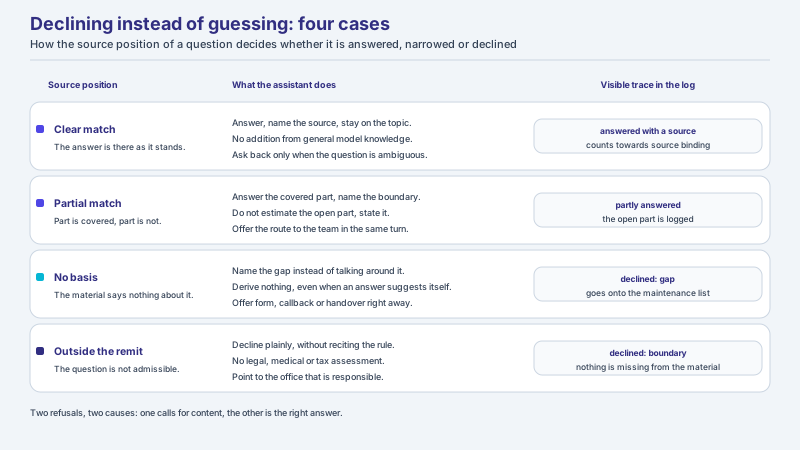
The source reference has a counterpart: where no passage carries the statement, nothing is stated – and nothing is estimated either. An assistant that puts a plausible figure there and simply omits the reference is more troublesome than one with no references at all, because the missing line does not stand out in the flow of answers. So the refusal is written out instead of the reference being silently suppressed.
I cannot give you that information – contact details of this kind are not stored in the excerpts available to me, and I do not invent contact details.
In our own measurement series 8 of 8 questions without a basis were declined instead of guessed; the measurement covered eight questions deliberately placed outside the material, and the wording of every answer is in the measurement file. What such a refusal sounds like without leaving the visitor stranded is described in the article on declining instead of guessing.
Measuring source binding instead of assuming it
Whether an assistant really backs up its answers is not a question of intent but a number. You take a fixed set of questions whose answers are in the material and count how many answers carry a source reference. In our own measurement series 42 of 48 answers carried a source reference; the count covered questions whose answer is in the knowledge base, six carried none. Method and limits are documented under measurement series.
- Use questions with a known passage, otherwise you are measuring the gaps in the material as well.
- Record two things per answer: whether a reference was there and whether it really carries the sentence.
- Look at answers without a reference one by one; six cases can be explained, sixty are a pattern.
- Ask the same questions again after every change to the material, in the same wording.
- Keep the figure separate from the refusal rate, otherwise one covers up the other.
The size of the corpus belongs to the picture. Our own knowledge base holds 2,670 sections from 70 documents; that figure applies to the corpus of the assistant answering on this site. The larger the corpus, the more the cut of the sections matters – a section covering three topics at once produces a source reference that points at all three and supports none of them. How a workable cut comes about is set out in the article on building the knowledge base.
How we go about it
At the start there is not the display in the window but the cut of the material. A source reference can only be as precise as the section it points at. Only afterwards is it settled what the line looks like, where it sits and what happens when two sections carry an answer or none does.
- Cut the material so that one section governs one question and carries a name a visitor understands.
- Record per section whether it can be linked publicly; only then can the reference have a target.
- Settle the form of the line and look at it on a real phone, not on a wide screen.
- Write the rules for multiple matches and for contradictions before the first contradiction turns up.
- Define fixed questions with known passages and count source binding before go-live.
- After four weeks, review the references from disputed answers and maintain the sections they name first.
What comes out of this is not a decorative strip below the answer but a route back: from the sentence in the window to the section that carries it. If you have an assistant whose answers are correct but that nobody can check, we will look at your material via contact and we will also say when the cut already works. How the corpus can be changed afterwards while the assistant keeps running is set out in the article on updating without downtime.
Frequent questions
Does every answer really have to carry a source reference?
No. A greeting, a clarifying question and the note about handing over to a person need none. Evidence is required for statements a visitor will act on: deadlines, availability, responsibilities, technical details, conditions. You draw that line once and write it into the system instruction instead of judging it case by case.
Does a source reference in a chat not look technical and cumbersome?
It does when it looks like a footnote from an academic paper. In practice a short, restrained line with the name of the section is enough, the way a member of staff would name it on the phone. If you cannot find that name again on your own website, the problem is not too much technology in the window but the wrong name.
What if the supporting section is not public at all?
Then the name is given and no target is linked: "Internal price list, section on volume discounts" tells the visitor what the answer rests on without opening the record. That is more honest than a link that leads nowhere, and it helps operations just as much, because the address for later maintenance stays the same.
How does the assistant deal with two contradicting sections?
It does not decide. A contradiction in the material is an open question for the business, and resolving it would be a commitment nobody has checked. The assistant states that two places say different things and offers a handover. For operations this is the most valuable finding of all, because it names a place that would otherwise only surface through a complaint.
Can the assistant invent a source reference?
If the reference is written by the model, yes – then it is part of the text and as inventable as any other sentence. That is why it is not formulated but set: from the sections the retrieval step actually handed over. Whether your own setup works that way is tested with questions whose passage you know, comparing the reference given with the one expected.
How do I measure whether source binding holds?
By two numbers from the same run: the share of answers carrying a source reference, and the share of references that actually cover the sentence. The first number alone can be dressed up with a line under every answer. In our own measurement series 42 of 48 answers carried a source reference; six carried none, and those six are the starting point for the next round.
Ask it yourself, Assistant of this website
Automated assistant