Answering Candidate Questions on Your Careers Page
Salary range, remote work, shift patterns: how an AI assistant on your careers page answers around the clock and takes interview requests. Here is how to start.
In plain language
On a careers page there is often nobody to ask. Many jobs stay open for a long time, and each open question makes this longer. A job ad rarely answers what people really want to know. That is pay, work from home, shifts, degrees and where their application stands. The assistant answers this day and night from your approved texts. It leads to the right job and takes a short application in the chat. The HR team confirms meetings. It is not meant to make offers, give contract details or judge papers.
In many companies the careers page is where the care that goes into every product page runs out. The job ad is online, an email address or a form sits underneath it, and the matter is considered settled. But the candidate reading it on the sofa at half past ten in the evening has questions. What is the salary range? How many days of remote work are realistic? Is there a shift pattern? Will a qualification earned abroad be recognised? And what became of the application sent three weeks ago? If those questions stay open, she drops off, not because the role is unattractive but because nobody was reachable. The labour market leaves little room for losses of that kind: in the fourth quarter of 2025 there were 1.26 million (IAB) job openings across Germany, and registered vacancies took an average of 180 days (Federal Employment Agency) to fill in January 2025. This article shows how an AI assistant on the public careers page answers candidate questions around the clock, guides people to the right role, captures short applications and takes interview requests that the HR team confirms, and where its limits are drawn on purpose.
%3C%2Ftext%3E%3Ccircle%20cx%3D'256'%20cy%3D'186'%20r%3D'4'%20fill%3D'%234f46e5'%2F%3E%3Cpath%20d%3D'M260%2C186%20H290'%20stroke%3D'%234f46e5'%20stroke-width%3D'1.6'%20fill%3D'none'%20marker-end%3D'url(%23xbAr)'%2F%3E%3Crect%20x%3D'290'%20y%3D'120'%20width%3D'160'%20height%3D'132'%20fill%3D'%23312e81'%20rx%3D'14'%2F%3E%3Ctext%20x%3D'370'%20y%3D'144'%20font-family%3D'system-ui%2C%20sans-serif'%20font-size%3D'12'%20fill%3D'%23ffffff'%20font-weight%3D'700'%20text-anchor%3D'middle'%3ERecruiting%20Assistant%3C%2Ftext%3E%3Crect%20x%3D'302'%20y%3D'156'%20width%3D'136'%20height%3D'22'%20fill%3D'%234f46e5'%20rx%3D'6'%2F%3E%3Ctext%20x%3D'370'%20y%3D'170'%20font-family%3D'system-ui%2C%20sans-serif'%20font-size%3D'8.5'%20fill%3D'%23ffffff'%20text-anchor%3D'middle'%3EJob%20postings%3C%2Ftext%3E%3Crect%20x%3D'302'%20y%3D'182'%20width%3D'136'%20height%3D'22'%20fill%3D'%234f46e5'%20rx%3D'6'%2F%3E%3Ctext%20x%3D'370'%20y%3D'196'%20font-family%3D'system-ui%2C%20sans-serif'%20font-size%3D'8.5'%20fill%3D'%23ffffff'%20text-anchor%3D'middle'%3EBenefits%20and%20terms%3C%2Ftext%3E%3Crect%20x%3D'302'%20y%3D'208'%20width%3D'136'%20height%3D'22'%20fill%3D'%234f46e5'%20rx%3D'6'%2F%3E%3Ctext%20x%3D'370'%20y%3D'222'%20font-family%3D'system-ui%2C%20sans-serif'%20font-size%3D'8.5'%20fill%3D'%23ffffff'%20text-anchor%3D'middle'%3Einternal%20HR%20knowledge%3C%2Ftext%3E%3Ctext%20x%3D'370'%20y%3D'240'%20font-family%3D'system-ui%2C%20sans-serif'%20font-size%3D'8'%20fill%3D'%23a5b4fc'%20text-anchor%3D'middle'%3Etrained%20on%20your%20sources%3C%2Ftext%3E%3Ccircle%20cx%3D'450'%20cy%3D'186'%20r%3D'4'%20fill%3D'%23a5b4fc'%2F%3E%3Cpath%20d%3D'M454%2C186%20H472%20V93%20H490'%20stroke%3D'%234f46e5'%20stroke-width%3D'1.6'%20fill%3D'none'%20marker-end%3D'url(%23xbAr)'%2F%3E%3Cpath%20d%3D'M454%2C186%20H472%20V165%20H490'%20stroke%3D'%234f46e5'%20stroke-width%3D'1.6'%20fill%3D'none'%20marker-end%3D'url(%23xbAr)'%2F%3E%3Cpath%20d%3D'M454%2C186%20H472%20V237%20H490'%20stroke%3D'%234f46e5'%20stroke-width%3D'1.6'%20fill%3D'none'%20marker-end%3D'url(%23xbAr)'%2F%3E%3Cpath%20d%3D'M454%2C186%20H472%20V318%20H490'%20stroke%3D'%23818cf8'%20stroke-width%3D'1.4'%20stroke-dasharray%3D'4%203'%20fill%3D'none'%20marker-end%3D'url(%23xbAr)'%2F%3E%3Crect%20x%3D'490'%20y%3D'62'%20width%3D'282'%20height%3D'62'%20fill%3D'%23ffffff'%20rx%3D'10'%20stroke%3D'%23c7d2fe'%20stroke-width%3D'1.2'%2F%3E%3Crect%20x%3D'502'%20y%3D'78'%20width%3D'30'%20height%3D'30'%20fill%3D'%23c7d2fe'%20rx%3D'8'%2F%3E%3Ctext%20x%3D'517'%20y%3D'97.7'%20font-family%3D'system-ui%2C%20sans-serif'%20font-size%3D'13'%20fill%3D'%233730a3'%20font-weight%3D'700'%20text-anchor%3D'middle'%3E%3F%3C%2Ftext%3E%3Ctext%20x%3D'544'%20y%3D'87'%20font-family%3D'system-ui%2C%20sans-serif'%20font-size%3D'11'%20fill%3D'%23312e81'%20font-weight%3D'600'%3EAnswer%20from%20the%20knowledge%20base%3C%2Ftext%3E%3Ctext%20x%3D'544'%20y%3D'103'%20font-family%3D'system-ui%2C%20sans-serif'%20font-size%3D'8.5'%20fill%3D'%23475569'%3Esourced%20from%20job%20ad%20and%20benefits%3C%2Ftext%3E%3Crect%20x%3D'490'%20y%3D'134'%20width%3D'282'%20height%3D'62'%20fill%3D'%23ffffff'%20rx%3D'10'%20stroke%3D'%23c7d2fe'%20stroke-width%3D'1.2'%2F%3E%3Crect%20x%3D'502'%20y%3D'150'%20width%3D'30'%20height%3D'30'%20fill%3D'%23c7d2fe'%20rx%3D'8'%2F%3E%3Ctext%20x%3D'517'%20y%3D'169.7'%20font-family%3D'system-ui%2C%20sans-serif'%20font-size%3D'13'%20fill%3D'%233730a3'%20font-weight%3D'700'%20text-anchor%3D'middle'%3E%2B%3C%2Ftext%3E%3Ctext%20x%3D'544'%20y%3D'159'%20font-family%3D'system-ui%2C%20sans-serif'%20font-size%3D'11'%20fill%3D'%23312e81'%20font-weight%3D'600'%3EShort%20application%20in%20the%20chat%3C%2Ftext%3E%3Ctext%20x%3D'544'%20y%3D'175'%20font-family%3D'system-ui%2C%20sans-serif'%20font-size%3D'8.5'%20fill%3D'%23475569'%3Ename%2C%20contact%2C%20role%2C%20availability%3C%2Ftext%3E%3Crect%20x%3D'490'%20y%3D'206'%20width%3D'282'%20height%3D'62'%20fill%3D'%23ffffff'%20rx%3D'10'%20stroke%3D'%23c7d2fe'%20stroke-width%3D'1.2'%2F%3E%3Crect%20x%3D'502'%20y%3D'222'%20width%3D'30'%20height%3D'30'%20fill%3D'%23c7d2fe'%20rx%3D'8'%2F%3E%3Cpath%20d%3D'M511%20237%20l4%204%20l8%20-9'%20fill%3D'none'%20stroke%3D'%233730a3'%20stroke-width%3D'2.4'%20stroke-linecap%3D'round'%20stroke-linejoin%3D'round'%2F%3E%3Ctext%20x%3D'544'%20y%3D'231'%20font-family%3D'system-ui%2C%20sans-serif'%20font-size%3D'11'%20fill%3D'%23312e81'%20font-weight%3D'600'%3EInterview%20slot%20requested%3C%2Ftext%3E%3Ctext%20x%3D'544'%20y%3D'247'%20font-family%3D'system-ui%2C%20sans-serif'%20font-size%3D'8.5'%20fill%3D'%23475569'%3Efree%20times%20from%20the%20HR%20team%3C%2Ftext%3E%3Crect%20x%3D'490'%20y%3D'274'%20width%3D'282'%20height%3D'88'%20fill%3D'%23312e81'%20rx%3D'10'%2F%3E%3Ctext%20x%3D'502'%20y%3D'296'%20font-family%3D'system-ui%2C%20sans-serif'%20font-size%3D'11'%20fill%3D'%23ffffff'%20font-weight%3D'700'%3EWhat%20the%20assistant%20does%20not%20answer%3C%2Ftext%3E%3Crect%20x%3D'502'%20y%3D'306'%20width%3D'72'%20height%3D'20'%20fill%3D'%234f46e5'%20rx%3D'6'%2F%3E%3Ctext%20x%3D'510'%20y%3D'319'%20font-family%3D'system-ui%2C%20sans-serif'%20font-size%3D'8.5'%20fill%3D'%23ffffff'%3ECommitments%3C%2Ftext%3E%3Crect%20x%3D'582'%20y%3D'306'%20width%3D'98'%20height%3D'20'%20fill%3D'%234f46e5'%20rx%3D'6'%2F%3E%3Ctext%20x%3D'590'%20y%3D'319'%20font-family%3D'system-ui%2C%20sans-serif'%20font-size%3D'8.5'%20fill%3D'%23ffffff'%3EContract%20details%3C%2Ftext%3E%3Crect%20x%3D'502'%20y%3D'332'%20width%3D'103'%20height%3D'20'%20fill%3D'%234f46e5'%20rx%3D'6'%2F%3E%3Ctext%20x%3D'510'%20y%3D'345'%20font-family%3D'system-ui%2C%20sans-serif'%20font-size%3D'8.5'%20fill%3D'%23ffffff'%3EJudging%20documents%3C%2Ftext%3E%3Ctext%20x%3D'760'%20y%3D'345'%20font-family%3D'system-ui%2C%20sans-serif'%20font-size%3D'8'%20fill%3D'%23a5b4fc'%20text-anchor%3D'end'%3Egoes%20to%20the%20HR%20team%3C%2Ftext%3E%3Crect%20x%3D'24'%20y%3D'366'%20width%3D'748'%20height%3D'62'%20fill%3D'%23ffffff'%20rx%3D'12'%20stroke%3D'%23c7d2fe'%20stroke-width%3D'1.2'%2F%3E%3Ctext%20x%3D'40'%20y%3D'390'%20font-family%3D'system-ui%2C%20sans-serif'%20font-size%3D'9.5'%20fill%3D'%23312e81'%20font-weight%3D'600'%3EWhen%20the%20questions%20come%20in%3C%2Ftext%3E%3Ctext%20x%3D'40'%20y%3D'404'%20font-family%3D'system-ui%2C%20sans-serif'%20font-size%3D'8'%20fill%3D'%2364748b'%3Eillustrative%20course%20of%20a%20day%3C%2Ftext%3E%3Crect%20x%3D'210'%20y%3D'408'%20width%3D'24'%20height%3D'6'%20fill%3D'%234f46e5'%20rx%3D'2'%2F%3E%3Crect%20x%3D'246'%20y%3D'409'%20width%3D'24'%20height%3D'5'%20fill%3D'%234f46e5'%20rx%3D'2'%2F%3E%3Crect%20x%3D'282'%20y%3D'407'%20width%3D'24'%20height%3D'7'%20fill%3D'%234f46e5'%20rx%3D'2'%2F%3E%3Crect%20x%3D'318'%20y%3D'402'%20width%3D'24'%20height%3D'12'%20fill%3D'%234f46e5'%20rx%3D'2'%2F%3E%3Crect%20x%3D'354'%20y%3D'392'%20width%3D'24'%20height%3D'22'%20fill%3D'%23c7d2fe'%20rx%3D'2'%2F%3E%3Crect%20x%3D'390'%20y%3D'386'%20width%3D'24'%20height%3D'28'%20fill%3D'%23c7d2fe'%20rx%3D'2'%2F%3E%3Crect%20x%3D'426'%20y%3D'388'%20width%3D'24'%20height%3D'26'%20fill%3D'%23c7d2fe'%20rx%3D'2'%2F%3E%3Crect%20x%3D'462'%20y%3D'390'%20width%3D'24'%20height%3D'24'%20fill%3D'%23c7d2fe'%20rx%3D'2'%2F%3E%3Crect%20x%3D'498'%20y%3D'394'%20width%3D'24'%20height%3D'20'%20fill%3D'%23c7d2fe'%20rx%3D'2'%2F%3E%3Crect%20x%3D'534'%20y%3D'388'%20width%3D'24'%20height%3D'26'%20fill%3D'%234f46e5'%20rx%3D'2'%2F%3E%3Crect%20x%3D'570'%20y%3D'384'%20width%3D'24'%20height%3D'30'%20fill%3D'%234f46e5'%20rx%3D'2'%2F%3E%3Crect%20x%3D'606'%20y%3D'396'%20width%3D'24'%20height%3D'18'%20fill%3D'%234f46e5'%20rx%3D'2'%2F%3E%3Cline%20x1%3D'204'%20y1%3D'415'%20x2%3D'642'%20y2%3D'415'%20stroke%3D'%23c7d2fe'%20stroke-width%3D'1.2'%2F%3E%3Crect%20x%3D'656'%20y%3D'382'%20width%3D'10'%20height%3D'10'%20fill%3D'%23c7d2fe'%20rx%3D'2'%2F%3E%3Ctext%20x%3D'672'%20y%3D'390.6'%20font-family%3D'system-ui%2C%20sans-serif'%20font-size%3D'8'%20fill%3D'%23475569'%3EOffice%20hours%3C%2Ftext%3E%3Crect%20x%3D'656'%20y%3D'400'%20width%3D'10'%20height%3D'10'%20fill%3D'%234f46e5'%20rx%3D'2'%2F%3E%3Ctext%20x%3D'672'%20y%3D'408.6'%20font-family%3D'system-ui%2C%20sans-serif'%20font-size%3D'8'%20fill%3D'%23475569'%3Eevenings%20and%20nights%3C%2Ftext%3E%3C%2Fsvg%3E)
Labels in the illustration
- Questions on the careers page
- What is the salary range?
- How much remote work is possible?
- Which shift model applies here?
- Is my foreign degree recognised?
- Where does my application stand?
- asked in the evening and at weekends
- 180
- days average
- vacancy time for listed jobs
- (Federal Employment Agency)
- Recruiting Assistant
- Job postings
- Benefits and terms
- internal HR knowledge
- trained on your sources
- ?
- Answer from the knowledge base
- sourced from job ad and benefits
- +
- Short application in the chat
- name, contact, role, availability
- Interview slot requested
- free times from the HR team
- What the assistant does not answer
- Commitments
- Contract details
- Judging documents
- goes to the HR team
- When the questions come in
- illustrative course of a day
- Office hours
- evenings and nights
The careers page as a blind spot
Companies invest heavily in product pages, landing pages and contact channels for customers. The careers page runs alongside: a list of open roles, a PDF, an email address. Yet in many professions the competition for candidates is fiercer than the competition for customers. In the fourth quarter of 2025 there were 1.26 million (IAB) job openings across Germany, around 80 percent (IAB) of which needed filling immediately, meaning they were already vacant. In the first quarter of 2025 the vacancy rate stood at 2.6 percent (IAB). For comparison: in the fourth quarter of 2022 there were still around 2 million (IAB) openings. So the market is calmer than at its peak, but filling roles still takes time: registered vacancies stayed open for an average of 180 days (Federal Employment Agency) in January 2025. Every week a role stays open costs contribution margin, overtime and the team's patience.
The second reason for the blind spot is reading behaviour. 79 percent (Nielsen Norman Group 1997) of users scan each new page, only 16 percent (Nielsen Norman Group 1997) read word by word, and on an average page at most 28 percent (Nielsen Norman Group 2008) of the words are actually read. A job ad that carries all the answers somewhere in its body copy therefore answers very little. The question left in the candidate's head goes unasked, because there is no channel for it, least of all at half past ten in the evening. That is exactly the gap an assistant on the careers page closes. It should not be confused with the internal AI assistant for employees, which distributes knowledge inwards; this is about external candidates who have not applied yet.
The questions that actually get asked
Reading chat logs from careers pages turns up surprisingly few surprises and a great deal of repetition. Before applying, candidates want to know whether the effort is worth it. So they ask about the hard parameters, not about company culture. And they ask when they have time: after work, at the weekend, during a lunch break. The following topics come up regularly in careers page projects.
- Salary range: a band, a pay grade or at least a statement of what the grading depends on
- Working hours and remote work: how many days on site are expected and whether there are fixed core hours
- Shift pattern: which shifts exist, how long the rotation runs and how weekends are handled
- Recognition of foreign qualifications: which documents are needed and who supports the process
- Language level: which level of German or English the role genuinely requires
- Process and duration: how many conversations are planned, whether a trial day is involved and when feedback arrives
- Application status: what became of the application sent three weeks ago
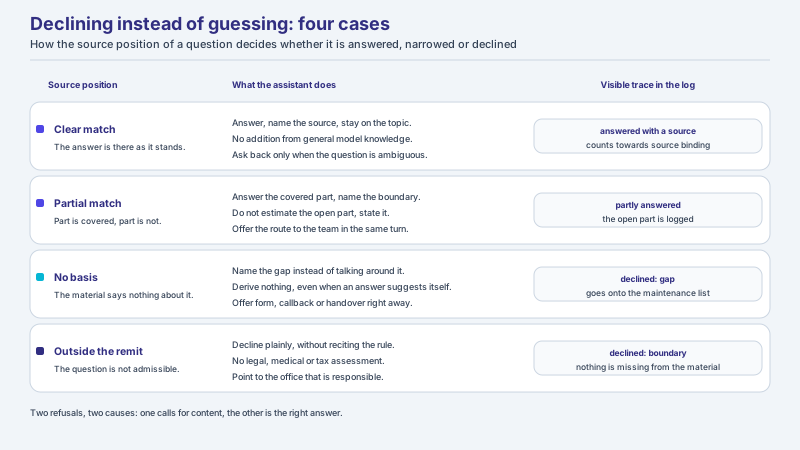
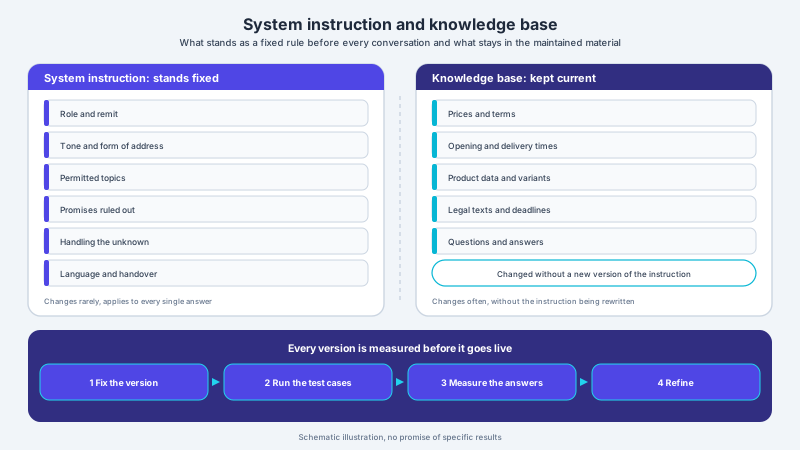
These questions can be answered without a person stepping in, provided the answers sit cleanly and up to date in a maintained source. That is precisely why the knowledge base is the foundation: the assistant is instructed to answer from cleared entries, and sourced answers name their reference. Which content belongs in it and how it should be cut is covered in building a knowledge base for AI chat. For the HR team that means something concrete: what the assistant is allowed to say is decided by an approval, not by chance.
-
Answers around the clock
Questions arise in the evening and at weekends. The assistant answers at the exact moment they come up, rather than on the next working day.
-
Guiding to the right role
Two or three follow-up questions on tasks, location and availability are typically enough to name the right posting.
-
Short application in the chat
Name, contact, preferred role and earliest start date are captured in conversation instead of in a long form full of mandatory fields.
-
Requesting a slot directly
Open HR slots appear in the chat, and the chosen one is held until HR confirms.
-
Application status
Once a person is reliably identified, the assistant names the processing status and the next step without revealing internal details.
-
Limits and data protection
Commitments, contract questions and the assessment of documents are meant to stay with the team, and candidate data is subject to fixed deletion periods.
From interest to the right role
Many careers pages list roles alphabetically or by department. For candidates who do not know the internal structure, that is a search task. An assistant reverses the direction: instead of asking the visitor to filter, it asks two or three short follow-up questions and then suggests one or two postings that genuinely fit. It is the same mechanism that works in product advice, only with a different goal: what stands at the end is not an order but an application that matches the role, which means less effort on both sides.
- Entry: the assistant asks about the field of work or the qualification, not about a job reference number
- Narrowing down: location, preferred hours and earliest start date already rule out most postings
- Suggestion: one or two matching roles, each with a sentence on the task and a link to the full ad
- Clarification: open questions on salary range, working hours or onboarding, answered from the knowledge base
- Short application: name, contact, preferred role, availability and optionally a document are captured in the conversation
- Handover: the case reaches the HR team in structured form, by email or directly in the applicant tracking system
The reason a short application in the chat reaches more candidates than the form next to it is friction. In retail an average checkout still contains around 11.3 form fields (Baymard Institute 2024); roughly 22 percent (Baymard Institute) of online shoppers have abandoned an order because the process felt too long or too complicated, and better input design lifts completion rates at large shops by an average of around 35 percent (Baymard Institute 2016). An application form with a CV upload, mandatory fields and an account to create is no different. How the same effect plays out in customer acquisition is described in qualifying leads via chat instead of a long form; the technology behind it is the lead assistant, which passes on the captured details in structured form. That the same route also carries complex enquiries is shown in the article on B2B quote requests in the chat.
The short application is the real lever
Most candidates do not fail at the role, they fail on the way to it. Someone interested at half past ten in the evening rarely fills in a twenty-field form and uploads three documents. A short application with four details, meaning name, contact, preferred role and earliest start date, lowers the barrier to something that takes two minutes in a chat. Documents can be submitted afterwards at leisure, and the HR team decides whether they are needed at all. What matters is that contact happens while the interest is still there.
Request the interview slot straight in the chat
The second big point of friction sits behind the application: scheduling. Three emails back and forth, plus a candidate who works during the day and cannot take calls freely, and days pass in which another company moves first. A booking assistant instead offers open slots from the stored appointment types and records the chosen one as a request once the candidate has agreed in the chat. For the HR team the workflow barely changes: they maintain their calendar as before and confirm the request in their overview; a binding direct entry happens only through a set-up calendar integration (Custom package).
To work reliably, the assistant needs more than read access, it needs permission to carry out an action. How an assistant drives systems instead of merely producing text is explained in AI assistants controlling your tools; the scheduling mechanics in detail are covered in appointment requests via a chat assistant, and the matching service is the booking assistant. The effect on time to hire cannot be quantified across the board, as it depends on the sector, the role and the team. What holds up is the observation that the stretch between first interest and first conversation is where candidates are lost most often.
| Aspect | Careers page without an assistant | Careers page with an assistant |
|---|---|---|
| Evening questions | Stay open until the next working day | Are answered from cleared sources |
| Choosing a role | The candidate filters through the list alone | Two or three follow-up questions lead to the right role |
| Application | A long form with mandatory fields and an upload | A short application in conversation, documents later |
| Scheduling | Several emails spread over days | An open slot is held straight away |
| Application status | A phone call or email is needed | An answer in the chat, once the person is reliably identified |
| Insights | Drop-offs stay invisible | Recurring questions reveal gaps in the job ad |
What the assistant deliberately does not answer
A recruiting assistant that is allowed too much does more damage than one that can do too little. A salary commitment made in a chat, a statement about an application's prospects or an opinion on submitted documents is not a service, it is a risk: it creates expectations the company is later expected to meet, and it pre-empts a decision that people make. Clear blocks therefore belong in the setup. The assistant states the framework and the process, but it is not meant to negotiate, assess or promise anything. A limit applies to the application status too: it is meant to name the processing status only once the person is reliably identified, and to confine itself to the next step rather than internal opinions.
An assistant that commits to a salary in a chat has not recruited faster, it has run a negotiation it had no mandate to run. That limit belongs in the concept, not in the clean-up afterwards.
Technically, this restraint rests on the assistant being instructed to answer exclusively from cleared sources and to pass on anything uncertain instead of phrasing whatever sounds plausible. How to secure that is described in preventing hallucinations with a clean knowledge base. When a conversation reaches the limit, an orderly handover to a human colleague is the decisive step. That also matches what users expect: 62 percent (Bitkom) want to reach a quickly available human contact when there is a problem, while a chatbot is preferred by only 36 percent (Bitkom). In recruiting this weighs double, because a person's professional future is at stake.
Equal treatment and non-discriminatory wording
An assistant in the hiring process speaks on behalf of the employer. Its wording is therefore held to the same standard as the job ad. Under section 1 (AGG) the German General Equal Treatment Act prohibits disadvantage on grounds of race or ethnic origin, gender, religion or belief, disability, age and sexual identity, and section 11 (AGG) expressly requires that a job advertisement must not breach the prohibition of disadvantage in section 7(1) (AGG). For the assistant that means three concrete rules: no follow-up questions about age, marital status, pregnancy, religion or origin; no wording that addresses one group while excluding another; and the same depth of information for every candidate.
In practice, equal treatment also means equal treatment of information. An assistant that gives one person the salary range and evades the question for another creates exactly the unequal treatment it is meant to avoid. Answers to sensitive framework questions are therefore stored fixed rather than left to the flow of the conversation. Personalisation has a different place here than in a logged-in area, where the assistant knows the orders and contracts of a known person; how that works there is shown in the article on personalised answers in the customer area. On a public careers page the opposite applies: everyone gets the same information, regardless of how the question was phrased.
Candidate data, deletion periods and hosting
As soon as the assistant captures a name, contact details and a preferred role, it processes candidate data. The same obligations apply as in the rest of the hiring process. Processing rests on Article 6(1)(b) (GDPR) for steps prior to entering an employment relationship, the information on purpose, recipients and storage period follows from Article 13 (GDPR), and the storage limitation in Article 5(1)(e) (GDPR) requires that data is not kept longer than necessary. In practice this leads to the widespread period of around six months after the process ends: claims under equal treatment law must be asserted in writing within two months (AGG), the subsequent limitation period for filing suit is three months (ArbGG), plus a short safety margin. Anyone wanting to move candidates into a talent pool needs separate consent for that.
- Purpose limitation: chat content from the hiring context is processed and analysed separately from customer enquiries
- Data minimisation: the assistant is meant to ask only for what the next step requires, no identity document numbers, no health data
- Transparency: at the start of the conversation it is clear that an assistant is answering and where the details go
- Deletion periods: short applications and the associated chat logs expire automatically once the defined period has passed
- Roles and rights: only the HR team sees candidate data, and the analysis of conversations runs in aggregate
- Hosting: storage in Germany, with a data processing agreement and documented deletion runs; the answers are generated by a specialised model provider, also outside the EU on the basis of standard contractual clauses
How to implement this technically and contractually is explored in the article on GDPR-compliant AI assistants; the framework for operation and storage location is described on the data protection and hosting page. For employee representation it also matters that the analysis of chat logs serves to improve ads and answers, not to evaluate individual employees. An explicit assurance to that effect belongs in the rollout, as does a decision on who reviews the logs and at what interval.
Chat logs show where the job ad is unclear
The underrated benefit lies not in the chat itself but in the analysis afterwards. When twenty candidates ask about the shift pattern in a single week, it is missing from the ad. When the question about the salary range breaks off at the same point every time, the answer there is too vague. When a posting triggers many conversations but produces few short applications, something between expectation and description does not add up. Without an assistant these patterns are invisible, because an unanswered question leaves no record. With one, they become the to-do list for the next revision of the job texts.
The route there runs through conversation analytics, which summarises topics, drop-off points and gaps; how to derive concrete improvements from that is shown in analysing and improving chats. The occasion is not theoretical: 41 percent (Bitkom) of companies with 20 or more employees now use artificial intelligence, up from 17 percent (Bitkom) the year before, and a further 48 percent (Bitkom) are planning or discussing it. Dialogue with customers and candidates is one of the areas where an assistant becomes visible first. In the IW future panel, 84.5 percent (German Economic Institute Cologne) of the companies that use or plan to use AI name relief from routine work as the goal, while 37.0 percent (German Economic Institute Cologne) of the companies surveyed use AI at all. HR is among the areas with the highest share of recurring questions and is therefore an obvious starting point.
A few steps to an assistant on your careers page
Getting started is smaller than it sounds. It begins with a stocktake: which roles are open, which questions arrive today by email and phone, what is already in the ad and what is missing? Out of that comes the first version of the knowledge base, usually from job ads, the benefits page and a short collection of answers from the HR team. After that the limits and handover routes are defined, the assistant is embedded on the careers page with a short snippet and signed off with test cases. Two to three weeks later the first analyses show which ad needs sharpening. How a question about meeting in person becomes an appointment request that only counts once you confirm it is shown by the booking assistant.
- Compile open roles, benefits and the steps of the process as cleared sources
- Collect the ten most common candidate questions and define one solid answer for each
- Define the block list: commitments, contract details and the assessment of documents stay with the team
- Store the HR team's appointment types and define which slots can be requested
- Put deletion periods for short applications and chat logs down in writing
- Run test cases with inadmissible questions and review the answers before go-live
Frequent questions
Which questions does an AI assistant answer on a careers page?
It answers the framework questions candidates want cleared up before applying: salary range or pay grade, working hours and share of remote work, shift pattern and weekend arrangements, the language level required, the recognition of foreign qualifications and the steps and duration of the process. The basis is exclusively cleared sources: the current job ads, the benefits page and a short collection of answers from the HR team. Sourced answers point to their reference, so it can be checked where they came from. Anything not stored there is usually not answered by the assistant but passed on to a person.
May the assistant give information about the status of an application?
Yes, but under two conditions. First, the person must be reliably identified, for example via a case number from the acknowledgement of receipt; without that identification the assistant gives no information. Second, the information is limited to the processing status and the next step, such as the documents now being with the specialist department and feedback arriving by a certain date. Internal opinions, assessments of documents or statements about prospects of success are expressly not part of it. As soon as a question goes beyond that, the assistant hands over to the HR team.
How do you prevent the assistant from asking inadmissible questions?
Through a fixed block list and test cases. The block list contains the characteristics protected by equal treatment law, meaning age, gender, origin, religion, disability and sexual identity, plus family planning and health. The assistant neither asks about these points nor processes them if a person mentions them unprompted. The wording is reviewed as well: references to a young team or to native speakers are replaced by factual details, such as the language level actually required. Before go-live, exactly those questions are asked as test cases and the answers are signed off.
Can the assistant book interview slots bindingly?
It enters an appointment directly and bindingly in the calendar only through a set-up calendar integration (Custom package). By default the assistant takes appointment requests: it names open slots from the stored appointment types, subtracts appointments already requested or confirmed and holds the chosen slot as a request once the candidate has agreed in the chat; the HR team confirms it. Which slots are offered at all is up to you, for example only Tuesday and Thursday afternoons or only with 48 hours' notice. Once the HR team confirms, the candidate receives a confirmation email, provided they gave an email address. This saves the usual chain of three to five emails.
How long is candidate data from the chat stored?
As long as the process requires and not a day longer. A period of around six months after the process ends is widespread: claims under equal treatment law must be asserted in writing within two months, the subsequent limitation period for filing suit is three months, plus a short safety margin. Short applications and the associated chat logs then expire automatically, documented through a deletion run. If an application is to move into a talent pool, separate consent is required. Storage takes place in Germany, secured by a data processing agreement; the answers in the chat are generated by a specialised model provider, also outside the EU on the basis of standard contractual clauses.
What separates the recruiting assistant from the internal assistant for employees?
The audience, the sources and the rights. The internal assistant talks to employees, knows price lists, work instructions and HR rules and works with role filters so that each person sees only what has been cleared for them. The recruiting assistant talks to external candidates on a public page and knows only what may go outside anyway: job ads, benefits and the steps of the process. It has no access to internal documents, no role logic by department and a considerably narrower mandate, because every statement in a hiring context carries legal weight.
Ask it yourself, Assistant of this website
Automated assistant