B2B Price Requests in Chat: Quote Instead of Cart
Business buyers want volume tiers, lead times and a written quote. How an AI chat assistant turns a price question into a complete quote request for sales.
In plain language
Firms often do not buy through the cart. They want a quote. So the assistant asks for the key facts. These are amount, type, date, address and way to pay. Stock and delivery time come from your system in the Custom package. Only the written quote gives the exact price. Firms and private customers take separate ways in the chat. At the end, your sales team has a full request.
In consumer business the purchase path ends at the checkout: item into the cart, pay, done. In business-to-business it rarely ends there. Anyone who needs 250 metres of hose, forty workstations or a pallet of consumables does not want a cart but a volume tier, a reliable lead time, payment on invoice and a written quote with a date and a named contact. This is exactly where the path breaks down in many shops: the prospect finds no field for the quantity, not a word about volume pricing and, at the very end, a contact form with three lines. Yet 67 percent (Gartner) of business buyers now prefer a purchase experience that works without sales contact. That requires them to get the information they need without having to ask. This article shows how an AI chat assistant leads from the first price question to a complete quote request, what it has to capture along the way, how it talks about prices without committing, and how the request reaches the right field sales rep.

Labels in the illustration
- Price request in chat
- Private customer
- Business customer
- Advice in the shop
- Quantity and variant
- Listed price applies
- Tier and delivery date
- Order directly
- Request a quote
- Friday, 19:12, sales team off duty
- The assistant records quantity, variant
- and target date and files the request.
- By Monday 8 a.m. it is with sales.
- Quote request A-2481
- created in chat
- Item
- Industrial hose DN 25
- Version
- EPDM, 10 bar, blue
- Quantity
- 250 metres
- Price tier
- from 200 m, tier 3
- Availability
- 180 m in stock, rest 12 days
- Payment
- Invoice, net 30 days
- Account
- Business, customer no. 40218
- Handed to field sales North
- Conversation summary attached
- Everything sales usually chases by phone is already in the request
Why a B2B request does not fit into the cart
A cart is built for a clearly defined item at a clearly displayed price. A business request rarely is. It starts with a quantity that triggers discount tiers, moves through variants that have to fit together technically, and ends with a lead time that has to match a construction date. Buyers themselves confirm how demanding this stretch is: 77 percent (Gartner) describe their last business purchase as very complex or difficult, and the main reason they name is pulling together information from several sources and several people. The shop typically supplies only one part of that, namely the item. Everything else, meaning tiers, availability, conditions and dates, sits in the ERP system, in the pricing system or in a colleague's head. The familiar consumer route of guided selling with suggestions and product cards, as described in the article on the product finder in chat, ends exactly where the business request begins.
At the same time the decision process largely runs without sales involvement. Business buyers spend only around 17 percent (Gartner) of their total buying time in direct contact with potential suppliers, while roughly 27 percent (Gartner) goes into independent online research. When they compare several suppliers, only five to six percent (Gartner) of that time remains per supplier. Add to that the number of touchpoints: business customers now use ten channels (McKinsey 2024) on average during their buying journey, twice as many as the five (McKinsey) they used in 2016. Anyone who fails to give reliable information during those few minutes of self-service is filtered out of the shortlist before a human is ever involved.
What the assistant has to capture in the conversation
The difference between a usable and an unusable request is not a question of length but of completeness. A sales rep who receives a request with item, quantity, variant and requested date writes the quote the same day. If two of those details are missing, the follow-up loop begins: an email, a callback, a second callback, and one day becomes four. The assistant knows the fields your sales team needs and clarifies them in conversation without it feeling like a form. That large volumes are involved has long been normal: in the 2024 survey 73 percent (McKinsey) of business buyers were willing to spend more than 50,000 dollars per order through digital self-service or remote channels, up from 59 percent (McKinsey) in 2022, and 39 percent (McKinsey 2024) named more than 500,000 dollars that way.
- Application and occasion: what the item is needed for and whether a tender or a project sits behind it
- Quantity and unit: pieces, metres or pallets, plus the question of a one-off purchase or call-offs over several months
- Variant and specification: material, dimensions, pressure rating, colour, standard or required certificate
- Accessories and additional services: what belongs to the item technically so the line can be costed in full
- Requested date and delivery address: construction site, warehouse or branch, ideally with a delivery time window
- Payment method: prepayment, invoice or direct debit, for new customers with a note on the credit check
- Contact person and customer number: who decides, who orders and where the quote should go
That is more than a classic contact form asks for, and still less tiring, because the assistant only clarifies what is actually still missing in each case. Someone who gives a customer number is not asked for a delivery address. Someone who names a standard is offered the matching variants straight away instead of a list of every version. This logic separates the quote path from general pre-qualification as performed by the lead assistant for service enquiries and as described in the article on qualifying leads via chat: there it is about need and urgency, here it is about line items, quantities and dates.
-
Capture quantity cleanly
Pieces, metres or pallets: the assistant asks for the unit as well and recognises which quantity triggers which tier.
-
Clarify variants
Material, dimensions, pressure rating: technical questions run in conversation instead of in a dropdown with forty entries.
-
State availability
Stock levels and lead times come from the connected ERP system, including a note on possible partial deliveries.
-
Explain the tiers
The assistant shows which quantity triggers which price tier without committing to a final price.
-
Produce the request
The conversation turns into a complete record with every field sales needs in order to write the quote.
-
Route it correctly
Region, product group and customer status decide which field sales rep the request lands with.
Availability, lead times and prices from the system
A quote request is only as good as the data flowing into it. That is why the ERP connection is the real lever: the assistant reads stock levels, replenishment times, minimum order quantities and the stored price framework instead of making general statements. "Usually available at short notice" becomes "180 metres from stock, the remainder in about twelve working days". That precision is the difference between a conversation that builds trust and one that sends the prospect to the phone after all. That digital channels have arrived in business-to-business shows in the revenue mix: at suppliers with their own online channel, around 34 percent (McKinsey 2024) of revenue now comes from it, which pushed in-person selling off the top spot for the second year running.
- State the listed price where one exists, with its date and a note that the figures are net
- With volume tiers, name the tier that matches the stated quantity instead of calculating a final price
- With customer-specific conditions, point to the stored price sheet, visible only after signing in
- With special versions, be open that the price has to be calculated and name the timeframe for it
- Mention additional costs early: freight, packaging, small-order surcharge, so the range does not grow later
- Make clear that the binding price appears in the written quote from the sales team
This restraint is not a detour but legally required and practically sensible: a price statement in chat can be read as a binding declaration if it is phrased without reservation. The assistant therefore works with ranges, tiers and validity notes. Behind it technically sits tool control connected to the ERP system, the pricing system and the CRM (Custom package); how an assistant reads systems and triggers actions is described in the article on an AI assistant controlling your own tools. That buyers now also gather information on vendors and products with AI tools of their own is shown by a recent survey: 45 percent (Gartner) of the business buyers surveyed used AI during a recent purchase.
A price range is not a commitment
The assistant may say a lot in the chat, but it should not promise anything. A volume tier, a range and a note about freight and small-order surcharges give the prospect the orientation needed for a shortlist. The price you can rely on is set by the sales team in the written quote. This separation protects both sides: the supplier from a statement it later has to honour, and the prospect from a figure that suddenly looks different in the quote.
Private or business: two paths in the same chat
Many shops serve both groups through the same interface, and in the chat they meet anyway. The assistant sets the switch early without turning it into an interrogation: it asks in passing whether the order is for a company and picks up signals such as quantities in pallets, questions about net prices, a company name in the greeting or a customer number that is mentioned. After that the path changes noticeably: the private route leads to advice, a listed price and an order, the business route to quantity, variant, date and quote. That both routes are needed side by side shows in the channel split in business-to-business: at every point of the buying journey, about one third (McKinsey 2021) of customers each use in-person contact, remote contact or digital self-service.
More delicate than the switch itself are the conditions behind it. Customer-specific prices do not belong in an anonymous conversation: a prospect who guesses a competitor's customer number must not get to see that competitor's price sheet. The assistant therefore only shows individual conditions once the user is signed in to their customer account, and otherwise relies on publicly listed prices and tiers. How an assistant answers with personalisation in the signed-in area without giving data away is explored in the article on the AI assistant in the customer account. The quote path differs from the familiar route with product cards and a cart in chat at one clear point: it does not end with a purchase but with a record that a human continues to work on.
| Aspect | Private customer in chat | Business customer in chat |
|---|---|---|
| Goal of the conversation | Find the right item and order it | Produce a complete quote request |
| Quantity | Usually one unit, rarely tiers | Quantities with volume tiers and call-off options |
| Price | Listed gross price applies immediately | Net, range or tier, quote to follow |
| Lead time | Standard shipping from the shop | Date, partial delivery and site logistics |
| Payment | Prepayment, card, direct debit | Invoice with payment terms, subject to credit check |
| Completion | Order in the cart | Handover to the responsible field sales rep |
From the request to the handover to field sales
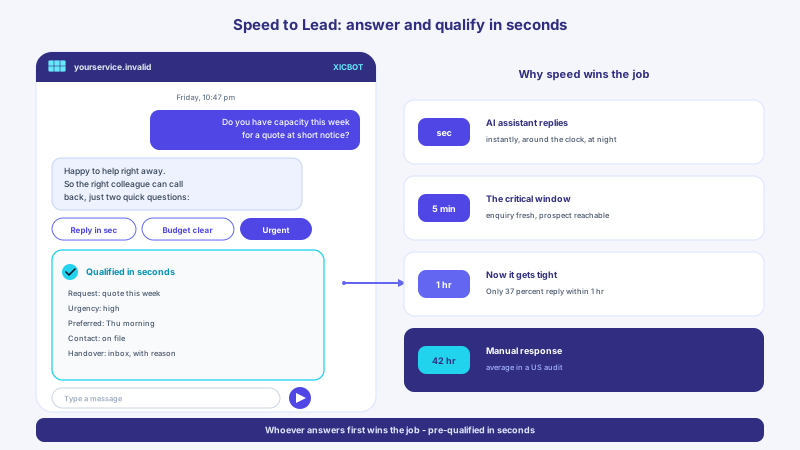
The best data capture is of little use if the request then lands in a general inbox. That is why routing belongs to the path: region, product group, customer status and order size decide who takes over. The assistant creates the request in the CRM, attaches the conversation summary and notifies the responsible colleague instead of generating a group email. That summary is more than a transcript: it records what the prospect cared about most, which variant they rejected and which question remained open. Why speed is decisive here is shown by a widely cited study: contacting a prospect within one hour makes a qualifying conversation about seven times (Harvard Business Review 2011) more likely than waiting even one hour longer.
The most expensive request is the one where sales first has to call and ask how many metres it is supposed to be. When quantity, variant and date are already in the record, the callback becomes a quote.
The difference becomes especially visible outside business hours. Requests arrive in the evening, at the weekend and from other time zones, and then the prospect faces a form or nothing at all. During those hours the assistant runs the same path, states openly that the binding quote follows on the next working day, and names a realistic time instead of a platitude. On Monday morning a complete record is waiting rather than a three-line note. The expectation behind this is well known: business customers expect a prompt response, and whoever comes back first with reliable details stands further ahead on the shortlist. How strongly response time influences the outcome is put in context by the article on speed to lead and response time; what matters when switching from assistant to human is described in the article on the handover to employees.
What the assistant deliberately does not promise
An assistant on the quote path is a helper, not a salesperson with power of attorney. It does not negotiate conditions, does not grant special discounts and does not confirm delivery dates that only planning can commit to. Nor does it cost a custom build; it recognises that a request is one and passes it on. That restraint matches what buyers expect, because the wish for human contact in delicate situations remains: by 2030, 75 percent (Gartner) of business buyers are expected to prefer purchase experiences that put human interaction ahead of AI. Equally, no fixed conversion rate can be promised. How many requests turn into orders depends on the product range, price level, competition and the response time of the sales team. What is reliable is the completeness of the record, not a particular figure. For handling customer data and conditions safely, the same requirements apply as everywhere, as the article on data protection and hosting for AI assistants shows.
The quote path in a few steps
The route begins with a look at the requests your sales team receives today: which details are typically missing, which follow-up questions repeat, which product groups create the most clarification effort? Those answers define the fields of the quote request. The assistant is then trained on your product range, tiers and technical vocabulary, connected to the ERP system and the CRM via integration in the Custom package and embedded in the shop with a short snippet. Which topics come up in live operation and where conversations break off is made visible by conversation analytics. That the same mechanism carries beyond sales is shown by the article on how an assistant answers candidate questions on the careers page. Practical examples are on the reference projects page, the packages on the page about pricing and scope, and anyone who would like to play the path through on their own product range can arrange a no-obligation demo.
- Review the last fifty requests and note which details were missing
- Define the mandatory fields of the quote request per product group, including unit and volume tiers
- Put the rules for price information in writing: what gets stated and what stays reserved for the quote
- Define the switch between private and business customers and tie access to conditions to signing in
- Store responsibilities in field sales: region, product group, order size
- Define the process outside business hours and anchor the promised response time in the team
Frequent questions
May an AI assistant in the shop state binding prices for business customers?
It should deliberately avoid doing so. A price statement without reservation can be read as a binding declaration, and in business-to-business the price additionally depends on quantity, variant, freight and individual conditions. A graded approach works well: state listed prices where they exist, name the matching tier for a given quantity, be open that special versions have to be costed, and raise additional costs early. In doing so the assistant makes clear that the binding price appears in the written quote from the sales team. That gives the prospect enough orientation for a shortlist without leaving a figure on the table that later has to be corrected.
What details does a complete quote request need?
As a rule eight building blocks: application and occasion, quantity with unit, variant or specification, required accessories, requested date, delivery address, payment method plus contact person and customer number. Which of them are mandatory differs by product group: for consumables, quantity and date matter, for technical items it is material, dimensions and standard. The assistant only asks for what is actually still missing in each case and fills in from the systems connected in the Custom package whatever is already on record. The result is a record that sales can turn into a quote without a callback.
How does the assistant know whether someone is a private or a business buyer?
It asks in passing during the conversation and it reads signals: quantities in pallets or containers, questions about net prices, a company name, a reference to a tender or a customer number that is mentioned. If the user is signed in to their customer account, the classification is unambiguous anyway. If it stays unclear, the assistant takes the more cautious route: it states publicly listed prices and clarifies the classification before it talks about tiers or payment terms. That way one path in the same chat leads to an order and the other to a quote request.
Do customer-specific conditions become visible in the chat?
Only after signing in to the customer account. Individual price sheets are confidential agreements, and an anonymous chat is the wrong place for them. The assistant therefore only accesses stored conditions once the session is unambiguously tied to an account, and otherwise works with publicly listed prices and tiers. A guessed or copied customer number is not sufficient proof. It also helps to have a clear rule in the system about which fields may enter the chat at all, so that no external conditions become visible during follow-up questions either.
What happens to requests outside business hours?
They are captured in full. In the evening, at the weekend and from other time zones the assistant runs the same path as during the day: it clarifies quantity, variant, date and contact, states availability and lead time from the system connected in the Custom package and creates the record. What it does not do is promise a binding quote. Instead it says openly when sales will get in touch and names a realistic time. On the next working day a complete record is therefore waiting rather than a note with a name and a phone number, and the first contact already has substance.
Does the assistant replace the field sales team?
No, it prepares their work. Negotiation, relationship building, technical design at the edge of the range and decisions about conditions stay with people. The assistant takes over the part before that: capturing, asking, filling in from the systems, routing and handing over. As a result the sales conversation does not start from zero but from a record with quantity, variant and date. The benefit lies in the time gained and in the completeness of the request, not in replacing personal contact. Especially with larger orders that contact remains the decisive part of the business.
Ask it yourself, Assistant of this website
Automated assistant