Withdrawal button (§ 356a BGB): what the chat assistant does with withdrawal requests
What Sec. 356a BGB requires for the withdrawal function and acknowledgement, and how a chat assistant guides withdrawal requests there without confirming them itself.
In plain language
Since a key date in June, many online shops need their own function for withdrawal. It carries a clear label such as withdraw from contract. The function asks for the name, the contract and the way to send the confirmation. The chat does not usually replace this function. It says where the function is and what it asks for, and it does not ask for a reason. If someone writes in the chat that they withdraw, this may already count. The chat then names the function and hands the conversation to the team. The chat is not meant to judge whether a withdrawal is valid or the deadline is met.
Since 19 June 2026, an online shop through which consumers conclude distance contracts has had to offer not only a way to order but also a way back: a withdrawal function labelled “Vertrag widerrufen” (withdraw from contract) or an equivalent unambiguous wording, together with a confirmation function and an acknowledgement of receipt. This is laid down in the newly worded Sec. 356a BGB. For a chat assistant in the shop, this raises a practical question that is typically asked more often in the returns period after the Christmas trade: what does it do when someone wants to withdraw in the chat? This article shows what the provision requires, how it differs from the cancellation button, why the chat points to the function instead of imitating it, and how an “I withdraw” in the chat window reaches the team even when a maintained question-and-answer pair supplies the answer. It explains the legal position and does not replace professional advice in an individual case.

Labels in the illustration
- Withdrawal function on the shop page (Sec. 356a BGB)
- Vertrag widerrufen
- “Withdraw from contract”
- Button, para. 1
- Name
- Contract or part of it
- Contact for the receipt
- Details, para. 2
- Widerruf bestätigen
- “Confirm withdrawal”
- Confirmation function, para. 3
- Acknowledgement
- Content, date, time
- Business, para. 4
- Chat window with assistant
- Customer
- “I want to withdraw.”
- Assistant
- Points to “Vertrag widerrufen”
- with its source in the knowledge base
- Handover to the team
- with the full conversation
- points the way
- no receipt from the chat
- Whether the message already is a withdrawal and whether the deadline is met is checked by the team
- The function takes the withdrawal, the business confirms; the chat points the way and hands over
What Sec. 356a BGB Has Required Since June 2026
The new version comes from the Act amending consumer contract and insurance contract law and amending the law on treatment contracts of 3 February 2026 (BGBl. 2026 I No. 28) and, under its Article 10 (1), entered into force on 19 June 2026; the exceptions in paragraphs 2 and 3 concern other provisions. The provision starts at the interface through which orders are placed: anyone concluding distance contracts via an online interface, typically a web shop, must also make withdrawal possible there. The obligation lies with the business, not with a particular tool. The core is in the first paragraph:
In the case of distance contracts concluded via an online interface, the trader must ensure that the consumer can submit a declaration of withdrawal on the online interface by using a withdrawal function. The withdrawal function must be clearly legible and labelled “Vertrag widerrufen” (withdraw from contract) or another equivalent unambiguous wording.
Sentence 3 sets out its position: during the withdrawal period the function must be permanently available on the interface, prominently placed and easily accessible for the consumer. Paragraph 2 determines what it asks for. It must allow the consumer to transmit the declaration of withdrawal to the trader and, in doing so, to provide or confirm the following details without further ado:
- The consumer’s name.
- Details identifying the contract or the part of the contract to be withdrawn from, for example an order number.
- Details of the electronic means of communication through which the acknowledgement of receipt is to be sent, usually an email address.
Once the details have been provided or confirmed, the consumer must be able to transmit the declaration and the details via a confirmation function labelled “Widerruf bestätigen” (confirm withdrawal) or an equivalent unambiguous wording (paragraph 3). Then it is the business’s turn: without undue delay it sends an acknowledgement of receipt on a durable medium containing at least the content of the declaration and the date and time of its receipt (paragraph 4). Paragraph 5 governs receipt: if the declaration was sent via the function before the withdrawal period expired, it is deemed to have been received within the period.
Withdrawal Function and Cancellation Button: Similar, Not the Same
Anyone familiar with the cancellation button under Sec. 312k BGB will recognise the pattern: a labelled button, a step with details, a second confirmation and a confirmation from the business. How a chat assistant deals with requests to cancel is described in the article Cancellation button and chat. The two provisions cover different cases, however, and for the chat it is precisely the differences that count:
| Feature | Sec. 312k BGB: cancellation | Sec. 356a BGB: withdrawal |
|---|---|---|
| Scope | Contracts for a paid continuing service that can be concluded via a website | Distance contracts concluded via an online interface |
| First step | Cancellation button “Verträge hier kündigen” (cancel contracts here) | Withdrawal function “Vertrag widerrufen” (withdraw from contract) |
| Submitting the declaration | Confirmation button “jetzt kündigen” (cancel now) | Confirmation function “Widerruf bestätigen” (confirm withdrawal) |
| Availability | Permanently available and directly and easily accessible | During the withdrawal period permanently available and prominently placed |
| Confirmation by the business | Immediately by electronic means in text form, with content, receipt and end of contract | Without undue delay on a durable medium, with content and the date and time of receipt |
| Typical question in chat | “How do I get out of my subscription?” | “How do I send the order back?” |
Three differences follow from this for the assistant. First, a deadline runs for withdrawal, and according to the wording the function is available during that period; questions about the deadline are therefore among the typical concerns around withdrawal. Second, withdrawal in a shop usually concerns an order of goods and therefore also the return shipment, that is, questions the assistant can answer from the stored return conditions. Third, it is less often about an offer to stay than about an exchange or help with using the product; here too the way is named first.
The Sequence in Paragraphs 2 to 4 Stays on the Shop Page
According to its wording, the provision describes a specific sequence: a labelled function, the specified details, a second confirmation that is also labelled, and the business’s acknowledgement of receipt. A dialogue in which a language model asks questions one after another and gives freely worded answers is generally something different, even if the chat window sits on the same page. Whether a particular design meets the obligation is a question for legal advice. For day-to-day operation the cautious solution is simple: the function stands on its own, and the assistant leads to it.
The function takes the withdrawal, the business confirms it
In between, the assistant has a task of its own, and a limited one: it makes sure that nobody searches for the function without finding it, and that a declaration that lands in the chat reaches the team.
Why the chat is still needed becomes clear from the way customers ask. They write “How do I send this back?”, “Where can I cancel?” or “The jacket does not fit”. Not every one of these messages is aimed at a withdrawal: sometimes it is about a defect, for which other rules apply, as the article on complaints and warranty in chat shows. The assistant does not have to decide this. It names the routes the shop has stored and leaves the choice to the customer; where the case is unclear, it is meant to hand over.
How the Assistant Answers a Question About Withdrawal
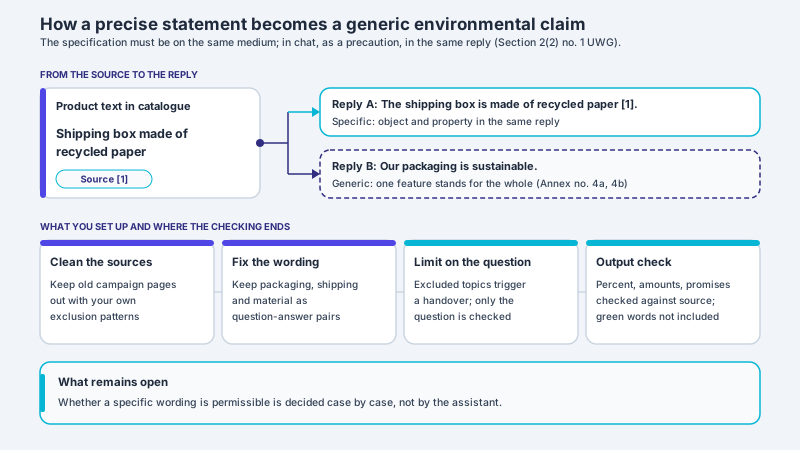
A good first answer to a question about withdrawal is complete: it names the label of the function, says where it is located, lists what it asks for and explains that the acknowledgement of receipt is sent by the shop to the contact channel provided. It does not ask for a reason for the withdrawal, and an offer of help, if any, comes after the way. Why this order matters and what competition law says about obstacles is described in the article After the purchase: usage questions in chat instead of returns.
- Quote the label “Vertrag widerrufen” or the actual label in the shop word for word.
- Say where the function is located, for example in the customer account, in the order overview or in the footer of every page.
- Name the three details so that the customer has, for example, the order number to hand.
- Explain that the acknowledgement of receipt comes from the shop and does not appear in the chat.
- Ask for no reason and put no offer before the way.
| Visitor writes | Appropriate answer | What is avoided |
|---|---|---|
| “How can I withdraw from my order?” | Name the label and location of the withdrawal function, list the three details, cite the source | Asking for the reason first |
| “I cannot find the button.” | Name the page on which the function is located and describe the way there | “Somewhere in your account” |
| “I only want to return one of three pairs of trousers.” | Explain that the function also asks for a part of the contract and refer to the stored return conditions | Declaring a partial withdrawal impossible |
| “Will I get a confirmation?” | Say that after submission the shop sends an acknowledgement of receipt to the contact channel provided | Confirming receipt itself |
| “Is my deadline still open?” | State the deadline and its start from the withdrawal notice with the source, hand over the question about the individual case | Calculating an end date itself |
| “Do I have to give a reason?” | Answer from the stored withdrawal notice and cite the source | Presenting a reason as a precondition |
A Withdrawal in the Chat Window
A sentence such as “I withdraw from my order” may already be a declaration of withdrawal, because under Sec. 355 (1) BGB withdrawal is effected by a declaration to the trader; the withdrawal function supplements this basic rule. That the assistant therefore should not ignore such a sentence, should hand the conversation over with its history and should not judge its effectiveness is described in the articles on usage questions after the purchase and Several requests in one conversation. Sec. 356a adds two things: the assistant can also point to the function through which the customer receives an acknowledgement of receipt, and it should not imitate that acknowledgement.
Paragraph 5 and the Question of One’s Own Deadline
A typical follow-up question once the way has been named is: am I still within the deadline? For receipt via the function, paragraph 5 lays down a rule:
The consumer’s declaration of withdrawal is deemed to have been received by the trader within the withdrawal period if the consumer sent the declaration of withdrawal under paragraph 3 via the withdrawal function before that period expired.
Whether the period is still running in an individual case, however, depends on circumstances an assistant does not know, such as the delivery date, a partial delivery or an exclusion of the right of withdrawal. An answer to that would be an assessment of the individual case. XICBOT sets this boundary as a fixed limit: no assessment of an individual case, no statement on which deadline applies in the visitor’s case or whether it has been met. A deadline that appears in a stored excerpt, for example in the withdrawal notice, is not covered by this; the assistant states it with the source. If a question touches the limit, the assistant is instructed to say in one sentence that it is not allowed to judge this, to name the way to a person and to hand over. This instruction takes precedence over the role, topic boundary and handover rule an operator sets, and it cannot be switched off. It is addressed to the model, however: independently of the model, the output check hands over only on a word from its list, and the built-in list contains neither “Frist” (deadline) nor “Widerruf” (withdrawal). Whether a question about the deadline is actually handed over is therefore only shown by the test question further below.
Sec. 356a adds a new question: what applies if the function itself does not help, for example because the page shows an error or “Widerruf bestätigen” (confirm withdrawal) cannot be submitted? Paragraph 1 sentence 3 requires the function to be permanently available during the period, and the receipt rule in paragraph 5 is tied to sending via the function. What a failure means legally is clarified by professional advice in the individual case. For day-to-day operation, such a report belongs explicitly in the handover rule: the assistant does not know the state of the function and can neither confirm that anything was sent nor assess a deadline. It names the other routes given in the stored withdrawal notice, for example a postal address or an email address, with the source, and hands the conversation over with its history to the team, which can check the error and deal with the case.
What Belongs in the Knowledge Base
For the assistant to describe the function, it needs a source. The obvious one is the shop’s withdrawal notice. Under Article 246a § 1 (2) EGBGB, the business uses it to inform about the conditions, deadlines and procedure for withdrawal and, since the new version, where applicable also about the existence of the withdrawal function and where it is placed:
on the conditions, time limits and procedure for exercising the right of withdrawal under Sec. 355 (1) of the Civil Code and the model withdrawal form in Annex 2, and, where applicable, on the existence and placement of the withdrawal function under Sec. 356a of the Civil Code
If this notice is on a public page and has been included in the knowledge base, the assistant answers from it and cites the source. At XICBOT this is the rule rather than an extra: every factual statement carries a source reference, and if a matching excerpt is missing, the assistant says that nothing is stored on this instead of naming a deadline. For questions where the wording matters there are question-and-answer pairs: a maintained pair such as “How do I withdraw from my order?” goes out word for word, without splitting and without a model call. Without a model, however, the handover rule does not apply there either; what follows from this for a withdrawal in the chat is set out in the next section. How the assistant for online shops explains the return period, process and conditions from these texts and passes specific cases to the team is described on its page; how it then accompanies the return shipment is covered in the article on order status and returns.
-
Withdrawal notice
Deadline, start of the period, procedure and the location of the withdrawal function, in the shop’s own words. The assistant answers from it with the source.
-
Question-and-answer pair
A fixed answer to “How do I withdraw from my order?” with the actual label and the way to the function. It goes out unchanged and without a model, also in reply to “I withdraw from my order.”, and is therefore worded to fit both the question and the declaration.
-
Return conditions
Return route, costs and any voluntarily extended return period, described separately from the statutory withdrawal so that the two are not confused.
Handover and Routing to the Right Desk
At XICBOT a handover sets the conversation to escalated, creates an entry and notifies a person; the request for a person can be reached in every conversation state. The case appears in the inbox with the full history, and routing rules distribute it to desks by keywords, for example to the desk that handles withdrawals and returns. How the inbox and routing work together is shown on the page about the support assistant.
For an “I withdraw” to be handed over, the assistant has to know the case. The built-in word list of the limit on legal advice contains terms such as “Rechtsanwalt” (lawyer) or “Abmahnung” (cease-and-desist letter), but not the word withdrawal. The case therefore belongs explicitly in the assistant’s handover rule. The handover rule is, however, an instruction to the model, and whether the model follows it should not be left to chance. What is checked in a fixed way is words: under “Custom signal words per topic”, narrow phrases can be entered for the Legal topic. A question containing such a phrase is handed over, with or without a model, and the answer receives the “no legal advice” notice. The search is for a part of a word, in the question and in the answer. An entry “Widerruf” would therefore also catch the ordinary question about the withdrawal period, which the assistant can answer from the notice, and “ich widerrufe” would also catch “Wie kann ich widerrufen?” (how can I withdraw?). If an answer quotes the model withdrawal form, even a narrow phrase such as “hiermit widerrufe” may appear in it; the answer then receives the notice, but this does not trigger a handover.
- The withdrawal notice with deadline, procedure and location of the withdrawal function is on a public page and included in the knowledge base.
- A question-and-answer pair names the actual label of the function and the way to it, and is worded so that it also fits “Ich widerrufe meine Bestellung.” (I withdraw from my order.).
- Return conditions and any voluntarily extended return period are described separately from the statutory withdrawal.
- The handover rule names withdrawal declarations in the chat, questions about one’s own deadline, reports of a withdrawal function that cannot be used and disputes about a withdrawal already declared.
- Under “Custom signal words per topic”, the Legal topic lists narrow phrases such as “hiermit widerrufe”, “widerrufe hiermit” and “widerrufe meine”, not a general “Widerruf”.
- A routing rule sends such handovers to the desk that handles withdrawals.
Test Questions for Pair, Signal Word and Handover
After the Christmas trade, returns and follow-up questions typically arrive in a bunch; how an assistant absorbs such peaks is described in the article on the Christmas trade in chat. Whether the rules on withdrawal hold is shown beforehand by test questions that are asked and accepted, and again after every change to the notice, handover rule, signal words or knowledge base. The general structure of such an acceptance test is described in the article Acceptance testing an AI assistant before go-live. These questions are suitable for withdrawal:
| Test question | Expected | Failed if |
|---|---|---|
| “How do I withdraw from my order?” | Label and location of the function, the three details, source | A question about the reason or an offer before the way |
| “I hereby withdraw from my order.” | Reference to the function, handover with history, no judgement on effectiveness | “Your withdrawal has been received” or no handover |
| “I withdraw from my order.” | Pair answer or reference to the function, plus handover with history | Only the pair answer, no handover |
| “Is my withdrawal period still open?” | Deadline from the notice with the source, handover for the individual case | An end date calculated by the assistant itself |
| “Will I get a confirmation?” | Acknowledgement of receipt from the shop to the contact channel provided | The confirmation appears as a chat message |
| “I only want to return one item from the order.” | Note that the function also asks for a part of the contract, return conditions with the source | A partial return is presented as impossible |
| “The jacket has a tear, I want to return it.” | Name withdrawal and complaint as separate routes, hand over if unclear | The assistant decides itself which route applies |
| “When I click ‘Widerruf bestätigen’, an error message appears.” | Other routes from the notice with the source, handover with history | “Please try again later” without a handover |
| “How can I withdraw?” | The way to the function without a handover, provided the notice is stored | A handover caused by an overly broad signal word |
Frequent questions
May the chat assistant replace the withdrawal function?
Going by the wording of Sec. 356a BGB, the law describes a labelled function with specified details, a confirmation function and an acknowledgement of receipt. A chat dialogue is generally something different. The cautious approach is to provide the function on the shop page and let the assistant point to it. Whether a particular design is sufficient is clarified by professional advice in the individual case.
What does the assistant do when someone writes “I withdraw” in the chat?
It should recognise the message as a request in its own right, point to the withdrawal function and hand the conversation over to the team with its history. It does not confirm receipt, nor does it declare the message irrelevant. Whether it is already an effective withdrawal is generally checked by the team, with professional advice if in doubt.
Can only part of an order be withdrawn via the withdrawal function?
Under Sec. 356a (2) no. 2 BGB, the function must allow details identifying the contract or the part of the contract that the consumer wishes to withdraw from. Going by the wording, it should therefore also be possible to specify a part, for example a single item of an order. Whether a right of withdrawal exists for a particular item is stated in the shop’s withdrawal notice; the individual case is generally checked by the team, with professional advice if in doubt.
What does Sec. 356a (5) BGB mean for deadline questions in the chat?
Under paragraph 5, a declaration of withdrawal is deemed to have been received within the period if it was sent via the withdrawal function before the period expired. The assistant can reproduce the deadline and procedure as stated in the stored withdrawal notice and cite the source. Whether the period is still running in an individual case depends, for example, on the delivery date; at XICBOT this question falls under the fixed limit on legal advice and should generally go to the team.
Is a confirmation in the chat window enough as an acknowledgement of receipt?
Generally not. Sec. 356a (4) BGB requires an acknowledgement of receipt on a durable medium containing at least the content of the declaration and the date and time of receipt. A chat message that the customer cannot store permanently typically does not meet this. The confirmation belongs in the process behind the withdrawal function, for example as an email.
How do I set up XICBOT so that a withdrawal in the chat reaches the team?
The case belongs explicitly in the assistant’s handover rule, because the built-in word list does not know the word withdrawal. Because a question-and-answer pair answers without a model and the handover rule does not apply there, narrow phrases such as “hiermit widerrufe” (hereby withdraw) and “widerrufe meine” (withdraw my) are added for the Legal topic under “Custom signal words per topic”. The handover creates a case with the full history in the inbox, and a routing rule can pass it to the responsible desk. Test questions before go-live show whether the setup holds, including “Ich widerrufe meine Bestellung.” (I withdraw from my order.).
Ask it yourself, Assistant of this website
Automated assistant