Black Week ahead: answering questions about future discounts honestly in chat
How a shop assistant answers whether an item will be cheaper in Black Week without anticipating future prices or voucher codes.
In plain language
Weeks before Black Week, customers ask: will it be cheaper then? A future price is not in the shop. So the assistant usually says that nothing is on record. A guess would be risky either way. A shop must not mislead people about a price advantage. A voucher for the sale belongs in the list only on the start day. The question about discounts gets a fixed answer. Open questions go to a list you can read before the sale.
At the end of October a particular kind of customer question starts to appear in online retail. The item is already in the cart or on the wish list, and before anyone orders, the question lands in the chat window: will this be cheaper in Black Week? Will there be a code then? Is it worth waiting, or will I get the difference refunded if I buy now? None of these questions has a reliable answer at the end of October as long as the shop has not decided on its sale and announced it. This article shows why a shop assistant must not name future or unpublished discounts, what it can say instead, what competition law requires of price statements and why voucher codes for the sales week belong in the voucher list only on the day the sale starts.

Labels in the illustration
- Before the sale starts
- Late October until the start day
- During the sale
- Start and end as you planned them
- After the sale
- From the day after the end date
- Start
- End
- Question
- “Will it be cheaper in Black Week?”
- Answer
- Nothing is on record for that yet.
- Today’s price from the shop, dated.
- Source
- Sale code not active yet
- Future prices: no source
- Question
- “Does the code work yet?”
- Answer
- Yes, the discount is deducted.
- Shop price, with its source.
- Source
- Code set active on the start day
- Price queried when answering
- Question
- “Is the discount still on?”
- Answer
- The code ran until the end date.
- Shop price again, dated.
- Source
- End date passed, German time
- Sale texts removed
- In all three phases
- No guesses about future prices, no pressure to buy.
- Questions without a basis
- go to the gap list in conversation analytics.
The question comes before the sale
For many shops the sales week at the end of November is a high point of the year, and for many customers it is a date they plan towards. Among those who intended to use the offers of the late-November sales days in 2025, 48 per cent (Bitkom) were accounted for by rather planned purchases in a Bitkom survey from late September and early October 2025. The survey did not ask when questions are put. It seems likely, though, that people who plan look at items early, put them on the wish list and then ask the question that is still keeping them from buying: will this be cheaper in a few weeks? If the shop has an assistant, that question lands in the chat window, right next to the item it concerns.
- Price question: Will this item be cheaper in Black Week?
- Code question: Will there be a voucher code, and does it also apply to reduced items?
- Waiting question: Is it worth waiting until the sales week?
- Refund question: Will I get the difference back if I buy now and the price drops later?
- Date question: When does the sale start, and is there early access for newsletter subscribers?
- Delivery question: Will an order from the sales week still arrive before the holidays?
Behind these questions there is rarely mere curiosity, usually an intention to buy with a price limit. In the same survey 45 per cent (Bitkom) classified themselves as wish fulfillers, describing themselves as treating themselves to things they have wanted for a long time but do not want to pay full price for. And most of them wanted to buy online: 69 per cent (Bitkom) of those who intended to use the offers wanted to take them up on the internet. For a shop the question about a future discount is therefore not a nuisance but a conversation with someone who wants to buy. What tips it over is an answer that promises more than the shop knows at that point.
What the assistant knows today and what it does not
A shop assistant does not answer from a hunch about retail but from data your shop gives it. With the shop assistant that is the product catalogue with title, description, price, strike-through price, attributes, rating, delivery time and a yes or no on availability. For a shop based on Shopware Community Edition this catalogue is taken over from the shop and synchronised on a schedule so that discontinued items are no longer mentioned. If your package includes the shop connection, the assistant reads the price, strike-through price, availability and delivery time of the items it is about to show from the shop while answering. Without the shop connection, or if the shop does not respond, the state of the last sync applies, and the assistant states when that was.
This leads to a limit that matters in the weeks before the sale: all of these details describe the situation now. The price query returns the price your shop states at that moment, not the one that is to apply in four weeks. A future price does not exist in any field of the catalogue, and a sale that has been prepared in the shop but not yet started does not appear as a price in the conversation. The assistant therefore cannot know whether an item will become cheaper, and it should not claim so either.
| Question in chat | What the assistant has | Answer that holds up |
|---|---|---|
| What does the item cost? | price from the shop when answering, otherwise the state of the last sync | today’s price, with its time if the state is older |
| Is it reduced right now? | strike-through price from the shop when answering, otherwise from the last sync | a strike-through price only if it is above the current price |
| Will it be cheaper in Black Week? | nothing: a future price is not in any field | nothing is on record for that, plus today’s price |
| Will there be a code? | no list of codes; only a code the customer names is checked | without a published announcement: nothing is on record for that |
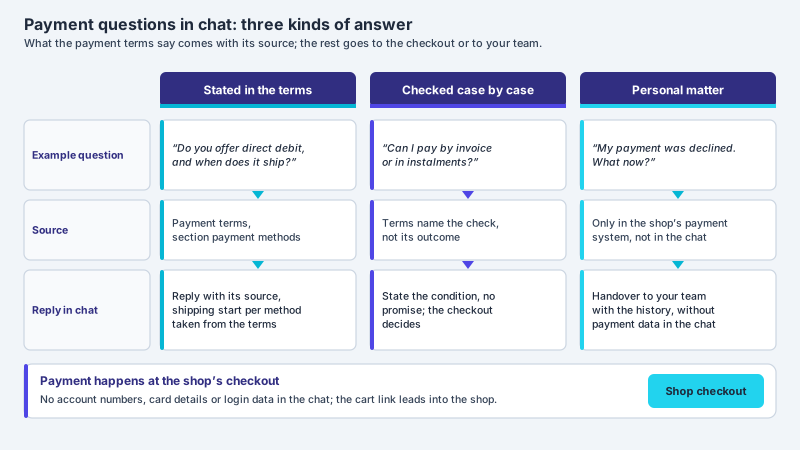
| Will I get the difference refunded? | your terms, if they cover it | the rule with its source, or a handover to your team |
| When does the sale start? | an announced sale as a document or question-and-answer pair | the published date, otherwise: nothing announced yet |
A future price is not information
Whatever the assistant says about prices has to come from a source that applies today. A guess about the sales week is not weaker information but no information at all: it has no source and still stands in the conversation as a statement made by your shop.
Why a language model likes to guess here
A language model has learned from its training that many shops cut prices at the end of November. The obvious answer to the question whether something will be cheaper is therefore a friendly probably yes. That very knowledge is out of place here, because what many shops do says nothing about what your shop has planned for this item. XICBOT ties answers to the retrieved context: factual statements as a rule carry a source reference that points to where the information was found. If the context is not sufficient, the assistant says so explicitly and refers to the relevant page or to a person. How such a refusal sounds without coming across as dismissive is described in the article Declining instead of guessing.
- Tips over: “It will certainly be cheaper in Black Week, you had better wait.” That is a price statement without any basis.
- Holds up: “Nothing is on record with me about future sales. Today the item costs the price the shop is currently showing.”
- Tips over: “You had better buy now, after the sale it will be more expensive again.” That puts pressure on people without any end date being fixed.
- Holds up: “I cannot say whether the price will change. The shop announces sales in its newsletter.” The second sentence only if your documents say so.
What competition law says about price advantages
The German Act against Unfair Competition (UWG) has no special rule for chat windows. It asks whether a commercial practice is misleading, and an answer an assistant gives on behalf of your shop can be such a practice. Under Section 5(1) UWG, anyone who engages in a misleading commercial practice that is likely to cause the consumer to take a transactional decision they would not have taken otherwise acts unfairly. Subsection 2 lists the circumstances about which a statement may be neither untrue nor likely to deceive. Number 2 covers exactly the ground on which the Black Week question moves:
the reason for the sale, such as the existence of a special price advantage, the price or the manner in which it is calculated, or the conditions under which the goods are delivered or the service is provided
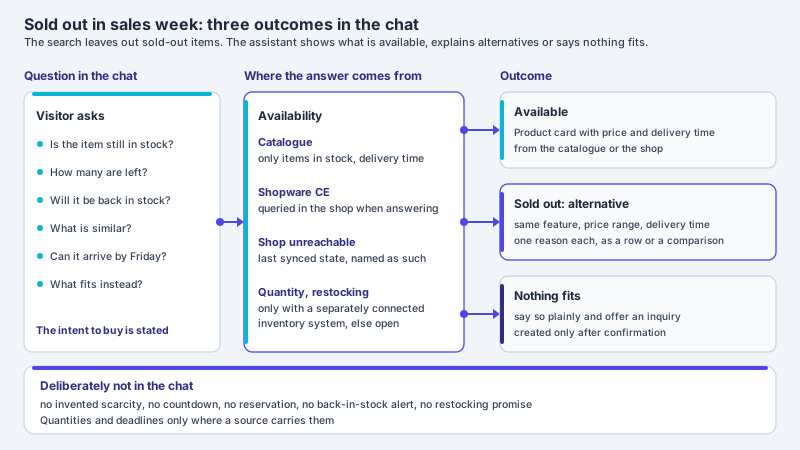
For the weeks before the sale this means two things. If the assistant announces a price advantage the shop is not planning at all, it creates an expectation on the strength of which someone postpones their purchase. If it denies a discount that has long been decided, someone buys at full price who would otherwise have waited. In both cases the issue is the existence of a special price advantage, and in both cases the statement comes from no source. This article does not assess whether a particular wording is misleading in an individual case; an answer that only reproduces what is on record and has been checked is usually less open to challenge. The other side of the sales week, the untrue claim that an offer is limited in time and invented scarcity, is covered in the article Sold out during sales week.
Before the sale: strike-through price and the 30-day rule
Besides the question about a future discount, a second one comes up in these weeks: is today’s price honest, or will it be raised before the sale so that the reduction looks bigger? The assistant does not judge that. It reproduces the strike-through price your shop keeps and shows it only if it really is above the current price. Which value is in that field is the shop’s responsibility. The wording of the 30-day rule in Section 11 of the German Price Indication Ordinance and what follows from it for strike-through prices in chat is covered in the article Prices in chat.
For the sales week, Section 5(5) UWG also matters: “It is presumed to be misleading to advertise a price reduction if the price was only charged for an unreasonably short period.” (translated) This does not give the chat a calculation of its own to do, but it does call for a check before the start: if your shop sets strike-through prices in the sales week, the assistant takes them over unchanged into its answer and the product card.
Enter voucher codes on the start day
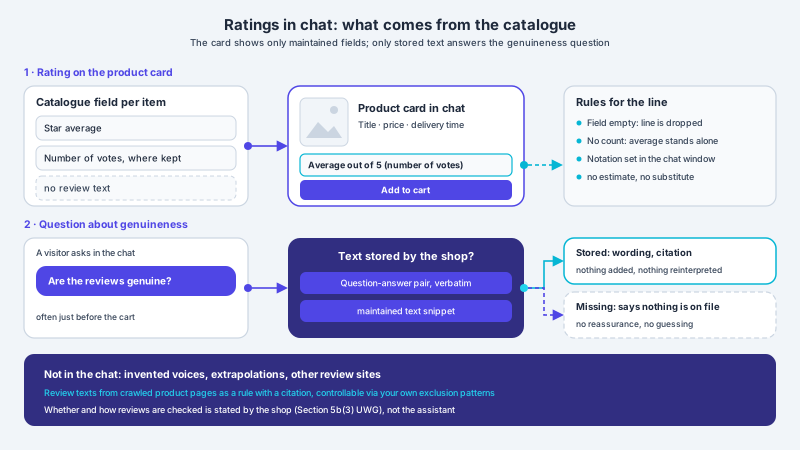
The cart assistant applies voucher codes that you store in the cart tool, at most twenty voucher rules per cart tool. A code that is named is checked strictly: type as percentage or fixed amount, value, minimum order value and validity until the end of the named day in German time. The voucher is not redeemed in the chat. The code travels with the cart, and whether the discount is granted is decided by your shop at the checkout.
For planning a sale one detail matters that is easily overlooked: the voucher rule carries an end date, but no start. From the assistant’s point of view, a code that is in the list and switched to active is valid from the moment it is entered; a code that has been switched off is rejected with a note. Anyone who stores the code for the sales week as active at the end of October so that nothing is forgotten on the start day has thereby released it in the chat. If a customer names the code, for instance because it appeared in a newsletter in advance, the assistant applies the discount to the cart weeks before the sale. Your shop’s checkout can still reject it then, but the chat has already shown a discount that does not exist yet. Codes for the sales week therefore usually belong in the list only on the start day, together with the end date of the sale.
- Create the code in the shop with start and end, the way your checkout checks it
- On the start day enter the code in the assistant’s voucher list as active, with type, value, minimum order value and end date
- Check in a test conversation whether the code deducts the expected amount on the cart and, with a smaller cart, states the amount missing up to the minimum order value
- Until the start, the answer to the code question remains: nothing is on record for that yet
- After the end date remove the entry so that the list only contains running codes
The waiting question: is it worth waiting?
The hardest question of these weeks is the one about waiting, because it calls for a recommendation. An assistant cannot honestly give one: it knows neither your sale planning nor the stock that will still be there in the sales week, nor the customer’s needs. What it can give are the facts on which a decision of her own can rest: today’s price, today’s availability and delivery time, and what your terms say about price changes after the purchase. The decision stays with the customer, and that is where it belongs.
-
Refund the price difference?
Only what your terms say, with its source. If they say nothing about it, the assistant says so and offers a handover instead of promising a goodwill gesture.
-
Reserve until the sale?
The assistant does not reserve anything. It states what is available today and says that this may change by the sales week.
-
Notify me if the price drops?
A price alert is not one of its tasks. If you have a newsletter for sales, it mentions it, provided it is in your documents.
-
Early access to the sale?
Whether there is early access is part of your sale planning. Until it is published, the answer is: nothing has been announced about that yet.
When the sale runs and when it ends
On the start day the answer changes without anyone having to rewrite the assistant. With the shop connection, the assistant reads price, strike-through price, availability and delivery time from the shop while answering; if your shop lowers the price, the new one appears. Without the shop connection, or if the shop does not respond, the state of the last sync applies, and the assistant states when that was. If the code is active in the voucher list and someone names it, the assistant applies it to the cart and states the amount deducted; if the cart is below the minimum order value, it states the amount missing.
After the sale the same applies in reverse. A code’s validity ends with the named day in German time, not an hour earlier; if someone names the code afterwards, they get a note that the code has expired instead of a silent discount. Sale texts in the knowledge base have no such expiry; they need to come out on the day after the end. How that becomes a fixed maintenance step is described in the article Keeping the knowledge base up to date.
- Four weeks before: store the waiting question as a question-and-answer pair and run test questions on price, code and refund
- With the announcement: add the date and conditions of the sale as a document or question-and-answer pair
- On the start day: enter codes in the voucher list as active, set prices and strike-through prices in the shop
- During the sale: look at the gap list daily and fill in open questions
- On the day after the end: remove sale texts from the knowledge base and take expired codes out of the list
What the gap list shows before the sale
The weeks before the sale are a good time to see what your customers want to know before the answers are fixed. A finished answer that ends without a single source reference is recorded as a gap; from the Pro package conversation analytics shows it as its own line in the gap list, with its type. Next to it are the messages that preceded an evasive answer, grouped into bundles of the same concern. Questions about the start date, codes, refunds or delivery before the holidays show up there as long as nothing is on record, and show which details you should add when you announce the sale.
What cannot be measured is how many customers waited until the sales week after an honest answer and how many bought anyway; there is no control group for that. A particular effect on revenue therefore cannot be promised. What can be measured is whether the question about a future discount received an answer with a source or ended up in the gap list, and that can be read in every single conversation.
Frequent questions
May the assistant say that an item will be cheaper in Black Week?
Only if your shop has decided on the sale, announced it and stored it for the assistant. Before that it has no source for it and usually says that nothing is on record about future sales. It should not voice a guess in either direction.
Can I already store the codes for the sales week in the assistant now?
Technically yes, but the voucher rule has no start date: a code that is active in the list is applied to the cart in the chat straight away as soon as someone names it and the cart meets the conditions. It therefore usually makes sense to enter codes only on the start day and to give them the end date of the sale.
What does the assistant answer when asked whether it is worth waiting?
It does not give a recommendation, because it knows neither your sale planning nor future stock. It states today’s price, availability and delivery time and, if on record, what your terms say about price changes after the purchase. A curated question-and-answer pair is usually suitable for a fixed wording.
Can the assistant promise a refund if the price drops later?
It should not make a promise of its own. If your terms contain a rule on price changes after the purchase, it reproduces it with its source; if they say nothing, it says so and offers a handover to your team. A goodwill gesture in an individual case is usually decided by a person.
Where does the assistant get the reduced price from during the sales week?
For a shop based on Shopware Community Edition with the shop connection, it reads price, strike-through price, availability and delivery time from the shop while answering. Without the shop connection, or if the shop does not respond, it usually works with the state of the last sync and states when that was.
How can I see which questions are asked before the sale?
In conversation analytics, from the Pro package: answers without a source reference appear as a line of their own in the gap list, and messages that preceded an evasive answer are grouped into bundles of the same concern. From this you can usually see which details about the sale you should add when you announce it.
Ask it yourself, Assistant of this website
Automated assistant