Complaints and warranty: the assistant in a dispute
Warranty or guarantee, the two-year period, the burden of proof in year one: what an AI assistant records in a complaint and what a person decides.
In plain language
The legal warranty applies by law, and the seller must answer for defects. A voluntary extra promise is a different thing. First the buyer may ask for a repair or a new item. Only after that come withdrawal, a price cut or damages. For goods, the period usually ends two years after delivery. In the first year, the defect is assumed to have been there from the start. The assistant records the order, the purchase date, photos and the wish, and checks the period. A person decides, and handing over is the rule here.
A complaint is the moment when a customer asks for something that costs money and a company has to decide whether to grant it. That makes chat a different tool here than it is for a question about opening hours: whatever an assistant promises in the name of the company, the company has to honour. The sensible scope is therefore narrow. The assistant explains the framework in your own words, records the facts in full, files the order number, the purchase date and the photos, works out where the case sits in the statutory periods and then hands over to a person. This article shows how the statutory warranty and a commercial guarantee differ, which rights Section 437 of the German Civil Code gives the buyer, why the burden of proof is different in the first year, and where the line between recording and deciding runs in a dispute.

Labels in the illustration
- 1. Record in chat
- The facts in plain words
- Order number and purchase date
- Photos of the defect
- The outcome the customer wants
- Contact route for follow-up
- 2. Place it in the period
- Delivery
- 12 months
- 24 months
- First year: Section 477
- The defect is presumed, the
- company has to rebut it
- Then up to month 24
- The buyer carries the burden,
- Section 438 sets the end
- 3. A person decides
- Rights under Section 437
- Cure (Section 439)
- Rescission or price reduction
- Damages
- Goodwill beyond the law
- Every promise comes from a
- person, never from the chat
- What stays out of automation
- No assessment
- Whether a defect exists is
- not for the assistant to say
- No promise
- Rescission, reduction and
- refunds stay with the team
- No refusal
- A no is a decision of the
- company just as much
- Recording and classifying can be automated, deciding stays with people
Statutory Warranty and a Guarantee Are Two Different Things
In everyday language everything is a complaint: the device that stops working after eight months, the seam that comes apart, the scratch that was already there when the box was opened. In law there are two separate foundations behind this. The statutory warranty is the seller liability for defects; it arises with the contract of sale and does not have to be promised anywhere. A guarantee, by contrast, is a voluntary declaration that someone gives in addition, usually the manufacturer. Section 443 of the German Civil Code describes it as an obligation that comes alongside the statutory liability for defects, and that is the point: it does not replace the warranty, it is added to it.
| Aspect | Statutory warranty | Contractual guarantee |
|---|---|---|
| Basis | Sections 434 and 437, applies by law | Section 443, voluntary declaration |
| Who is liable | The seller | Whoever gave the declaration, often the manufacturer |
| Scope | Fixed by statute | As far as the declaration reaches |
| Period | Two years from delivery (Section 438(1) no. 3) | The period named in the declaration |
| Condition | The defect existed at the passing of risk | The conditions named in the declaration |
| Relationship | Remains in place independently | Comes in addition to the statutory liability |
For the assistant this distinction is not a nicety, it is a switch. If someone asks about the guarantee for a device bought twenty months ago, the manufacturer undertaking may have expired while the statutory liability has not. An assistant that only repeats the manufacturer conditions sends the customer away with a false picture, and quite possibly into a complaint that costs more than the case itself. The knowledge base therefore needs both: your own rules and the sentence that statutory rights remain unaffected.
What Section 437 Gives the Buyer
If the thing is defective, the buyer does not have one claim but a graded set of options. The statute lists them in a fixed order, and that order is the most common source of misunderstandings in chat: asking for a refund straight away skips the first stage.
If the thing is defective, the buyer may, if the requirements of the following provisions are met and unless otherwise specified, demand cure under Section 439.
Cure means, under Section 439(1), that the buyer may choose: removal of the defect or delivery of a thing free of defects. Only when that stage fails do the further rights come into play, namely rescission or price reduction under Section 437 no. 2 and damages under Section 437 no. 3. Where a consumer is the buyer, Section 475d additionally governs when rescission no longer requires an express deadline to be set.
- Stage one: cure, with the buyer choosing between repair and replacement (Section 439(1))
- Stage two: rescission of the contract or reduction of the purchase price (Section 437 no. 2)
- Stage three: damages or reimbursement of futile expenditure (Section 437 no. 3)
- Alongside and independently: claims under a guarantee against whoever gave it (Section 443)
An assistant may explain these stages. It may say that cure comes first and that your team normally offers repair or replacement for it. What it may not do is apply them to the individual case: whether this condition is a defect, whether cure has failed, whether rescission holds. The difference between general information and applying the law to a case is easy to overlook in chat and is the whole difference in a dispute.
Two Years, One Year of Burden of Proof
The claims named in Section 437 no. 1 and no. 3 become time-barred after two years for movable goods; that is set out in Section 438(1) no. 3. Under Section 438(2) the period starts with delivery of the thing, and with handover in the case of land. These two years are a limitation period, not a durability statement: they say how long a claim can be enforced, not how long a product has to last.
Where, within one year of the passing of risk, the goods show a condition deviating from the requirements of Section 434 or Section 475b, it is presumed that the goods were already defective at the passing of risk, unless this presumption is incompatible with the nature of the goods or of the defective condition.
In practice this sentence shifts the burden. If a consumer reports a defect within the first year, the company would have to show that the goods were sound at the passing of risk. After that the relationship reverses and the buyer carries the burden. For live animals Section 477(1) sentence 2 shortens the period to six months, and for goods with digital elements Section 477(2) contains its own rule. For chat this means one thing above all: the purchase date is the single most important piece of information in the whole conversation.
Technology may calculate, not judge
From the purchase date and today, without any discretion at all, you can derive which section a case falls into: first year, second year, beyond. That classification is arithmetic and is in good hands with the assistant. Whether the goods are defective is not arithmetic.
What the Assistant May Record
The real benefit is not in the answer but in the intake. Most complaints arrive incomplete: one sentence in a contact form, no photo, no order number, no purchase date. The team writes back, asks, waits, and the case drags on for days before anyone can even assess it. An assistant saves that round trip, because it asks while the customer is still in the conversation.
- The facts in the customer own words: what was bought, what happened, since when
- Order, job or invoice number so the case can be matched without guessing
- Purchase date and delivery date, because the statutory periods hang on them
- Photos or a short video of the condition being complained about
- What the customer wants: repair, replacement, a refund, or first of all an assessment
- Name, a way to reply and the consent to use those contact details for it
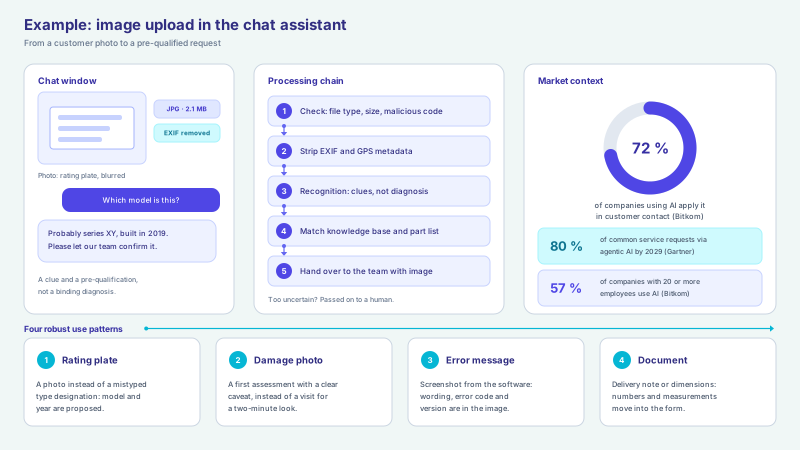
Photos are the biggest lever here, because one picture often settles at a glance what would otherwise take three messages; how to handle that cleanly in chat is covered in the article on image upload in chat. For contact details the same rule applies as everywhere else in chat: they are collected because the case needs them, not as a stock. The rules that apply are described in the article on GDPR, data protection and hosting.
-
Complete rather than quick
A case that arrives with number, date and photo is handled once instead of queried three times.
-
A fixed order
The assistant asks every case in the same way. That produces comparable records instead of free text in any shape.
-
Period classified directly
The purchase date shows whether the case sits in the first year, the second, or outside the limitation period.
-
The tone stays calm
The assistant confirms receipt and names the next step without passing judgement on the matter.
What It Does Not Decide
The line runs where a piece of information turns into a declaration by the company. Anything that creates, waives or refuses rights does not belong in automation. That is not caution on principle, it is the only division that holds up in a dispute: an assistant cannot examine a set of facts, it can only pass them on.
- No assessment of whether a defect exists or whether it was wear or improper use
- No promise about rescission, price reduction, refund or replacement
- No refusal either, because a no is just as much a decision by the company
- No goodwill beyond the statutory rights
- No setting of deadlines, no waiver, no statement on limitation in the individual case
- No information about the terms of a guarantee that a third party has given
Handover Is the Rule Here
For most questions, handing over to a person is the exception. In our own measurement series 43 of 48 questions stayed without a handover to a person; this was measured on a single assistant on our own knowledge base, not on customer projects, and a figure from live operation is not yet available. The method is set out under measurement series. For complaints this ratio is deliberately reversed: they belong to the cases that are handed over, and from the very start.
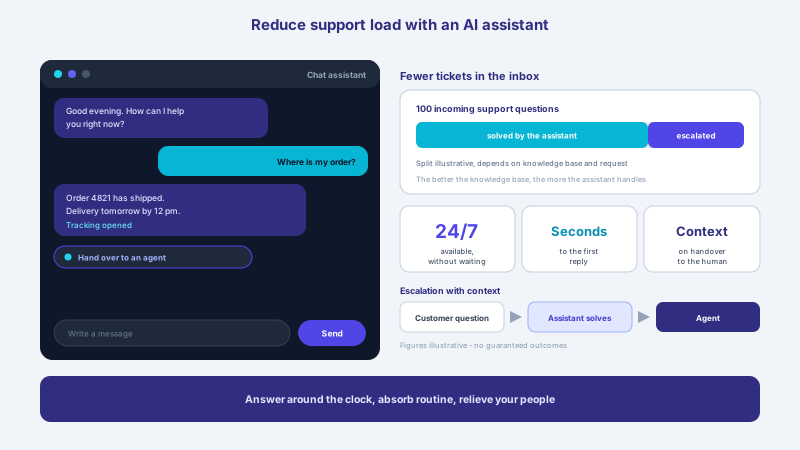
Handing over does not mean breaking off. The customer should not be sent to a form to type everything in again. The conversation continues with everything that has already been said, and the member of staff joins fully informed. What that handover looks like technically and organisationally is covered in the article on handover to human agents.
- The full transcript of the conversation, not a summary of it
- Order number, purchase date and the period classification the assistant calculated
- The uploaded photos, firmly attached to the case
- The outcome the customer expressly named, in their own words
- The note that the assistant promised nothing and refused nothing
During office hours a person ideally takes over directly. Outside those hours the assistant records the case in full, confirms receipt and names the next step, without committing to a processing time that nobody knows. Even that is progress for the customer compared with a form that disappears without a word.
A Flow That Protects Both Sides
For the division to hold in day-to-day operation it has to be part of the flow, not of good intentions. The following cut has proved workable: five steps, each one stating what the technology does and what it expressly leaves alone.
| Step | What the assistant does | What it leaves alone |
|---|---|---|
| Identify the matter | Tell a complaint, a withdrawal and a guarantee question apart | Put the case in a box that already fixes a legal consequence |
| Record the facts | Ask for number, date, description and photo | Steer the wording towards something that suits the company |
| Explain the framework | Set out the statutory stages and your own rules in general terms | Say which stage applies in this particular case |
| Place the period | Calculate the section from the purchase date and name it | Derive a statement about the outcome from that section |
| Hand over | Pass the case with all details to the team and confirm receipt | Promise an outcome, an amount or a date |
Transparency, Data Protection and Records
Anyone discussing a dispute in chat has to know who they are talking to. Article 50(1) of Regulation (EU) 2024/1689 requires that people are informed that they are interacting with an AI system, unless this is obvious anyway. In a complaint conversation this labelling is more than a formality: it is the reason why nobody has to take the answer for the binding statement of a case handler. What the duty means in detail is covered in the article on the transparency obligation.
In data protection terms a complaint is not an easy case. Order data, contact details and often photos accumulate, and those photos frequently show more than the condition complained about: a flat, a number plate, a person in the background. Article 5(1)(c) GDPR requires that only what is necessary for the purpose is collected, and point (e) limits storage to what is needed for it. In practice: no mandatory fields without a purpose, a named retention period for photos, and hosting you can name. The article on data protection and hosting goes into this.
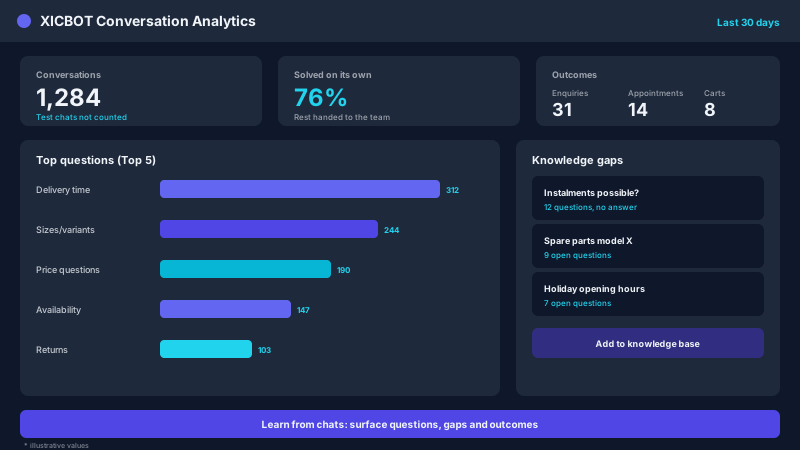
That leaves the record. In a dispute a chat transcript is a file: it shows what was reported, when it was reported and what was answered. That helps both sides, as long as the transcript stays complete and is not tidied up afterwards. Anyone analysing conversations should look at complaints separately: they are rare, but they show the gaps in the knowledge base most clearly. How to do that systematically is covered in the article on conversation analytics.
Honest Limits
An assistant does not settle a complaint. It shortens the path to the point where a person decides, and it makes sure that person has everything in front of them. Where your own rules are written down nowhere, the assistant cannot repeat them either; where nobody on the team picks the case up, even the most complete intake helps nothing. And an assistant can be wrong. That is why it is bound to your sources, shows what an answer rests on, and is meant to pass sensitive cases on instead of handling them. How the support assistant records complaints and hands them over to your team is shown on the product page; we are happy to go through your own processes for warranty and withdrawal with you via the contact page.
- Keep statutory warranty, guarantee and withdrawal cleanly apart in chat
- Write down your own rules on cure, returns and who bears the cost
- Define the mandatory details: number, purchase date, description, photo, desired outcome
- Let the period classification be calculated, but not the assessment of the defect
- Prescribe the handover sentences word for word and take every promise out of automation
- Limit retention of photos and contact details and keep the AI labelling visible
Frequent questions
What is the difference between statutory warranty and a guarantee?
The statutory warranty is the seller liability for defects. It arises with the contract of sale, does not have to be promised and follows Sections 434 and 437 of the German Civil Code. A guarantee, by contrast, is a voluntary declaration under Section 443 that someone gives in addition, often the manufacturer, with its own conditions and its own period. The two exist side by side: an expired manufacturer undertaking says nothing about whether the statutory rights still apply.
How long do the statutory warranty rights last?
For movable goods the claims under Section 437 no. 1 and no. 3 become time-barred after two years; that is set out in Section 438(1) no. 3. Under Section 438(2) the period starts with delivery of the thing. The two years are a limitation period, not a statement about how long a product has to last.
What does the reversal of the burden of proof in the first year mean?
If, in a consumer sale, the goods show a deviating condition within one year of the passing of risk, Section 477(1) sentence 1 presumes that the goods were already defective at the passing of risk. The company would have to rebut that presumption. After that year the burden lies with the buyer. For live animals the period is six months.
May an AI assistant reject a complaint?
No. A rejection is a decision by the company and is attributed to it even when it appears in chat. An assistant records the case, explains the general framework and hands over. The same applies in the other direction: a promise of a refund or a replacement does not belong in automation either.
Which details should the assistant record in a complaint?
The facts in the customer own words, the order or invoice number, the purchase and delivery dates, photos of the condition complained about, the desired outcome and a way to reply together with consent to use it. With those details a case can be handled in one pass instead of after three rounds of questions.
What happens to a complaint outside business hours?
The assistant records the case in full, confirms receipt and names the next step. It commits to a processing time only as far as your own rules state one. On the next working day the team has a case with number, date, description and photo in front of it instead of one line from a form.
Ask it yourself, Assistant of this website
Automated assistant