Gift Advice in Chat: Occasion, Budget, Delivery Date
How a shop assistant gives gift advice: five details, suggestions only from the catalogue, delivery times without promises, exchange and withdrawal kept apart.
In plain language
With a gift, the buyer is not the user. So the assistant asks about the occasion, budget, interests and delivery date. It asks one thing at a time. Suggestions come only from the shop catalogue. If no product fits, the assistant says so openly. It gives delivery times only from the shop data and does not promise a date. An exchange after the holidays is voluntary, the right of withdrawal is law. If nothing fits, a voucher can help.
Anyone looking for a gift is buying for someone who is not reading along. The buyer knows her godchild’s tastes roughly, the budget exactly and the day of the party to the hour. What she does not know is the range. Purchase intent is easily lost in online retail anyway: averaged across 50 studies from 2006 to 2025, 70.22 % (Baymard Institute) of online shopping carts are abandoned. Gift buying adds three doubts of its own to the usual ones. Will they like it? Will it arrive in time? Can it be exchanged after the holidays? This article shows how a chat assistant handles these three questions: with five details instead of a questionnaire, with suggestions taken only from the catalogue, with delivery deadlines from the shop data rather than from the calendar, and with a clean line between a voluntary exchange offer and the statutory right of withdrawal. The end of September is a good time for this, because whatever is set up before the Christmas season does not have to be patched under load in December.

Labels in the illustration
- Details in the conversation
- Occasion
- birthday, new home, thanks
- Budget
- upper limit incl. shipping
- Relationship
- colleague, father, godchild
- Interests
- cooking, garden, reading
- Latest delivery date
- day and destination country
- Matching against the catalogue
- Price within budget
- shop price or as of last sync
- Available by the date
- delivery time and order cut-off
- Matches the details
- product attributes
- Result in the chat
- Up to three suggestions
- Reason based on the details
- Price and delivery time
- Source reference to the passage
- only from the shop catalogue
- No suitable product
- say so, then offer a voucher
- or suggest another direction
- After the order: deadline and exchange
- Order
- delivery time from shop data
- Received by the recipient
- withdrawal period usually starts
- Holiday
- unwrapping, maybe an exchange
- Exchange
- under the shop’s own terms
- A voluntary exchange and the statutory right of withdrawal are two separate rules.
Gift buyers shop for someone else
In ordinary purchase advice, the person who will use the product is sitting in front of the screen. They know their shoe size, their taste and the device the accessory is meant to fit. With a gift, that certainty is gone. The buyer describes another person from memory, often with gaps: she knows her sister likes to cook, but not which pans are already in the cupboard. She knows her colleague cycles, but not whether that means a road bike or a cargo bike. An assistant that advises here as it would for a purchase for oneself asks questions nobody can answer and recommends products whose fit depends on an assumption.
This calls for a different weighting. In gift advice, the properties that count are those that assume little: products without a size choice, sets rather than single parts, consumables rather than equipment that has to match what is already there. And three questions count that sit on the margins of ordinary purchase advice: whether the product arrives in time, how it reaches the recipient and what happens if it is not liked. How ordinary advice is structured is described in the article on guided selling in chat; this one is about the difference.
The buyer is not the user
The advice is addressed to the buyer, the suggestion to the recipient. An assistant that keeps the two apart asks about what the buyer knows and suggests what holds up on that knowledge.
Five details that carry the suggestion
For a dependable suggestion, the assistant needs five details. None of them is unusual, but their order and purpose decide whether the conversation has a suggestion after three messages or is still asking after ten. The table shows what each detail is needed for and which shop data the assistant answers it from.
| Detail | What it is needed for | Where the answer comes from |
|---|---|---|
| Occasion | Narrows down the kind and tone of the gift: birthday, wedding, new home, thanks, Christmas | Attributes and descriptions of the products, where occasion or theme is maintained there |
| Budget | Sets the upper limit, including shipping and wrapping | Live price from the shop with a connected Shopware Community Edition, otherwise as of the last sync; shipping costs from the stored shipping terms |
| Relationship | Determines how personal a gift may be: colleague, father, godchild | No field of its own, shapes the choice among the matches |
| Interests | Sets the direction of content: cooking, gardening, reading, cycling | Titles, descriptions and attributes of the products |
| Latest delivery date | Rules out whatever cannot arrive in time | Delivery time per product from the catalogue; order cut-off and shipping methods from the stored shipping documents |
What matters is that the assistant does not query the five details like a form. Someone who writes “I am looking for something for my father, he has a milestone birthday coming up and loves gardening” has already named the occasion, relationship and interests. A good flow recognises this and only asks for what is missing, usually the budget and the date. Conversely, it starts with the date if the buyer writes that it is urgent: if the occasion is only a few days away, the assistant first clarifies by when and to which country the gift should be delivered, and filters after that. The buyer then only sees products she can actually get in time, and no suggestion that fails on delivery time at the checkout.
Suggestions only from the catalogue
A gift suggestion that points to a product the shop does not carry is worse than none. The buyer has warmed to the idea and now has to drop it again. That is why a firm rule belongs here: nothing is suggested unless it is in the catalogue, within budget and listed as available. With XICBOT, the shop assistant in the Pro package reads the catalogue from Shopware Community Edition, and products the shop reports as unavailable drop out of the answer. It looks up price and availability in the shop on request; if the shop does not respond, it states the data as of the last sync together with its time.
With XICBOT, answers are bound to the shop’s own material and as a rule name the passage as a source reference: the product, the shipping page, the exchange terms. If an answer ends without a source reference, the system writes a row into the gap list. For gift advice this has a practical benefit. The buyer can check where the delivery time comes from, and the conversation history shows which information a suggestion rests on. How the suggestions appear in the window is shown by the product cards in chat. A good gift suggestion has five components.
- No more than three products, so the buyer can compare rather than search.
- One reason per product that draws on her details, for example “suits the garden, no size choice, within budget”.
- Price and delivery time from the shop data, with the time of the data if it is not current.
- A note if the product may be excluded from the right of withdrawal, for example because it is engraved.
- A fallback if none of them fits: a different interest, a different budget limit or a gift voucher.
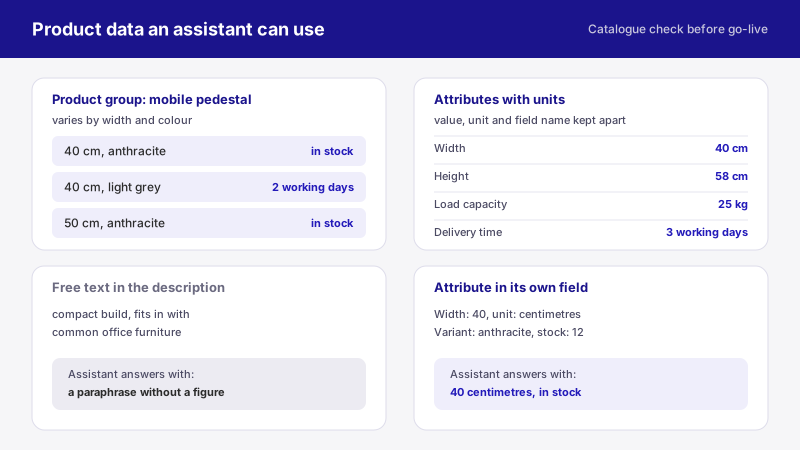
The reason is not decoration. It shows the buyer that her details have been understood, and it makes the suggestion checkable: anyone who reads why a product is supposed to fit quickly notices when an assumption is wrong and corrects it in the next sentence. Which data fields can carry such a reason is described in the article on product data for the shop assistant.
The latest delivery date: state it, do not promise it
Before holidays, delivery time becomes the main question, and this is exactly where the temptation to be obliging is greatest. “Will it arrive by Christmas Eve?” asks for a yes. An assistant may only answer this question from the data the shop has stored: the product’s delivery time, the order cut-off for the holidays, the shipping method. Anything beyond that is a guess, and a guess in the tone of a promise does particular damage here.
Legally, the delivery date is a mandatory piece of information anyway. The information required in distance selling includes the terms of payment, delivery and performance and the date by which the trader undertakes to deliver the goods (Article 246a Section 1 para. 1 no. 10 EGBGB). The assistant is not meant to invent this information anew but to repeat what the shop says about it and point to the passage. It becomes delicate when the chat confirms a date that the buyer has named as decisive. Under the German Civil Code, setting a deadline before rescinding the contract is not required, among other cases, where
the obligor does not render performance by a date specified in the contract or within a period specified in the contract, although timely performance is essential for the obligee according to a notice given by the obligee to the obligor before the contract was concluded or on the basis of other circumstances accompanying the conclusion of the contract
For gift advice this sentence is noteworthy, because a chat before the order is a place where such a notice can be given. The provision does, however, require a date specified in the contract, and its consequence is that no deadline has to be set before rescinding the contract. If the buyer writes that the gift has to arrive by the birthday and the chat confirms a date, it remains open whether that statement becomes part of the contract. That depends on the individual case and is a question for legal advice. For the design of the assistant the conclusion is enough: it states delivery time and order cut-off from the shop data, relates them to the date given and does not promise a date. The table shows the difference using three typical questions.
| Question in the chat | Answer that promises | Answer that states |
|---|---|---|
| Will it arrive by Christmas Eve? | Yes, it will arrive in time. | The product is available. For standard shipping the shop states an order cut-off before the holidays; the shipping page is linked. |
| And if I only order at the weekend? | No problem, that still works. | After the order cut-off the shop does not state delivery before the holiday. An e-mail gift voucher would be an option. |
| Is that binding? | Yes, you can rely on it. | What counts is what the shop states in the checkout and in the order confirmation. I can show you the stored delivery time. |
Gift wrap, greeting card, a different delivery address
Besides the product itself, gift buyers ask about everything around it. Can it be wrapped? Is a card included? Can it go straight to the recipient, and will the price then be on the delivery note? Whether the shop offers this is for the shop alone to decide. The assistant only mentions options that are in the knowledge base or the catalogue, together with their conditions, and it says clearly when an option does not exist.
-
Gift wrapping
Only mention it if the shop offers it, with the surcharge and the products it is not available for, such as bulky goods. A surcharge belongs in the budget calculation.
-
Greeting card
An assistant can help with the wording. The text, however, belongs in the field in the checkout, where the buyer sees it before sending the order.
-
Delivery to another address
Whether and where delivery is possible is governed by the shipping terms. The address itself is taken by the checkout, not by the chat.
-
Receipt without a price
Some shops enclose a gift receipt or leave the price off the delivery note. If that is not available, the assistant says so before the order is placed.
A special case is a gift for relatives abroad. Whether the shop delivers there is not a matter of goodwill; whether delivery restrictions apply must be stated at the latest at the beginning of the ordering process (Section 312j para. 1 BGB), as the article on shipping and delivery time explains. For gift advice, the order of questions matters most: if the gift goes straight to the recipient, the assistant asks for the destination country, not the address, and does so before any product is chosen. It then repeats what the shop has stored about delivery countries, shipping methods and transit times there, so that nobody picks a gift that cannot be sent to its destination or only arrives after the holiday.
Exchanges after the holidays: keep goodwill and withdrawal apart
Besides delivery time, gift buying typically raises a second question: “And what if they do not like it?” In everyday life, two things get mixed up here that an assistant has to keep apart. One is the statutory right of withdrawal that consumers have for distance contracts (Section 312g para. 1 BGB). The period for it is 14 days (Section 355 para. 2 BGB). The other is an exchange the shop offers voluntarily, for instance with an extended period over the holidays. For this exchange, only the conditions the shop has set out apply. In a consumer goods sale, the statutory period begins
as soon as the consumer or a third party named by the consumer, other than the carrier, has received the goods
For gifts, this half-sentence matters. If the goods go straight to the recipient, the recipient is generally the named third party, and the period starts on receipt, not on the day of the celebration. For someone who orders in early December and has the gift delivered directly, the statutory period may run out before it is unwrapped. In addition, the right of withdrawal belongs to the consumer who concluded the contract, which as a rule is the buyer. Both points argue for the assistant naming the shop’s voluntary exchange rule explicitly, if there is one, and not presenting it as the right of withdrawal. How an assistant handles returns after the order is described in the article on order status and returns.
| Feature | Statutory right of withdrawal | Voluntary exchange |
|---|---|---|
| Basis | Sections 312g and 355 BGB | The shop’s terms |
| Period | Set by law, start under Section 356 BGB | As long as the shop sets it |
| Who can use it | The consumer who concluded the contract | Whoever the shop allows, for example the recipient too |
| Exceptions | Among others, goods that are not prefabricated and are clearly tailored to personal needs | As the shop names them |
| What the assistant says | Period and procedure from the withdrawal notice | Period and conditions verbatim from the exchange rule |
When nothing fits: the gift voucher as a way out
Sometimes nothing fits. The budget is too tight for what matches the interests, the order cut-off has passed, or the buyer simply knows too little about the recipient. Then it is better to say so openly than to talk up a weak suggestion. At this point the voucher is not a stopgap but an answer in its own right: delivered digitally, it arrives regardless of shipping, and the choice is made by the person who will use the gift.
For the voucher to work as a way out, the assistant needs its terms from the knowledge base: delivery method, validity, redemption online or in store, handling of remaining balances. For vouchers without a validity period of their own, the regular limitation period of three years (Section 195 BGB) applies. It generally begins at the end of the year in which the claim arose and the creditor became aware of it or would have become aware of it without gross negligence (Section 199 para. 1 BGB). Whether a shorter time limit is effective in an individual case is a matter for legal advice. The assistant states the terms as the shop has published them. It also keeps a gift voucher apart from discount codes, because a voucher is paid-up credit while a discount is a price reduction with its own rules. How discounts are handled in chat is described in the article on vouchers and discounts in chat.
Talking about third parties: what the assistant does not need to know
Gift advice is a conversation about a person who is not present. That makes it more sensitive in terms of data protection than it looks. Personal data must be adequate, relevant and limited to what is necessary in relation to the purposes for which they are processed (Article 5(1)(c) GDPR). For a gift suggestion this means: interests and occasion are needed, the recipient’s name and place of residence as a rule are not. The line becomes particularly clear with one category of information that easily comes up in passing.
Processing of personal data revealing racial or ethnic origin, political opinions, religious or philosophical beliefs, or trade union membership, and the processing of genetic data, biometric data for the purpose of uniquely identifying a natural person, data concerning health or data concerning a natural person's sex life or sexual orientation shall be prohibited.
This sentence affects gift advice more often than one might think. “Something for my mother after her knee operation” is an obvious way of putting it and contains health information about a third person. The assistant does not have to reject it, but it should not ask follow-up questions, should not carry any of it into a profile and should base the advice on what a gift actually needs: something for quiet days, for reading, for the sofa. Article 9 has exceptions; which of them apply to a shop is a question for data protection advice. Four rules for the assistant’s system instruction follow from this.
- Ask about interests and occasion, not about the recipient’s name, place of residence or health.
- Do not pursue health details that are volunteered, and do not repeat them in the suggestions.
- Do not ask for the delivery address in the chat; it belongs in the checkout.
- Do not create a profile of the recipient’s preferences for later occasions.
Set up and measure before the Christmas season
Gift advice pays off all year round, but it is put to the test in the fourth quarter. Starting in October leaves time for a calm pass in six steps. Order cut-offs, delivery notes and stock levels change faster than usual in December; whatever is in the knowledge base should be updated first on those days, ahead of any campaign.
- Check the catalogue: Which products work as gifts, which need no size choice, which sets are there? Where attributes or descriptions for this are missing, add them.
- Store the shipping data: delivery times per shipping method and, once known, the order cut-off dates before the holidays.
- Separate exchange and withdrawal: the voluntary exchange rule as a text of its own, separate from the withdrawal notice, each with period and procedure.
- Add the voucher terms: delivery method, validity, redemption, remaining balances.
- Extend the system rules: no promised dates, no questions about health or names, a note on exceptions to withdrawal for personalised products.
- Write test cases: ten typical gift requests with the expected answer, including one without a suitable product and one after the order cut-off.
Whether gift advice works does not show in individual successful conversations but in patterns. Anyone reviewing the gift-related conversations in the first weeks should look at three things: how often a conversation leads to a suggestion, how often the voucher was the way out and which requests remained without a suitable product. The third is the most valuable, because it reveals gaps in the range or in the product data that search statistics often do not show. Which topics pile up and which questions were left without a source is shown by conversation analytics.
Frequent questions
How does gift advice differ from ordinary purchase advice?
In gift advice, the buyer is not the user. The assistant therefore asks about what the buyer knows, such as occasion, budget, relationship and interests, and tends to prefer products that assume little, for example those without a size choice. On top of that, delivery date, wrapping and exchange become topics of their own, which usually sit on the margins of ordinary advice.
May the assistant promise that a gift will arrive in time?
That is not advisable. The assistant should state delivery time and order cut-off as the shop has stored them and not promise a date. If a delivery date is specified in the contract and the buyer said before the contract was concluded that it is essential to her, she can rescind the contract without setting a deadline if delivery is late (Section 323 para. 2 no. 2 BGB). Whether a date confirmed in the chat becomes part of the contract depends on the individual case; that is for legal advice to clarify.
How long can a gift be returned?
The period for the statutory right of withdrawal in distance selling is 14 days (Section 355 para. 2 BGB) and in a consumer goods sale generally begins on receipt of the goods, even if a named third party receives them. Some shops also offer a voluntary exchange; for that, only their own terms apply, which the assistant should repeat verbatim from the knowledge base.
Can the recipient exchange the gift themselves?
As a rule, the statutory right of withdrawal belongs to the consumer who concluded the contract. Whether the shop also accepts an exchange by the recipient, for instance with a gift receipt, is governed by its own terms. The assistant should say so as stated there and, in case of doubt, hand over to the team.
What happens if no product fits?
Then the assistant should say so openly and offer alternatives: a different interest, an adjusted budget limit or a gift voucher. With the XICBOT Pro package, products, prices and availability come from the connected catalogue in Shopware Community Edition, and the answers as a rule name the passage as a source reference. The assistant states the voucher terms as the shop has stored them.
What information about the recipient does the assistant need?
As a rule, occasion, relationship and interests are enough. A gift suggestion typically does not need the name, place of residence or health details; under Article 9(1) GDPR, data concerning health belong to the specially protected categories. The delivery address is taken by the checkout, not by the chat.
Ask it yourself, Assistant of this website
Automated assistant