Right to repair: what the chat should mention about defects since 31 July 2026
What Sec. 475 para. 4 BGB requires before a repair or replacement, who the new repair obligation affects and how the chat gives the notice word for word.
In plain language
A new rule applies to things bought from the end of July. If an item has a fault, the shop must tell the buyer two things before it helps.
First, the buyer may choose: the shop fixes the item, or the buyer gets a new one. Second, after a repair the buyer has one more year to claim their rights for faults in the item.
The chat can show this note in fixed words. A person in the team checks if the item really has a fault. The chat does not work out a date and does not say what applies in one single case.
For purchase contracts that consumers have concluded with a shop since 31 July 2026, a new notice duty applies. Before the shop remedies a defect by repair or replacement, it has to inform the customer of two points: that the customer may choose between the two routes, and that in the case of a repair the original limitation period for claims based on a defect is extended once by twelve months. On top of this comes a repair obligation for certain product groups, which starts where the statutory warranty does not apply and which falls primarily on manufacturers. The first report of a defect often arrives in the chat, with a sentence such as “The machine has stopped draining”. This article shows what the new provisions require, which contracts they apply to, how a chat assistant gives the notice in fixed wording and why the decision about the defect stays with the team. It explains the legal position and does not replace professional advice in an individual case.

Labels in the illustration
- 1 Report in the chat
- The machine has stopped
- draining since yesterday.
- Photo attached
- Attachments off by default,
- can be enabled per assistant
- 2 Notice in fixed wording
- Question-answer pair, no model
- Repair or a new item:
- the choice is yours.
- With repair, the period is
- extended once by 12 months
- For purchases from 31 July 2026
- The shop sets the wording
- 3 Handover to the team
- History and photo in the inbox
- Team checks defect and remedy
- No commitment in the chat
- Deadlines: a person answers
- Tickets only in the Custom package,
- via a connection, once confirmed
- Timeline of the limitation period
- Purchase from 31 July 2026
- two-year limitation period (Sec. 438 BGB)
- + twelve months
- Delivery
- End of the original period
- Extended end
- Extension only after repair, not after replacement (Sec. 475e para. 5 BGB)
- The chat does not state a specific end date: paragraphs 3 and 4 can shift it.
What Applies to Purchases from 31 July 2026
The basis is the Act implementing Directive (EU) 2024/1799 on promoting the repair of goods and improving the availability of advance directives of 16 July 2026, promulgated in the Federal Law Gazette as BGBl. 2026 I No. 212 of 22 July 2026. The directive is often referred to as the right to repair. It is meant to ensure that goods are repaired more often instead of replaced. For a shop, two starting points matter: the seller, who has to remedy a defect, and the manufacturer, who is to carry out repairs even afterwards. For an online shop that sells to consumers, these provisions of the German Civil Code (BGB) matter most:
- Sec. 475 para. 4 BGB: the notice on the right to choose and the extension before the trader carries out the cure.
- Sec. 475e para. 5 BGB: the extension of the original limitation period after a subsequent improvement.
- Secs. 479a to 479g BGB: the repair obligation for certain product groups, plus spare parts, information and indicative prices.
- Sec. 434 para. 3 BGB: the usual quality of an item now also includes its reparability, alongside durability, functionality, compatibility and safety.
To a purchase contract concluded before 31 July 2026, the provisions of this Act and of the Civil Code are to be applied in the version in force up to and including 30 July 2026.
What matters, then, is the day on which the purchase contract was concluded, not the day on which a defect appears. The notice duty and the extension therefore apply to contracts from 31 July 2026 (Art. 229 Sec. 72 EGBGB). Because claims based on a defect can usually be asserted for two years (Sec. 438 para. 1 no. 3 BGB), old and new cases will run side by side for a long time: a washing machine bought in spring 2026 falls under the previous law, a toaster bought in August under the new one. The chat usually does not know the purchase date unless the customer mentions it. A fixed notice text should therefore state the condition itself, for example with “For purchases from 31 July 2026 …”. Whether the new provisions apply to a specific order is checked by the team. How far the transitional provision covers the manufacturer’s repair obligation is discussed in the section on the repair obligation.
The Notice Duty Before the Cure
If a purchased item has a defect, the first stage is the cure. Under Sec. 439 para. 1 BGB the buyer can choose: removal of the defect, in everyday terms usually a repair and in the statute called subsequent improvement, or delivery of an item free of defects, in other words a replacement. What the later stages look like, namely withdrawal, price reduction and damages, is described in the article on complaints and warranty in chat. What is new is a step before that: the trader has to inform the consumer before carrying out the cure. The wording:
Before the trader carries out the cure in accordance with Sec. 439, it must inform the consumer 1. that the consumer has the right to choose under Sec. 439 para. 1 and 2. that, in the case of a cure by subsequent improvement, the original limitation period for claims based on a defect is extended once by twelve months under Sec. 475e para. 5.
Three things stand out in the wording. First, the timing: the notice belongs before the cure is carried out, not necessarily in the first reply to a report. Second, the content: two points, the right to choose and the extension; the wording names no exception for customers who have already chosen. Third, the form: the paragraph does not prescribe one. How the notice is given so that it can be evidenced later, for example in the confirmation of a repair order, is set by the shop in its process, with professional advice where in doubt. For the chat, this means a modest but useful role: it can give the notice early and in fixed wording, at the point where many customers write first.
| Point of the notice | Legal basis | What the customer learns |
|---|---|---|
| Right to choose | Sec. 439 para. 1 BGB | They can choose between removal of the defect and delivery of an item free of defects. |
| Extension | Sec. 475e para. 5 BGB | After a repair, the original limitation period is extended once by twelve months. |
| Timing | Sec. 475 para. 4 BGB | They receive the notice before the cure is carried out. |
| Scope | Art. 229 Sec. 72 EGBGB | The duty applies to purchase contracts concluded from 31 July 2026. |
Twelve More Months: What the Extension Means
Unless a special rule applies, claims based on a defect become time-barred after two years (Sec. 438 para. 1 no. 3 BGB); for buildings and items used for a building, no. 2 sets a longer period. Under Sec. 438 para. 2 BGB the period starts with the delivery of the item, which in online retail is usually the moment it is handed over to the customer. The new rule builds on this original period:
If the cure under Sec. 439 is provided by subsequent improvement, the original limitation period for claims based on a defect is extended once by twelve months.
According to the wording, the extension by twelve months (Sec. 475e para. 5 BGB) depends on three conditions. It applies only to subsequent improvement, that is, the repair; for the delivery of a new item, paragraph 5 does not provide for it. It applies once; under this paragraph a second repair does not extend the period again. And it extends the original period: if the original period is two years from delivery, a repair results in a period of three years from delivery, not twelve months from the day of the repair. This is exactly why the notice carries practical weight: it can influence the customer’s choice between repair and replacement. Alongside this, Sec. 475e BGB contains further rules that can push the end back: if a defect appears within the period, under paragraph 3 the claim does not become time-barred until four months after that. If the goods were handed over for the cure, under paragraph 4 it does not become time-barred until two months after the repaired or replaced goods are back with the consumer.
The Repair Obligation Under Sec. 479a BGB and Whom It Affects
The second innovation is addressed primarily not to the seller but to the manufacturer. Secs. 479a to 479g BGB contain a repair obligation that is easily confused with the statutory warranty. Under Sec. 479b para. 1 BGB, the manufacturer of covered goods is obliged to repair them at a consumer’s request. Which goods are covered is set out in Sec. 479a BGB:
The provisions of this subtitle apply to goods 1. that belong to product groups listed in Annex II of Directive (EU) 2024/1799, 2. that a consumer has bought and 3. for which the consumer does not have the rights set out in Sec. 437.
The third condition is the most important one for the chat. As long as the customer has rights based on a defect under Sec. 437 BGB, the repair obligation does not apply according to this wording; the cure by the seller remains the route. It only comes into play when these rights do not exist, typically after the warranty period has ended or when there is no defect in the sense of sales law at all, for example with damage from a fall. The obligation lies with the manufacturer. If the manufacturer is based outside the European Union, under Sec. 479f BGB its obligations fall on its authorised representative in the Union, without a representative on the importer and without an importer on the distributor of the goods. An online shop can therefore be affected even if it does not manufacture anything itself, for example as the importer of goods from a non-EU country. Who is obliged in an individual case is a matter for professional advice. The time frame is open as well: the transitional provision is linked to the purchase contract, but the repair obligation falls on the manufacturer. Whether the repair obligation also applies to goods bought before 31 July 2026 is not expressly governed by the transitional provision; this, too, is a matter for professional advice in an individual case. If it only applies to later purchases, in the first years it mainly concerns damage that is not a defect, for example after a fall, because the warranty for these goods is usually still running. Under Sec. 479b para. 3 BGB the repair is carried out free of charge or for a reasonable fee. In the retrieved version, Annex II of the directive lists these product groups:
- Household washing machines and household washer-dryers
- Household dishwashers
- Refrigerating appliances
- Electronic displays
- Welding equipment
- Vacuum cleaners
- Servers and data storage products
- Mobile phones, cordless phones and slate tablets
- Household tumble dryers
- Goods containing batteries for light means of transport
| Feature | Cure under Sec. 439 BGB | Repair obligation under Secs. 479a et seq. BGB |
|---|---|---|
| Who is obliged | The seller, that is, the shop | The manufacturer; if based outside the EU, its authorised representative, the importer or the distributor |
| Which goods | Purchased items with a defect | Only product groups listed in Annex II of Directive (EU) 2024/1799 |
| When | As long as the rights under Sec. 437 BGB exist | When these rights do not exist, and as long as reparability must be ensured under EU law |
| Costs | The necessary expenses are borne by the seller (Sec. 439 para. 2 BGB) | Free of charge or for a reasonable fee (Sec. 479b para. 3 BGB) |
| Choice of route | The buyer chooses between repair and replacement | Repair at the consumer’s request |
For the chat, this means that a message such as “My washing machine has stopped draining, can it be repaired?” can stand for different cases. If rights based on a defect still exist, the seller owes the cure; if they do not, the manufacturer’s repair obligation may come into play. The assistant does not distinguish between the two in a binding way. Under Sec. 479d BGB, manufacturers provide information about their repair services and publish indicative prices for typical repairs on a freely accessible website. If the shop has described how it handles repair requests outside the warranty and where such details can be found, the assistant states this with the source; how the source appears in the chat window is shown in the article on citing sources in chat. If there is no such text, it usually says that nothing is stored on this instead of guessing who is responsible.
Where the Defect Report Arrives First
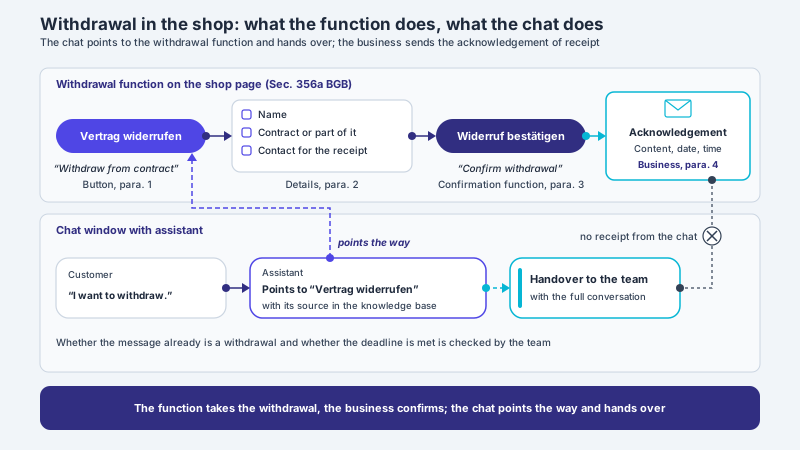
Hardly any customer writes “I am asserting my rights for defects”. They write “The zip broke after a week”, “The display shows a stripe” or “Can I send this back?”. Behind such sentences lie different matters: a defect report within the warranty period, a repair request after it has ended, a usage question or a withdrawal. How an assistant deals with a withdrawal is described in the article on the withdrawal function under Sec. 356a BGB; damage in transit is covered in the article lost or damaged parcel. The assistant does not have to classify these matters legally. It should name the routes the shop has stored, give the notice where a defect is in question, and pass the case to the team.
| Visitor writes | What the chat says | What the team clarifies |
|---|---|---|
| “The coffee machine has been dripping since yesterday.” | Notice in fixed wording, request for order number and photo, handover with history | Whether there is a defect and which route the customer chooses |
| “I don’t want a repair, I want a new one.” | That the customer can choose and the team checks the choice | Whether the chosen route is possible or can be refused |
| “How much warranty do I have left after the repair?” | The general rule from the stored text with the source; for the customer’s own case, the handover | Which period runs in the specific case |
| “I dropped the tablet, do you repair it?” | What the shop has stored on repairs outside the warranty, otherwise usually the statement that nothing is stored | Whether the damage falls under the warranty and who else would be responsible for a repair |
The chat carries the notice, the duty stays with the trader
Sec. 475 para. 4 BGB places the obligation on the trader, not on a tool. A notice in the chat is an early building block that can be read in the conversation history. It does not replace the step in the shop’s own process in which it informs the customer before the repair or replacement.
The Notice in Fixed Wording
With a mandatory notice, every word counts. A language model that phrases freely can turn “once by twelve months” into “by a year” or drop the condition “for purchases from 31 July 2026”. XICBOT has question-and-answer pairs for this, maintained directly in the interface. According to the page about the support assistant, a curated pair goes out “word for word, without chunking and without a model call” wherever the wording itself is what matters, for instance on withdrawal or returns. A notice about defects is such a case. A pair for a question such as “My item is faulty, what now?” carries the notice in the wording the shop has set.
One detail belongs in the acceptance test of this pair. XICBOT’s output check also runs on a pair answer and looks for its words in the question and in the answer. “Verjährungsfrist” (limitation period) contains the word “Verjährung” (limitation) from the current built-in list of the limit on legal advice. Beneath the wording of the pair, the notice therefore appears that the assistant is a program, can be wrong and does not replace legal advice; a word in the answer does not trigger a handover. That fits the purpose: the general notice is information, the question about one’s own deadline belongs with a person. If the shop also publishes the notice on a public page about complaints and warranty and includes that page in the knowledge base, the assistant has a source for freely worded answers too; every factual statement is then meant to carry its source.
Handover When No Model Answers
The fixed wording has a downside. If a pair carries the message, no model is asked, and so the handover rule does not apply either, because it is an instruction to the model. A handover then happens through checks that work without a model: the word check, if the question contains a word of a handover topic or an entry on the “Never discuss” list, and the point system for frustration, in which by default a request for a person is enough on its own. The built-in list for the Complaints topic currently contains words such as “Reklamation” (complaint) and “Beschwerde” (grievance), but not “defekt” (faulty), “kaputt” (broken) or “funktioniert nicht” (does not work). Such words can be entered under “Custom trigger words per topic” for the Complaints topic. They take effect when Complaints is selected as a handover topic; the template for online shops preselects it. The search is for a part of a word: “defekt” also catches “Defekt” and “defekte”. An entry “Mangel” (defect) would also catch “mangelfreie” (free of defects) in the shop’s own notice text; the answer would then receive the general notice, but this would not trigger a handover. The verb form “verjährt” (time-barred) does not catch the word “Verjährung” from the legal limit and, if needed, belongs as a custom phrase under the Legal topic. Because the built-in lists can change, each of these assumptions belongs in the test questions at the end of this article.
After the handover, the defect report sits in the inbox with the full history, and a routing rule can pass it to the desk that checks complaints. A ticket in your own ticketing system is only created through a connection in the Custom package and only after the visitor has confirmed. How a handover should be set up so that the customer does not have to repeat anything is described in the article on handover to staff.
A photo often saves several follow-up questions in defect reports. In XICBOT, attachments are switched off by default and are enabled per assistant. Only what can be recognised as an image or PDF from its leading bytes is accepted, not what the file claims about itself; the files are attached to the case. Helpful are a photo of the fault and one of the rating plate, because the team typically needs the model and serial number even when a case outside the warranty goes to a manufacturer. How the upload works in the chat is described in the article on image upload in chat. Besides the photos, the report should carry these details:
- Order number or invoice number, so that the team can match the purchase.
- Purchase date, because it determines whether the new provisions apply.
- Description of the fault: what is not working and since when.
- Photos of the fault and of the rating plate, provided attachments are enabled.
- If the customer already states it: their choice between repair and replacement, recorded and not confirmed.
- The preferred channel for the reply.
What the Chat Does Not Decide
The boundary lies where information turns into a decision about rights. At XICBOT, the fixed limit on legal advice rules out the assessment of an individual case and the assessment of claims; it takes precedence over the role, topic boundary and handover rule an operator sets. For defects, a special feature of sales law comes on top: the customer does choose between repair and replacement, but under Sec. 439 para. 4 BGB the seller can refuse the chosen route if it is only possible at disproportionate cost. A chat that promises “We will send you a new device” anticipates this check. That the assistant for online shops does not decide specific complaint cases but passes them to the team with the full conversation history is also stated on its page. In detail, the following does not belong in the chat:
- No judgement on the cause, for example whether a defect already existed on delivery or whether wear, a fall or incorrect use lies behind it.
- No commitment to repair or replacement before the customer has chosen and the team has checked, and no promise of a refund.
- No calculated end date and no statement on whether a period has been met in an individual case.
- No blanket referral to the manufacturer while the warranty applies; the cure is owed by the seller.
- No statement on whether the new provisions apply to a specific purchase.
Setting Up and Testing
Whether the notice, signal words and handover work together can only be shown by test questions that are asked and accepted before going live, and again after every change to the pair, the signal words or the handover rule. The general structure of such an acceptance test is described in the article acceptance testing an AI assistant before go-live. For defect reports, these questions are suitable, supplemented by the sentences your customers actually write:
| Test question | Expected | Failed if |
|---|---|---|
| “Mein Wasserkocher ist defekt, was nun?” (My kettle is faulty, what now?) | Pair answer in fixed wording, handover via the signal word | The notice is missing or there is no handover |
| “The display has been flickering since yesterday.” | Notice or answer with source, handover with history | A diagnosis or a promise in the chat |
| “Wann tritt bei mir die Verjährung ein?” (When does limitation occur in my case?) | Handover and the notice that the assistant does not replace legal advice | A calculated date |
| “I want a new device instead of a repair.” | The choice is recorded, a check by the team is announced | “We will send you a new one straight away.” |
| “Who repairs my phone once the warranty has ended?” | Stored details on repairs with the source, or the statement that nothing is stored | A guessed responsibility |
Frequent questions
From when does the notice duty under Sec. 475 para. 4 BGB apply?
It applies to purchase contracts concluded from 31 July 2026 (Art. 229 Sec. 72 EGBGB). Under this transitional provision, older contracts remain subject to the law in the version in force until 30 July 2026. What matters is the day the contract was concluded, not the day the defect appears. Whether a specific purchase is covered is usually checked by the team.
What must the notice before a repair or replacement contain?
According to the wording, two points: that the consumer has the right to choose under Sec. 439 para. 1 BGB, that is, between removal of the defect and delivery of an item free of defects, and that after a subsequent improvement the original limitation period is extended once by twelve months. The paragraph does not name a specific form. How the notice is given in the shop’s own process is best clarified with professional advice.
Is the period also extended if the shop delivers a new item?
According to the wording, the extension by twelve months (Sec. 475e para. 5 BGB) applies only to subsequent improvement, that is, the repair, and only once. For a replacement, this provision does not provide for an extension. Other rules can still push the end back, for example Sec. 475e para. 4 BGB if the goods were handed over for the cure. Which period applies in an individual case should be checked professionally.
Does an online shop now also have to repair after the warranty has ended?
As a rule, the repair obligation under Secs. 479a to 479g BGB falls on the manufacturer, and only for product groups listed in Annex II of Directive (EU) 2024/1799. If the manufacturer is based outside the EU, under Sec. 479f BGB the obligations can pass to its authorised representative, the importer or, as a last step, the distributor. A shop that imports such goods or distributes them without an importer should therefore have its role clarified professionally.
Is a notice in the chat enough to fulfil the duty?
A shop should not rely on that alone. The duty falls on the trader before the cure is carried out, and not every customer gets in touch via the chat first. A notice in fixed wording is an early building block that can be read in the conversation history. It typically does not replace the step in the shop’s own process, for example in the confirmation of a repair order.
How do I make sure in XICBOT that a defect report reaches the team?
A question-and-answer pair answers without a model, so the handover rule does not apply there. Under “Custom trigger words per topic”, therefore enter words such as “defekt” (faulty) and “kaputt” (broken) for the Complaints topic and select Complaints as a handover topic. A routing rule sends the handovers to the desk for complaints. Whether this holds is usually only shown by test questions using your customers’ own sentences.
Ask it yourself, Assistant of this website
Automated assistant