Chat Assistant, Form or Live Chat Compared
Contact form, staffed live chat or AI assistant: cost, response time, availability and scalability compared, and which combination suits your website.
In plain language
How customers reach you affects how many ask at all. A form is enough when nobody must reply at once. But each follow-up question then costs a day. A live chat with staff gives good advice. But it only works in office hours. An AI assistant answers day and night. What matters is a clean handover to people. Often the mix works: a fast first answer and advice from people.
Anyone who wants to make contact on a website usually meets one of three paths: a contact form, a live chat with a human at the other end, or an AI chat assistant. At best all three lead to the same goal, an answered question or a new enquiry, yet they differ sharply in cost, response time, availability and scalability. Choosing the wrong path wastes enquiries: around 62 percent (Harvard Business Review) of customers have had to make contact more than once to resolve a single issue, and 54 percent (Forrester) of US online consumers even believed in 2019 that interacting with a chatbot would have a negative impact on their quality of life. This article compares the three contact paths soberly, along the questions of cost, response time, availability, scalability and combinability, and shows why the best answer is rarely an either-or but a well-considered combination, with the AI assistant as a 24/7 first contact and a clean handover to people.
%3C%2Ftext%3E%3Crect%20x%3D'285'%20y%3D'330'%20width%3D'229'%20height%3D'62'%20rx%3D'10'%20fill%3D'%23ffffff'%20stroke%3D'%23e2e8f0'%20stroke-width%3D'1.2'%2F%3E%3Ctext%20x%3D'399.5'%20y%3D'360'%20font-family%3D'system-ui%2C%20sans-serif'%20font-size%3D'24'%20fill%3D'%230e7490'%20font-weight%3D'800'%20text-anchor%3D'middle'%3E54%25%3C%2Ftext%3E%3Ctext%20x%3D'399.5'%20y%3D'375'%20font-family%3D'system-ui%2C%20sans-serif'%20font-size%3D'7.5'%20fill%3D'%23475569'%20font-weight%3D'600'%20text-anchor%3D'middle'%3Eexpected%20in%202019%20chatbots%20to%20lower%20their%3C%2Ftext%3E%3Ctext%20x%3D'399.5'%20y%3D'385'%20font-family%3D'system-ui%2C%20sans-serif'%20font-size%3D'7.5'%20fill%3D'%2364748b'%20font-weight%3D'600'%20text-anchor%3D'middle'%3Equality%20of%20life%20(US%20respondents%2C%20Forrester)%3C%2Ftext%3E%3Crect%20x%3D'530'%20y%3D'330'%20width%3D'230'%20height%3D'62'%20rx%3D'10'%20fill%3D'%23ffffff'%20stroke%3D'%23e2e8f0'%20stroke-width%3D'1.2'%2F%3E%3Ctext%20x%3D'645.0'%20y%3D'360'%20font-family%3D'system-ui%2C%20sans-serif'%20font-size%3D'24'%20fill%3D'%234338ca'%20font-weight%3D'800'%20text-anchor%3D'middle'%3E7x%3C%2Ftext%3E%3Ctext%20x%3D'645.0'%20y%3D'375'%20font-family%3D'system-ui%2C%20sans-serif'%20font-size%3D'7.5'%20fill%3D'%23475569'%20font-weight%3D'600'%20text-anchor%3D'middle'%3Ehigher%20chance%20to%20qualify%3C%2Ftext%3E%3Ctext%20x%3D'645.0'%20y%3D'385'%20font-family%3D'system-ui%2C%20sans-serif'%20font-size%3D'7.5'%20fill%3D'%2364748b'%20font-weight%3D'600'%20text-anchor%3D'middle'%3Ewithin%20one%20hour%20(HBR)%3C%2Ftext%3E%3Crect%20x%3D'40'%20y%3D'398'%20width%3D'720'%20height%3D'38'%20rx%3D'10'%20fill%3D'%23312e81'%2F%3E%3Ctext%20x%3D'400'%20y%3D'421.6'%20font-family%3D'system-ui%2C%20sans-serif'%20font-size%3D'10'%20fill%3D'%23e0e7ff'%20font-weight%3D'600'%20text-anchor%3D'middle'%3EThree%20paths%2C%20one%20goal%3A%20be%20quickly%20reachable%20and%20still%20involve%20people%3C%2Ftext%3E%3C%2Fsvg%3E)
Labels in the illustration
- Criterion
- Contact form
- classic
- Live chat
- with staff
- AI assistant
- around the clock
- Recommended
- Availability
- intake only
- office hours
- around the clock
- Response time
- later
- short if staffed
- short, also at night
- Scalability
- unlimited
- staff-limited
- in parallel
- Cost per contact
- low
- staff-heavy
- low to run
- How an AI assistant ties the three paths together
- Website visitor
- AI assistant
- 24/7 first contact
- Routine solved in chat
- Complex: handover to team
- Reachable in the evening, pre-qualifies, hands over to people with full context
- 80%
- of common service issues resolved
- by agentic AI by 2029 (Gartner)
- 54%
- expected in 2019 chatbots to lower their
- quality of life (US respondents, Forrester)
- 7x
- higher chance to qualify
- within one hour (HBR)
- Three paths, one goal: be quickly reachable and still involve people
Why the Choice of Contact Path Decides Enquiries
The path a visitor uses to make contact is not a detail but decides whether interest turns into an enquiry. Expectations have shifted: customers want an immediate response, around the clock and without following up several times. Gartner expects digital-first technologies such as self-service and live chat to overtake the classic channels of phone and email as the most valuable service technologies by 2027 (Gartner). At the same time the market for AI technologies keeps growing: a worldwide market size of 617.62 billion US dollars (Statista) is expected for 2026, and around 1.42 trillion US dollars by 2032; Statista names consumer-facing applications such as virtual assistants and chatbots as one of the drivers. Anyone offering only a form today is measured against expectations shaped by fast, dialogue-capable channels.
The Contact Form: When It Is Enough
The contact form is the cheapest and simplest path: it is quickly added, incurs no ongoing staff costs and delivers structured details to the inbox. That is precisely its strength when enquiries are rare, uniformly structured, and no one expects an immediate answer. The price is friction: every additional field holds visitors up. In e-commerce checkouts the average flow still contains around 11.3 form fields (Baymard Institute), and a better designed checkout can lift the conversion rate of an average online shop by around 35 percent (Baymard Institute) through design alone; similar logic applies to contact forms. On smartphones in particular, which account for more than half of website visits (Statcounter), long forms are tedious.
- Enquiries are rare and fit into a few, uniform fields
- An immediate answer is not expected, a reply on the next working day is enough
- The details are clearly defined, such as name, email and a short message
- There are hardly any recurring questions that would need clarifying first
- The effort of a staffed chat is not worth it at the enquiry volume
The form reaches its limit as soon as the visitor has a question before they enquire. A form delivers an enquiry but answers nothing. Someone who wants to know whether a provider is even responsible gets no information and, in doubt, closes the tab. An AI assistant can close this gap and still pre-fill the existing form at the end once the visitor has confirmed the details, as the article on qualifying leads via chat instead of long forms shows in detail. The form does not disappear; it gains a conversation partner in front of it.
The Live Chat With Staff: Strength and Limit
A human-staffed live chat is the most personal of the three paths. It plays to its strengths when cases that need explanation are solved in direct dialogue, when empathy and judgement are called for, and when there are enough staff. For complex or delicate concerns the human remains indispensable, as Gartner puts the share of service issues fully resolved through self-service today at only around 14 percent (Gartner). The limit of live chat, however, is structural: it is only staffed when someone is at their desk, and it does not scale freely, because one agent cannot hold ten demanding conversations at once.
-
Personal and flexible
A human picks up on nuance, engages with special cases and makes judgement calls. For complaints, goodwill and sensitive topics there is no substitute.
-
Tied to office hours
Outside service hours the live chat stays empty. Enquiries in the evening, at the weekend or from other time zones run into nothing or end up back in the form.
-
Limited scalability
When many enquiries arrive at once, waiting times appear or more staff are needed. Quality depends directly on the number of available agents.
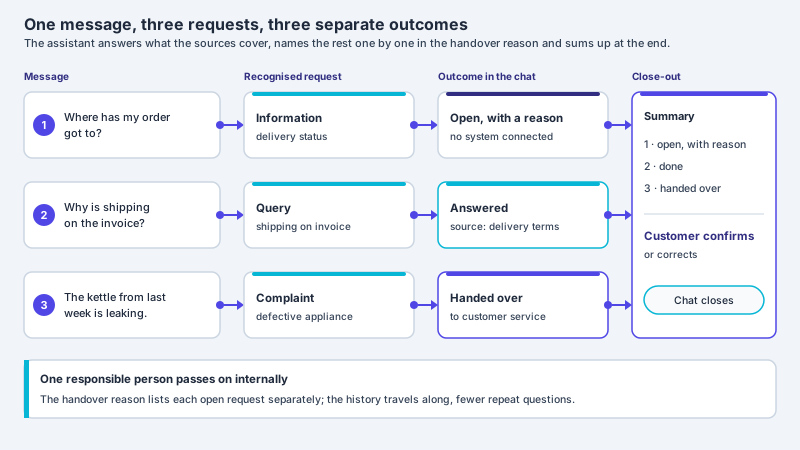
On top of this comes the cost factor. A staffed chat ties up people who do nothing else during that time, and covering off-peak hours in particular is expensive. That is why live chat is rarely the solution for the mass of recurring standard questions, but for the demanding cases where a human is genuinely needed. This is exactly where the combination comes in: the AI assistant takes over the routine and passes on the cases that require human judgement with full context, as the article when the AI assistant should hand off to a human describes.
The AI Assistant: Around the Clock, Scalable, With Handover
The AI chat assistant fills the gap between form and live chat. It is reachable around the clock, replies without waiting for a free agent, holds many conversations in parallel and qualifies concerns before a human is needed at all. Gartner expects agentic AI to resolve around 80 percent (Gartner) of common service issues without human intervention by 2029, with operating costs falling by about 30 percent (Gartner). And Gartner expects that by 2028 around 30 percent (Gartner) of Fortune 500 companies will offer service through only a single, AI-enabled channel. This is no longer a distant vision but a direction customer service is moving towards.
-
Around the clock
The assistant replies at night, on weekends and on holidays, without an on-call rota. The first contact happens at the moment of interest, instead of waiting until the next working day.
-
Scales in parallel
Whether one enquiry arrives or many at once, all draw on the same knowledge base. Peaks can be absorbed without extra staff.
-
Hands over with context
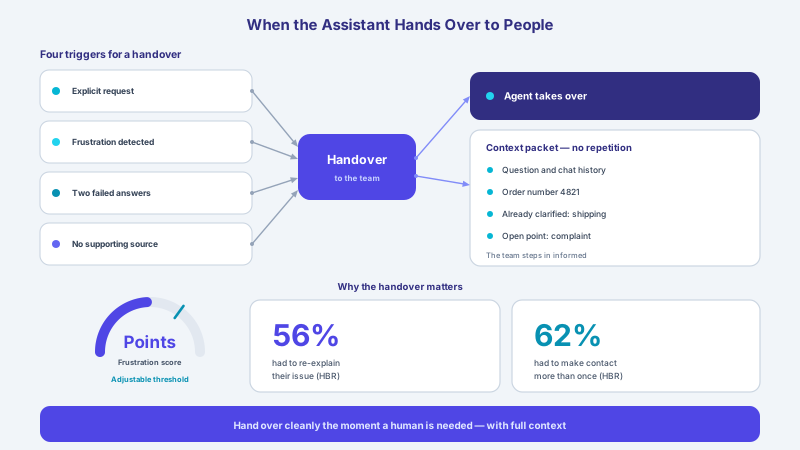
Whatever the assistant cannot resolve with confidence, it is meant to pass to a human with the full conversation history, so no one has to repeat themselves.
Not every chatbot is meant here
That 54 percent (Forrester) of US online consumers expected interacting with a chatbot to harm their quality of life has a lot to do with poor, generic bots that answer in circles. An assistant individually trained on your content, with a visible option to reach a human, is something different. What sets it apart is shown in the article on a custom-trained assistant instead of a standard chatbot.
The Five Criteria in a Direct Comparison
Rather than crowning an overall winner, it pays to look at the individual criteria. Each path has strengths, and which ones count depends on your enquiry volume, complexity and your audience's expectations. The following comparison sums up where form, live chat and AI assistant are strong and where they are weak.
| Criterion | Form | Live chat | AI assistant |
|---|---|---|---|
| Availability | Intake anytime, answer later | Only during office hours | Around the clock, no office hours |
| Response time | Delayed, via reply | Short when staffed | Short, also outside office hours |
| Cost | Low, barely ongoing | Staff-intensive | Setup, then low |
| Scalability | Unlimited intake | Limited by staff | Many in parallel |
| Qualification | Only afterwards | In chat, staff-dependent | Automatic in the conversation |
| Handover to a human | Not applicable | Is the human | With full context |
It becomes clear: the form scores on cost and intake scalability, the live chat on the personal handling of complex cases, the AI assistant on availability, response time and parallel scalability. No path is superior in everything, and that is exactly why the combination is so effective.
Cost Considered Honestly
At first glance the form is unbeatably cheap, but that calculation is incomplete. The real cost of a form is the enquiries it does not deliver, because visitors give up beforehand or get no answer to their in-between question. The live chat, by contrast, causes visible, ongoing staff costs that rise with enquiry volume and the desired availability. The AI assistant sits in between: it requires an initial setup and upkeep of the knowledge base, but then runs at comparatively low ongoing cost and absorbs exactly the routine that otherwise ties up staff. Gartner expects agentic AI to reduce operating costs in customer service by around 30 percent (Gartner) by 2029.
Response Time and Availability as a Conversion Lever
The speed of the first response often decides the quality of an enquiry. An often-cited study found that companies contacting a prospect within an hour are around 7 times (Harvard Business Review) as likely to have a qualifying conversation with a decision maker as those that wait even an hour longer. A form with an answer on the next working day wastes exactly this window, a live chat hits it only during office hours, an AI assistant hits it around the clock. On top of this comes the frustration over breaks: 56 percent (Harvard Business Review) of the customers surveyed reported having to re-explain an issue in customer service.
The Best Path Is Often the Combination
Playing the three paths off against each other is misleading. In practice they complement one another: the AI assistant takes the first contact around the clock, answers recurring questions, qualifies concerns and pre-fills the existing form when needed, once the visitor has confirmed the details. As soon as a case requires human judgement, it hands over to the live chat or the team with full context. That people in service are supported by assistance systems is becoming the norm: Gartner expected that by the end of 2025 around 73 percent (Gartner) of customer service organizations would have implemented agent assist solutions that can provide their staff with real-time customer insights and prompts. And Forrester expects one in four brands to increase its successful simple self-service interactions by about 10 percent (Forrester) by the end of 2026.
- The AI assistant is the 24/7 first contact and answers the common questions itself
- For a concrete enquiry it qualifies in the conversation and pre-fills the form once the visitor confirms
- Sensitive or complex cases it is meant to hand to a human with the full history
- With XICBOT the handover lands in the inbox, where a staff member can take over the conversation; there is no switch by office hours
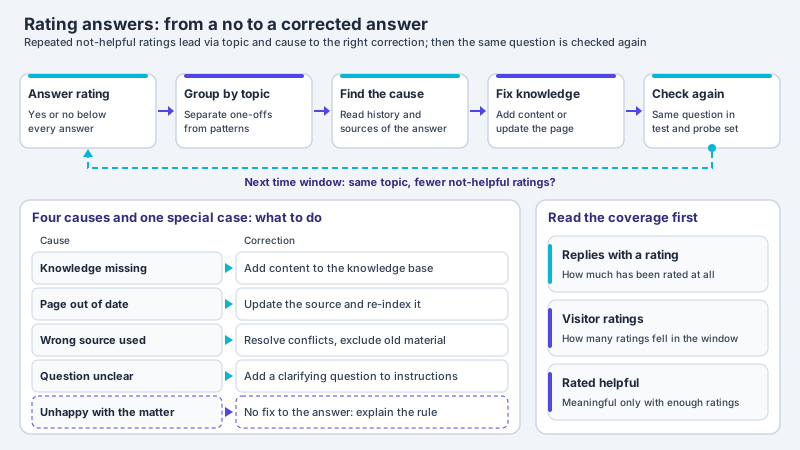
- The conversations continuously produce knowledge that improves the assistant and the website
One conversation, several stations
For the visitor, the switch between automatic help, form and human should feel like one continuous conversation, not three separate systems. How an assistant resolves as much as possible itself and passes on only the rest is shown in the article on reducing the support load with a 24/7 AI assistant; the data-based improvement is handled by conversation analytics.
Which Path Suits Which Industry
Which mix makes sense depends on the business. An online shop benefits from the assistant that clarifies availability, shipping and, once your inventory system is connected in the Custom package, order status around the clock and recovers abandoned carts in chat, while complex complaints are meant to go to the team. For service providers and in the trades, what counts above all is a fast, qualified response: the assistant separates emergency from plannable job with a few questions and hands over the finished lead before the first callback is needed.
In regulated or sensitive fields the limits are tighter. A law firm lets the assistant ask about process, jurisdiction and deadlines, but gives no legal advice and hands every individual question to a human. A medical practice answers consultation hours and appointment requests automatically, but leaves medical assessments to the team. So the pattern stays the same in every industry: the assistant takes the routine, the form gathers structured details, and the human decides where it counts. Which cases make sense per industry is bundled in the industries overview.
Honest Limits and Data Protection
Honesty means naming the limits. An AI assistant can err and is therefore bound to your own sources; sensitive cases it is meant to pass deliberately to humans. A live chat is only as good as the staff behind it, a form only as good as the attention with which the inbox is handled. And above all stands data protection, because each of the three paths processes personal data. Hosting in Germany, a data processing agreement and a clear deletion concept belong in from the start, as the page on privacy and hosting describes. The technical integration itself happens with a short code snippet, as explained under integration.
- Realistically assess your audience's enquiry volume and availability expectations
- Keep a form for rare, clearly structured enquiries without time pressure
- Provide live chat with staff for complex cases that need explanation
- Use an AI assistant as a 24/7 first contact for routine and qualification
- Define clear handover rules and a permanently visible option to reach a human
- Ensure data protection with hosting in Germany, a contract and a deletion concept
Which path works for you shows up in a look at your inbox over the last few weeks: when did enquiries arrive, how long did they wait, and how many of them could an answer from your own content have settled? Send us these observations and we will tell you which combination we would recommend, even if it works without an assistant.
Frequent questions
Contact form, live chat or AI assistant, which is better?
It depends on your enquiry volume, complexity and your audience's expectations. A form is enough for rare, clearly structured enquiries without time pressure. A staffed live chat is strong for complex cases that need explanation, but tied to office hours. An AI assistant is there around the clock, replies without waiting for staff and holds many conversations in parallel. In practice a single path rarely wins, but the combination does: the assistant takes the 24/7 first contact and the qualification and is meant to hand complex cases to a human with full context.
Does an AI assistant replace live chat with staff?
No. The assistant takes the recurring routine off the team, not the decision. For complaints, goodwill, legal or medical questions and anything requiring empathy, the human stays central, especially as only around 14 percent (Gartner) of issues are fully resolved through self-service today. A good assistant recognizes these cases and hands them over early and with the full conversation history, so the live chat or the team steps in informed instead of starting from scratch.
What does an AI assistant cost compared to live chat?
A live chat causes ongoing staff costs that rise with enquiry volume and the desired availability. An AI assistant requires an initial setup and upkeep of the knowledge base, but then runs at comparatively low ongoing cost and absorbs the routine that otherwise ties up staff. Gartner expects agentic AI to reduce operating costs in customer service by around 30 percent (Gartner) by 2029. An exact figure for the individual case cannot be promised, because it depends on industry and enquiry volume.
Is a contact form still needed at all?
Often yes, but in a different role. Instead of being the only hurdle, the form becomes the structured conclusion of a conversation. The AI assistant first clarifies the question, qualifies the concern and pre-fills the existing form, so the visitor only confirms. This keeps the advantages of a form, clean and structured details in the inbox or CRM, without visitors failing at a long field jungle. For rare, uniform enquiries a lean form can also be enough on its own.
How fast do you have to respond to an enquiry?
As fast as possible. An often-cited study found that companies contacting a prospect within an hour are around seven times (Harvard Business Review) as likely to have a qualifying conversation as those that wait even an hour longer. A form with an answer on the next working day wastes this window, a live chat hits it only during office hours. An AI assistant reacts around the clock and catches the first contact at the moment of interest.
Can the three paths be combined?
Yes, and usually that is the best approach. The AI assistant is the 24/7 first contact, answers common questions, qualifies concerns and pre-fills the form when needed, once the visitor confirms the details. Complex or sensitive cases it is meant to hand to the live chat or the team with full context; with XICBOT the case then sits in the inbox with the history, and a staff member can take over the conversation. That people in service are supported by assistance systems is becoming the norm: Gartner expected that by the end of 2025 around 73 percent (Gartner) of customer service organizations would have implemented agent assist solutions for their staff.
Ask it yourself, Assistant of this website
Automated assistant