Fixed wording: when a question-answer pair is the better source
When a curated question-answer pair beats a text source, how variants match and what downsides fixed wording has in a chat assistant.
In plain language
An assistant can answer in two ways. Most of the time it looks in your texts and writes the answer itself.
For some questions, you set the answer in advance. This is a pair of a question and an answer. If the question fits, the chat sends just your text.
This is good when each word counts, for example for returns. But a mistake in the text also goes out just as it is. So check your pairs after each change.
Some answers should reach the customer exactly as you wrote them: the conditions for a return, the last order day before the holidays, the department responsible for complaints. An assistant that rewords your texts for every question usually gets the meaning right, but not the wording. That is what the curated question-answer pair is for: a question with variants and an answer that goes out unchanged. This article explains how the route through a pair differs from the route through a text source, which answers are worth a pair, how to write and maintain variants, what downsides fixed wording has and how to check pairs after every change.

Labels in the illustration
- Visitor question
- in the chat
- Pair matches?
- words, variants
- no
- Search sections
- from text sources
- Model writes it
- with citation
- Second check
- hard figures
- yes
- Wording unchanged
- no splitting, no rewording, no model
- Fixed layer
- locks, handover
- Without a match the question runs through the text sources; a match stops before the search. The fixed layer applies to both.
- Which route fits? Two questions for every answer
- Answer rarely changes
- Answer changes often
- Wording matters
- binding, agreed
- Meaning is enough
- free phrasing will do
- Returns, responsibilities
- Question-answer pair
- Shipping cut-off before holidays
- Pair with a fixed review date
- Opening hours, payment methods
- Pair or text source
- Product advice, comparisons
- Text source, the model writes it
Two routes to an answer
A knowledge base holds two kinds of content side by side. Most of it consists of text sources: pages of your website, documents, pasted texts. They are split into sections, and for each question the assistant searches for the matching sections. A language model then words the answer from them and names the passages it relies on; if no section covers the question, the assistant says that nothing is stored on the subject. XICBOT then checks prices, deadlines and promises in such an answer against the excerpts once more. The result is an answer that fits the question and rests on your sources, but whose wording is created anew for every question.
The second kind is the curated question-answer pair. It consists of a question, further phrasings of the same question and an answer you have written yourself. According to the page on the XICBOT knowledge base, such a pair is not split, not reworded and not searched: its wording goes out unchanged, and when a pair matches, the answer is produced without a model call. The order is fixed. First the assistant checks whether a pair covers the question; only if none matches does the search in the text sources begin. As its citation, an answer from a pair shows the pair's question, so you can see in the conversation history where it came from.
| Feature | Text source | Question-answer pair |
|---|---|---|
| What you maintain | a page, document or text in your own words | a question, its variants and a finished answer |
| How the answer is produced | search in sections, the model writes it | the stored wording goes out unchanged |
| Citation | the sections used | the pair's question |
| Second check of hard figures | runs over the model's answer | does not run, the text is itself the source |
| Language of the answer | the model answers in the language of the conversation | the language the pair is written in |
| When a change takes effect | with the next run that reads the source again | as soon as the pair is saved |
| Earlier states | versions that can be restored at the source | no versions; the old wording is replaced on saving |
When the wording itself matters
For most questions it is enough for the answer to be correct in substance. Whether the assistant writes that delivery usually takes a few working days, or says that it typically arrives after a few working days, makes no difference to the customer. It is different with statements whose phrasing you chose deliberately: conditions, exceptions, responsibilities and the limits of what your business promises. There, a single word can shift the meaning. When wording freely, “usually within two working days” easily becomes “within two working days”, and a goodwill gesture you grant in individual cases becomes a rule. The page on the support assistant names exactly this case: wherever the wording itself is what matters, for instance on cancellation rights or returns.
Withdrawal rights show that wording can also matter legally. Where consumers have a right of withdrawal under § 312g(1) BGB, Article 246a § 1(2) EGBGB requires the trader to inform them about, among other things, the conditions, time limits and procedure for exercising it. Under Article 246a § 1(2) sentence 2 EGBGB, the trader can fulfil these duties by providing the statutory model withdrawal notice, correctly filled in, in text form. Here the law attaches a legal consequence to a prescribed text. This does not mean that the chat should take over such a notice, but it does mean that there is content for which a paraphrase is not the same as the defined wording. The provision reads (original German wording):
Der Unternehmer kann diese Informationspflichten dadurch erfüllen, dass er das in der Anlage 1 vorgesehene Muster für die Widerrufsbelehrung zutreffend ausgefüllt in Textform übermittelt. Pair or text source: two questions to decide
Whether an answer belongs in the knowledge base as a pair or as a text source can be settled with two questions. First: does the wording matter, or is the meaning enough? Second: does the answer rarely change, or does it depend on the day, the season or the individual case? The two questions give four fields, which the drawing above also shows. Where the wording matters and the answer holds for a long time, the pair is the obvious place. Where neither applies, for instance in advice on a product, the text source is the stronger route, because there the model can build an answer to exactly the question asked from several sections.
| Case | Example | Recommended route | What matters |
|---|---|---|---|
| Wording matters, rarely changes | return conditions, responsibility for complaints | pair | maintain variants and agree the wording once |
| Wording matters, changes often | shipping cut-off before holidays, terms of a promotion | pair with a fixed review date | switch off expired versions instead of leaving them in place |
| Meaning is enough, rarely changes | opening hours, directions, payment methods | pair or text source | set one place as authoritative so that no second one contradicts it |
| Meaning is enough, changes often | product advice, usage questions, comparisons | text source | keep sources up to date; the model connects the sections |
- The question comes often and almost the same: visitors ask the same thing in a few words, for instance about returns, invoices or responsibilities.
- The answer is short and self-contained: it fits in a few sentences and needs no reference to what was said earlier in the conversation.
- The phrasing has been agreed: you settled it with the specialist department, legal advice or management.
- A deviation would have consequences: a freer version could extend a promise, drop an exception or make a deadline sound different.
- The answer applies to everyone: it does not depend on an order, a customer account or an individual case.
A pair is the wrong choice when the answer has to be assembled from several pieces of information, when it depends on the details of the question or when visitors ask it in a great many different forms. A question such as “Does this charger fit my older model?” has no fixed answer; it needs the sections from the data sheet and the compatibility list. Long texts do not belong in a pair either. A manual as the answer of a pair would be a wall of text that goes out the same way for every matching question. Which content belongs in the knowledge base in general and how to structure it is described in the article on building a knowledge base.
Writing the question and variants so the pair matches
A pair only helps if it matches. To decide, XICBOT compares the meaningful words of the visitor's question with the curated question and with each variant, in both directions: the words of the visitor's question must be found in the phrasing, and the words of the phrasing in the visitor's question. Only when both carry far enough does the pair count as a match. If this comparison finds nothing, a second look over character sequences follows; it can also bring together a German compound such as “Versanddauer” and the question “Wie lange dauert der Versand”, which share no whole word. The two-way measure prevents a single word such as “price” from matching every pair in which it appears. For maintenance, however, it has a consequence: a terse one-word question usually does not match a long curated question, and a long message with three concerns does not match a pair that covers only one of them.
The most important rule for variants follows from this: they should cover the forms in which visitors actually ask, not the same question in more polished language. The page on the knowledge base mentions up to 20 phrasing variants per pair. Good sources for them are the questions in your inbox, notes from the phone and the knowledge gaps that the analytics collects. The following list shows which forms are worthwhile, using returns as the example.
- The short form: the keyword many people type, such as “returns” or “free returns?”.
- Everyday language: “Can I send this back?” next to “What is your return period?”.
- Related terms: return, send back and return shipment, if your customers use them interchangeably.
- No other concerns: a variant about exchanges does not belong on the returns pair if the answer to it is a different one.
- One language per pair: English variants on a German pair mean that English questions receive the German wording.
| Field | Example |
|---|---|
| Question | How long can I return an order? |
| Variants | Returns · Return period · Can I send this back? · How much time do I have for a return? |
| Answer | You can return unused goods within the period stated in our return conditions. You will find the return label in your customer account under “Orders”. For questions about an individual return, our customer service will help you. |
| Switch | Off until the answer is agreed; a pair created together with its answer is active at once |
Active, switched off and the order of the list
Each pair has an “Active” switch. Only switched-on pairs with answer text take part in the comparison. A pair without answer text does not become active; left empty means switched off, and deleting the answer switches the pair off at the same time. This makes the switch a tool for preparation: a pair can lie in the list fully worded and switched off until it is meant to apply. Note, however, that a new pair created together with its answer is active at once. To prepare one, create the pair without an answer and enter the answer afterwards with the switch left off, or switch it off directly after creating it. How this can be used for price changes on a fixed date is described in the article on new prices on 1 January.
Pairs also come out of the analytics. XICBOT collects questions the assistant had no answer to as knowledge gaps, and similar questions are grouped together. From such a group, a pair can be created with one click. It is created switched off and without an answer, because only someone who knows the answer can write it. Only once you have entered it and switched the pair on does it apply in conversations.
The order of the list has a meaning. When answering, XICBOT compares a limited number of active pairs with an answer, in list order; switched-off pairs do not count. If the list grows beyond this limit, the maintenance view shows how many pairs are no longer used. A new pair is placed at the end of the list at first. With “Move up” and “Move down” you decide which pairs come first. Which pair answers is decided by the overlap; the language of the conversation gives a pair in that language priority, and where two values are equal, the pair higher up wins.
- Switch off or delete expired pairs instead of leaving them in place with a note.
- Before a change, keep a copy of the old wording if it may be needed later.
- Merge duplicate pairs on the same concern; two answers to the same question will contradict each other sooner or later.
- Change information that also appears on the website in both places on the same day.
- Move frequently asked pairs up and rarely used ones down.
The downsides of fixed wording
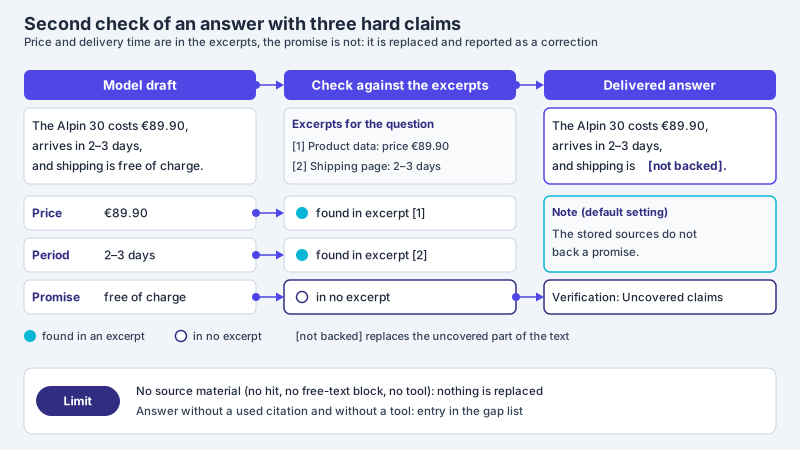
What makes a pair strong is also its weakness: nothing stands between your text and the visitor any more. With a model answer, XICBOT checks prices, deadlines and promises against the excerpts after wording and suppresses a figure that does not appear there. With a pair, this second check does not run, because the text itself is the source. A typo in an amount, a transposed digit or an outdated date therefore goes out exactly as it stands in the pair. How the second check works for model answers and what it does not do is described in the article on the second check against the source.
Second, the pair comes before the search. If it matches, the text sources are not consulted at all. If a pair still names the former contact point for complaints while the customer service page has long given the new one, the assistant sends visitors to the old contact point as long as the pair matches. Anyone who maintains a piece of information in two places therefore has to change it in both, on the same day.
Third, a pair has no model, and with it everything that is phrased as an instruction to the model is missing. A handover rule in the system instruction, such as “hand complaints over to a person”, does not apply to an answer from a pair. What works without a model still applies: frustration detection keeps counting, and if the question touches one of the fixed locks, a handover topic through its signal words or an entry on the taboo list, XICBOT hands over here too and adds the promised notice below the pair's wording. If the pair contains a modified version of that notice, the promised one takes its place. When a handover makes sense is described in the article on handing over to staff.
Fourth, a pair has no versions. A text source writes every run into a new version, and an earlier one can be restored at the source. A pair, by contrast, is changed in a form; once saved, the old wording is replaced. The log records the change, but not the previous text. And finally, a pair does not know the conversation. It answers the message that is coming in, regardless of what was said before. A follow-up such as “And for reduced items?” therefore usually does not match the returns pair and is answered from the text sources.
| Downside | What helps |
|---|---|
| no second check of the wording | check amounts and dates in the pair when saving, ideally with a second person |
| priority over newer text sources | review pairs with every website change and adjust them on the same day |
| no handover rule from the model | maintain signal words for the handover topic and test them with a check question |
| no earlier versions | keep a copy of the old wording before changing it |
| no reference to the conversation history | write answers so that they make sense without what came before |
Pairs in an English conversation
A text source exists once, and the model answers in the visitor's language. That does not work for a pair, because its wording is not translated. XICBOT determines the language of a pair when it is saved, based on the answer and, if that is too short for a reliable judgement, on the question. In a conversation, a pair in the language of the conversation takes priority over an equally good pair in another language. But language does not turn a weak match into a strong one: whether a pair matches is still decided by the overlap of words.
This shapes what an English-speaking visitor experiences. If they ask about returns in English, their question usually shares hardly any words with a German pair; the pair does not match, and the answer is built from the text sources, rendered into English by the model. That is usually good enough, but it has the downside described on the page on multilingual answers: nobody has read that phrasing beforehand. If an English question does match a German pair, say through a product name or an English variant, the visitor receives the German wording. If an answer is to go out in fixed wording in English as well, it needs its own English pair.
- For each answer with fixed wording, decide whether it must be fixed in English too.
- If so, create a second pair with an English question, English variants and an English answer.
- Attach English variants only to English pairs, German ones only to German pairs.
- Change both pairs on the same day and check them together.
- Create one check question per language in the acceptance run and set the language of the check question accordingly.
After every change: check questions in the acceptance run
A pair takes effect as soon as it is saved, and no check runs when it is saved. That makes a check that you repeat the same way after every change all the more important. XICBOT provides the acceptance run for this: a set of check questions with a sample answer that you run against the published version of the assistant before going live and after every change. You start the run yourself with “Start acceptance run”. Each question is asked as if by a visitor, along the same route with pair, search and fixed layer. The verdict is reached without a model: through terms that must be included, terms that must not appear and the share of words from the sample answer that are found in the answer. For a pair this is a strict standard that fits well, because its wording is fixed.
For each important pair, several check questions are worthwhile, showing not only that it matches but also that it does not match too much. The curated question itself is the easiest case. More revealing are the short form, a phrasing that appears in no variant, and a neighbouring question that the pair is explicitly not meant to answer. Add the English version and a question that should trigger a handover. The general structure of an acceptance test is described in the article on test cases before going live.
| Check question | What it shows | Expectation |
|---|---|---|
| Wie lange kann ich eine Bestellung zurückgeben? (How long can I return an order?) | the curated question itself | answer from the pair, wording unchanged |
| Rückgabe? (Returns?) | the short form | the same pair, provided the short form is stored as a variant |
| Bis wann muss die Retoure bei Ihnen sein? (By when must the return reach you?) | a phrasing without a variant | if it does not match, add it to the pair as another line |
| Kann ich reduzierte Ware umtauschen? (Can I exchange reduced items?) | the neighbouring question | not the returns pair, but the matching source or a clear decline |
| How long do I have to return an order? | the English conversation | the English pair, if created, or an answer from the text sources, not the German wording |
| Die Ware ist kaputt angekommen, ich will mich beschweren. (The goods arrived broken, I want to complain.) | the handover | handover to a person, provided complaints are set up as a handover topic with suitable signal words |
- Must contain: a term that only appears in the wording of the pair, such as “return label”. If it is missing, the answer did not come from this pair.
- Must not contain: the old value after a change, so that a forgotten second pair or an old passage of text stands out.
- Minimum coverage: set it high when the sample answer is the wording of the pair, lower for an answer from the text sources.
- Language of the check question: set it for very short questions; it applies when the language of the question cannot be recognised.
The same questions, every time
A pair is only properly maintained once check questions show that it matches where it should and stays silent where a different answer is called for. Running the same set after every change usually reveals a shift before a visitor notices it.
What XICBOT provides
In XICBOT, question-answer pairs are a separate part of the knowledge base and are maintained individually in the interface: question, variants, answer and the “Active” switch, plus the order of the list. When a pair matches, its wording goes out without a model call, and the answer names the pair's question as its citation. All other answers are built from the sections of your text sources with citations; a rebuild there writes into a new version and switches over only at the end. With the acceptance run you check pairs and text sources with the same check questions; you start the run yourself before going live and after every change. Further building blocks are shown in the overview of XICBOT features, and what the knowledge base reads in total on the page on the knowledge base. During setup we test typical questions from your customers and check the answers against the sources.
Frequent questions
What is a question-answer pair in a chat assistant?
A question-answer pair consists of a question, further phrasings of that question and a finished answer. If a visitor's question matches the pair, the stored answer goes out verbatim; if the question touches a fixed lock, a notice is added below it. In XICBOT, a pair is checked before the search in the text sources.
When is a text source better than a pair?
Usually when the answer has to be assembled from several pieces of information or depends on the individual question, for instance in advice on a product. There the model can build a fitting answer from several sections and name the sources. A pair tends to suit short, agreed answers that apply equally to everyone.
Why does my pair not match a question?
Often the phrasing that visitors actually use is missing. The overlap of words is compared in both directions, and a very short or a very long question often does not reach it. It usually helps to add the short form and typical paraphrases as variants and to check the result with a check question. A switched-off pair or a pair without answer text does not apply either.
Is a German pair translated in an English conversation?
No, the wording of a pair is not translated. An English question usually does not match a German pair, and the answer is then built from the text sources in English. If the English answer should also have fixed wording, create a separate English pair for it and check it with an English check question.
Does a pair on withdrawal replace the withdrawal notice?
Generally not. A pair is information given in a conversation and is not meant to replace a withdrawal notice. Under Article 246a § 1(2) sentence 2 EGBGB, the trader can fulfil the information duties on the right of withdrawal by providing the statutory model, correctly filled in, in text form. A pair can answer frequent questions on this in the defined wording and point to the notice. Which information has to appear where is something to clarify with professional advice in the individual case.
How do I check pairs after a change?
Ideally with check questions that you run the same way after every change; you start the run yourself. In XICBOT they belong in the acceptance run: the curated question, its short form, a neighbouring question the pair should not match, the English version and a question that should trigger a handover. Under “Must contain” and “Must not contain” you record which wording should appear and which old value should no longer appear.
Ask it yourself, Assistant of this website
Automated assistant