Club Member Questions: What an Assistant Answers
Fees, statutes, training times, joining, leaving and donation receipts: what an AI assistant answers in a club and where the board decides.
In plain language
Volunteers often have no stand-in and no fixed hours. So whether a club can be reached depends on how it is set up, not on good will. The questions are mostly the same. They are about fees, rules, training, joining, leaving and donation receipts. The answers are in papers the club already keeps. When someone wants to leave, the assistant explains the rule from the law. Your own rules say which notice period applies. Whether someone pays less or nothing is up to the board.
The treasurer has a day job, and so does the secretary. Whoever answers members’ questions in a club usually does it in the evening after their own work, between training sessions, the audit of the accounts and the annual general meeting. The questions arrive anyway, and every year they arrive in the same order: How much is my fee and when is it collected? What do the statutes say about it? When does the youth squad train? How do I sign up my child? How do I leave at the end of the year? And will I get a receipt for my donation? None of these are hard questions. There are many of them, they repeat, and they meet a structure built differently from a company: there is no business hour in which somebody is paid to pick up the phone. An AI assistant on the club website takes over exactly this recurring layer. It answers from the statutes, the fee schedule and the training plan, and hands over whatever the board has to decide. This article shows which questions those are, why a volunteer structure carries a constant load less well than a business, and where the line runs on fee waivers and individual decisions.

Labels in the illustration
- Question from a member
- Answer from your own records
- Decision by the board
- Fees and due dates
- Fee schedule, statutes
- Waiver or deferral
- What the statutes say
- Statutes and by-laws
- Reading it in a dispute
- Training and hall times
- Training plan of the section
- Exception or closure
- Joining and admission
- Application form and steps
- Refusing an admission
- Leaving and notice period
- Notice period, Section 39 BGB
- Hardship, early exit
- Donation receipt
- Route and documents needed
- Signing the receipt
- The assistant restates the rule. The decision in an individual case is made by the board.
- Answering recurring member questions without consuming volunteer hours
Why a volunteer structure carries the load differently
A business spreads recurring work over paid time. If someone is out, someone covers; if it becomes too much, the role is expanded. A club does not have that lever. Club offices are offices, not jobs, and Section 27 (3) sentence 2 BGB states explicitly for the board: board members serve without remuneration unless the statutes provide otherwise. Whoever holds the office holds it alone, often alongside a full working day and frequently for several years. A constant load that would be a role in a company is a single person in a club.
That has two consequences for availability. First, the time when members ask coincides with the time when the volunteer has a private life: evenings, weekends, the week before the season starts. Second, the load is not spread evenly across the year but piles up on a few dates: when fees are collected, when people register for the new season, before the annual general meeting, and in January when donation receipts fall due. In exactly those weeks a multiple of the usual requests lands on the same single person. The result is rarely an argument; usually it is silence: an email sits for a week, a callback never happens, and someone who wanted to join simply does not.
The six questions that come back every year
Club enquiries look varied as long as you read them one at a time. Lay out a whole year side by side and few patterns remain, and almost all of them have a documented answer in a record the club keeps anyway. That is exactly what makes them suitable for an assistant: the answer does not have to be invented, only found and restated correctly. In practice the following six fields cover the largest part of incoming questions, without a single one of them requiring a decision.
-
Fees and due dates
Amount by membership type, joining fee, family reduction, collection date and direct debit: all details from the statutes and the fee schedule, which the assistant restates verbatim.
-
Statutes and by-laws
What do the statutes say about voting rights, the financial year or the general meeting? The assistant names the passage and restates it instead of interpreting it.
-
Training and hall times
Which group trains when, in which hall, with which age limit, and what applies during the holidays: a question that comes up again after every change of plan.
-
Joining and admission
Which form, which signature, which documents, which route. The assistant walks step by step to the application form instead of putting people off until office hours.
-
Leaving and notice
By when, in which form, to which address. The period is in your statutes; the statutory frame for it is Section 39 BGB.
-
Donation receipt
Who receives a donation receipt, which details are needed for it and when it is sent. It is issued by the club, not in the chat.
Fees: information from the schedule, waivers from the board
The fee is the most frequent question and at the same time the best documented one. That there is a written basis at all is built into German association law: Section 58 no. 2 BGB requires the statutes to contain provisions on whether and which contributions members have to pay. Most clubs add a fee schedule listing amounts, membership types and collection dates. For the assistant that means it has a source it can cite, and it needs no second one. The fee schedule and the statutes are stored in the knowledge base; if the club changes the amounts, the answer changes with the source and not only at the next conversation on the touchline.
But this is also where the first hard line runs. The question "What does membership cost?" is a matter of information. The question "Can my fee be waived because I am currently unemployed?" is not. A waiver, a reduction or a deferral is a decision on an individual case, and as a rule it lies within the board’s discretion. An assistant that answers "yes" has promised the member something nobody promised, and has placed an expectation in the board’s way that it must now either meet or disappoint. The right handling is therefore not a cautious wording but declining to answer: the assistant explains that the statutes or the fee schedule provide for a waiver, names the conditions if they are on file, describes the route to an application and hands over.
Information is not a decision
What is written in a record, the assistant may say. What someone gets in an individual case is decided by the board. This separation is not caution but the precondition for the assistant being usable in member contact at all: a volunteer structure cannot catch a wrong statement as easily as a service department, because weeks often pass between the answer and the next board meeting.
Statutes and leaving: state the rule, hand over the case
Questions about the statutes are the point at which an assistant most quickly goes too far if it is not kept on a tight rein. Statutes are a set of rules, and rules invite application. That is precisely what the assistant must not do: it restates the provision, it puts it in context, and it stops before applying it to a concrete set of facts. The difference is audible in the conversation. "Under section 4 of your statutes, membership ends by resignation at the end of a financial year, and the declaration must reach the board in text form three months beforehand" is a restatement. "Your resignation therefore takes effect on 31 December" is an application, and it can fail on a detail the assistant does not know.
The statutes may provide that resignation is permitted only at the end of a financial year or only after a notice period has expired; the notice period may not exceed two years.
This single provision explains a large part of the resignation questions that reach a club. Section 39 (1) BGB gives every member the right to resign; subsection 2 allows the statutes to tie that resignation to the end of the financial year and to a notice period, and caps that period at two years. What applies in your club is therefore not in the statute but in your own articles, and that is exactly how the assistant should answer: first the frame, then your rule, then the route. It does not accept the resignation itself. It states in which form the declaration must be given and to whom, and it notes the matter for the office. Whether a late declaration still counts for this year, or whether hardship justifies an early exit, is decided by the board, not by the chat.
Training times and joining: the answer is in the plan
Training and hall times are the questions with the shortest half-life. A hall falls through, a group is split, the holidays shift the plan, and the website already says something different from the group. For an assistant that is less a problem than a requirement: it is only as current as the source it reads. If the training plan sits in the knowledge base as a maintained document and is re-read after every change, the assistant answers the question about the time just as reliably as the one about the fee. If it sits there as last year’s notice, the assistant restates last year’s notice. How to build this maintenance step into club routine is described in the article on building a knowledge base.
- Take the question in plain language, for example "Can my nine-year-old son play handball with you?"
- Name the matching group, time and hall from the training plan, and add the age limit
- Point out the trial period or taster session if the club offers one
- Link the application form and list which details and signatures it requires
- For minors, point out explicitly that a parent or guardian has to sign
- Name the responsible section head and how to reach them, instead of making a commitment
That way the conversation does not end with a pointer to office hours but with a completed next step. For clubs that hand out taster sessions or trial workouts, the same flow can be carried through to choosing a date; what such an appointment request looks like in chat is shown on the page about the booking assistant. Anyone who is only showing interest and does not yet want to file an application is recorded cleanly, so the section head can follow up deliberately instead of collecting loose notes.
Donation receipts: explain the route, the document stays in house
In January the question about donation receipts arrives, and it arrives in a bundle. It is easy to answer as long as you distinguish information from issuance. The deduction of donations is governed by Section 10b of the German Income Tax Act, and the evidence required by Section 50 of the Income Tax Implementing Ordinance. What the assistant can answer from that is the procedure: who receives a receipt, which details the club needs for it, by when it is usually sent, what applies to a donated membership fee, and whom to contact if a receipt is missing. What it cannot and should not do is produce the receipt itself or make any commitment about whether a particular payment is deductible.
Where the board decides and the assistant stays silent
The line can be put in one sentence: everything that can be looked up in a record, the assistant may say; everything that requires someone to weigh things up belongs with a person. In practice the list of cases requiring judgement in a club is short, but it is exactly the list where a mistake becomes expensive. It helps to draw that line once in writing and put it into the assistant’s system instruction, instead of leaving it to the language model. The following table is a usable starting point for most clubs and associations.
| Matter | The assistant | Board or office |
|---|---|---|
| Fee amount | Restates the fee schedule and membership type | Only for special arrangements |
| Fee waiver | Names conditions and the route to an application | Decides the individual case |
| Question on the statutes | Quotes the provision and puts it in context | Interprets it in a dispute |
| Leaving | Names form, period and address from the statutes | Confirms and reviews hardship |
| Admission | Leads to the form and lists the documents | Admits or refuses |
| Expulsion and complaints | Records the matter and hands over at once | Runs the procedure |
| Donation receipt | Explains the procedure and required details | Issues and signs it |
For the right-hand column to work in daily life, the handover has to be more than a sentence with an email address. It makes sense for the assistant to pass on the conversation so far, name the matter and pick the responsible person by section, so the treasurer’s question does not land in the youth coordinator’s inbox. How to build such a handover cleanly, without the enquirer having to tell their story a second time, is covered in the article on handover to human agents. For a volunteer structure the point matters especially: the more complete the matter arrives, the less of an evening it costs.
What belongs in a club’s knowledge base
A club assistant is not a question of the model but of the filing. What is not on file it cannot say, and what is filed wrongly it says wrongly. The good part: the records already exist, they are just spread over several computers, a folder in the clubhouse and the email attachments of the last board meeting. The effort therefore lies less in writing than in collecting, and in deciding which version is the valid one. That step is also the one that makes the club independent of individual people: what is in the knowledge base survives a change of office holders.
- The statutes in the version currently registered, with the date of the last amendment
- Fee schedule with membership types, joining fee, reductions and collection dates
- Youth, facility and usage by-laws, as far as they apply to members
- Training and hall plan per section, with holiday rules and age limits
- Application and resignation forms and the routes for them, including addresses
- Contacts per section and office, with the date of the last election
- Procedure and deadlines around donation receipts and donated membership fees
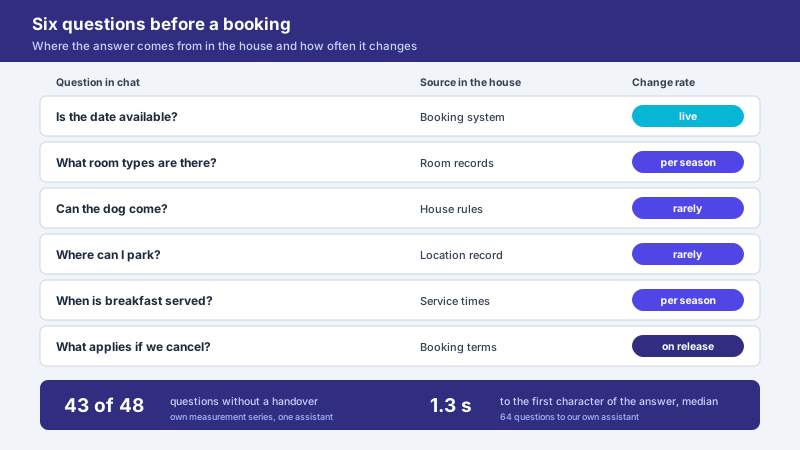
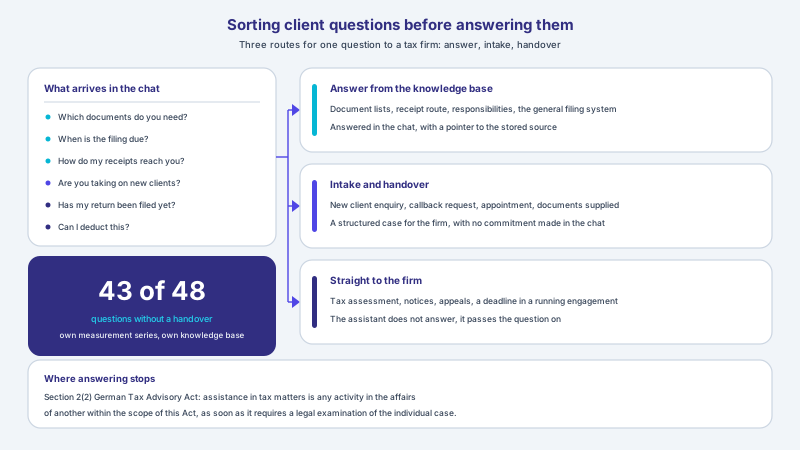
How far such a filing carries depends on its completeness, not on the language model. In our own measurement series, 43 of 48 questions stayed without a handover to a person. The figure is measured on a single assistant on our own knowledge base, not on customer projects, and a figure from the live operation of a club is not available to us; the method behind it is documented on the page about measurement series. For a sense of scale: the knowledge base behind that assistant holds 2,670 sections from 70 documents. A mid-sized club needs considerably less, because its questions rest on few records; what matters is not the volume but whether the six recurring fields are in there cleanly and in a valid version.
Data protection, disclosure and sign-ups for children
A club processes personal data like any other controller, and the duties under the General Data Protection Regulation apply regardless of charitable status. For the chat that means concretely: Article 13 GDPR requires the data subject to be informed at the time of collection about the purpose, the legal basis and the storage period, and to be informed where the collection happens, not only in a policy linked in the footer. On top of that comes disclosure: Article 50 (1) of Regulation (EU) 2024/1689 requires the person concerned to be informed that they are interacting with an AI system, unless this is obvious anyway. Both are handled in two sentences in the chat window and belong there from the start.
A second point is more common in clubs than elsewhere: a substantial share of sign-ups concerns children and young people, and the enquiry often comes from a parent. The assistant should therefore not accept a minor’s registration but lead to the application form, which a parent or guardian signs. Questions about health limitations, medical certificates or care needs do not belong in a chat transcript but with the section head. For the technical frame the same applies as for any other processing: hosting in Germany, a data processing agreement, a defined deletion policy, and collecting no more data than the matter requires. What has to be settled in detail is set out in the article on data protection with AI chatbots.
A few steps to your club assistant
The pragmatic start is not the big project but a narrow scope that takes load off early. Collect the statutes, the fee schedule and the training plan in a valid version, write down the six most frequent questions from the past year, and decide which three topics go to the board explicitly. That is enough to set up an assistant covering the questions on fees, times and sign-ups and handing over everything else. It is embedded in the existing club website with a short snippet, without rebuilding the site; the available routes are described in the article on embedding on a website or shop. Before going live, a short test run with real questions from the inbox is worth the time, so it becomes visible where the assistant still guesses instead of citing. How an assistant answers visitor questions from your own documents and leads to the right page is shown by the website assistant.
Frequent questions
Is an AI assistant worth it for a small club at all?
The measure is not the number of members but repetition. A club with two hundred members has the same six question areas as one with two thousand, just less often, and as a rule it has fewer shoulders to carry them. If the same questions reach the same person every year in the evening, an assistant takes over exactly that layer. Do not count in hours saved but in matters that no longer sit unattended: the sign-up that would otherwise not have happened, and the resignation that runs in an orderly rather than a contested way.
May the assistant decide on a fee waiver?
No, and it should not hint at it either. A waiver, a reduction or a deferral is a decision on an individual case and as a rule rests with the board. The assistant may say that the statutes or the fee schedule provide for such an option, it may name the stored conditions and describe the route to an application, and there it stops. Anything beyond that would be a commitment the club would later have to honour without having examined it.
How does the assistant handle questions about the statutes?
It restates the provision and puts it in context; it does not apply it. For resignation that means, for example: it names the statutory frame in Section 39 BGB, which grants the right to leave and allows the statutes a notice period of at most two years, and then the period that actually appears in your own statutes. Whether a particular declaration was in time it is not meant to judge. This separation between restating and applying should be written explicitly into the system instruction so that it does not depend on the accidents of a conversation.
Can the assistant issue donation receipts?
No. It explains the procedure: who receives a donation receipt, which details the club needs for it, when it is usually sent and whom to contact if it is missing. It is issued and signed by the office or the board. The reason is not technical but a matter of liability: Section 10b (4) of the German Income Tax Act attaches liability for the lost tax to an incorrect receipt. The assistant collects the details, the document stays in house.
How many questions does an assistant answer without handing over?
In our own measurement series, 43 of 48 questions stayed without a handover to a person (XICBOT, own measurement series of 11 September 2026). The figure is measured on a single assistant on our own knowledge base, not on customer projects, and a figure from the live operation of a club is not available to us. What transfers from this is not a rate but the mechanism: how much works without a person is decided by the completeness of the stored records, not by the choice of language model.
Who maintains the assistant when the board changes?
That is precisely why the content sits in a knowledge base and not in one person’s head. What is maintained is not the assistant but the records: if the fee schedule is amended, the new version is read in and the answers change with it. It makes sense to attach this step to occasions that exist anyway, such as a resolution of the general meeting and the change of plan at the start of the season. A change of office then costs a briefing of a few minutes instead of a handover of knowledge that is written down nowhere.
Ask it yourself, Assistant of this website
Automated assistant