When Relatives Ask: AI Chat for Home Care Services
Home care: how an AI assistant informs relatives about services and care levels in the evening without advising, and hands over to the manager. Read the guide.
In plain language
Many people in Germany need care, often at home. Relatives tend to ask in the evening or at the weekend. Then the office is empty. An assistant gives information on services and names the source. It does not state a care level, promise cost cover or confirm an open place. Those are decided by the care fund, the assessors or the care manager. In the chat it collects place, needs, start date and a time for the callback. So the manager knows the case when calling back.
The enquiry almost never comes from the person it is about. It is the daughter sitting at the kitchen table late in the evening, the hospital discharge letter in front of her, wanting to know whether someone can come twice a day from Monday. It is the son organising everything from another city who has no idea what respite care actually means. These people are not writing because they are interested in care; they are writing because they have run out of options. And they write at the hour when nobody is left in your office. An AI assistant on the website of a home care provider therefore has a narrowly defined job: explain what your service does and how intake works, record the details in a structured way, and hand the case over to the care manager. Not advise. Not assess. Not promise. This article describes what that separation looks like in technical and linguistic terms, and why it is precisely that separation which makes an assistant work in this sector.

Labels in the illustration
- What relatives ask
- What does the care fund pay for?
- How do we get a care level?
- What is respite care exactly?
- What do we have to pay ourselves?
- Do you still have capacity free?
- usually late in the evening, often after a hospital call
- 1.1
- million cared for at home
- by outpatient services
- (Federal Statistical Office)
- Care service assistant
- service descriptions
- catchment area and rounds
- how intake works
- trained on your sources
- 1
- Answer from the knowledge base
- with the source in your own content
- 2
- Intake form filled in the chat
- place, hours needed, care level, start
- 3
- Callback from the care manager
- within the agreed time window
- What the assistant never promises
- care level
- cost coverage
- a place in the rounds
- goes to the care manager
- When relatives get in touch
- illustrative course of a single day
- office hours
- evening and night
Who actually gets in touch with a care provider
Read through the enquiries of a home care provider once and a clear pattern appears. The person in need of care rarely writes. It is daughters and sons, spouses, sons- and daughters-in-law, sometimes neighbours. They are under time pressure because a discharge is imminent or because nothing has worked at home for several days. They do not know the terms your sector uses, and they have no idea what a care provider is allowed to do, what it costs and how quickly it can start.
This starting position differs fundamentally from that of a medical practice. There the patient knows the concern and wants an appointment. We described that elsewhere when writing about the front desk of a practice in chat: consultation hours, repeat prescriptions, appointment slots. With a care provider it is a situation that did not exist three days ago. The person asking does not know what to ask. The first service an assistant provides is therefore not the answer but the sorting: what it is about, for whom, where and from when.
The second peculiarity is timing. The call from the hospital arrives in the afternoon, the family talks it through in the evening, the search happens late. At the weekend even more so. Anyone who then opens a page and finds only a contact form either leaves nothing at all or leaves something very incomplete, and carries on searching. An assistant that answers at that moment wins the enquiry not through cleverness but through presence.
The questions that come back every time
Enquiries resemble each other across providers so strongly that the effort for a well-kept knowledge base pays for itself within a few weeks. Write the answers down once, properly, and you cover the bulk of what arrives in the evening. The typical points are these:
- What is it you actually do? The difference between personal care, nursing care, domestic support and companionship is professional vocabulary. Relatives instead ask who helps with showering, who gives the tablets, who does the shopping.
- Do you come to us? Catchment area, districts, the time windows of the rounds. A clear answer saves both sides a meeting that would not have worked out anyway.
- What does the care insurance fund pay? Behind this is usually the question about the share the family pays itself. This is where the zone begins in which one explains but does not advise.
- How do we get a care level? Application route, assessment, deadlines. The assistant describes the route and names the body that decides.
- What is respite care? A term almost every family hears at some point and almost nobody can explain.
- Do you even have capacity? The one question an assistant must never answer with yes.
- How quickly can you start? That too is decided by the scheduling of rounds, not by the website.
It is striking that only two of these seven points come anywhere near a commitment. Five of them are pure information drawn from your own content. That ratio is exactly what makes the sector suitable for an assistant: the overwhelming part of the work is repeated explaining, and explaining is what a well-fed assistant does reliably. How such a knowledge base is built, and how it fails when the link to the source is missing, we described in the article on answers tied to their sources.
Three blocked zones that are never negotiated
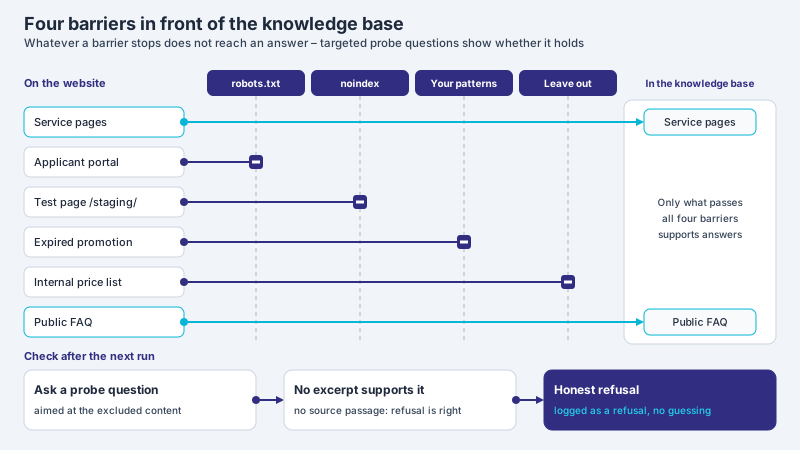
An assistant in care does not become trustworthy by phrasing things cautiously, but by having certain statements ruled out in the concept in the first place. Three areas belong here. They are not politely sidestepped; they are excluded, and they are checked with test cases at acceptance.
-
No assessment
The assistant never names a care level, not even as an estimate or a tendency. The level is determined using a professionally grounded assessment instrument divided into six modules. A chat window does not replace that.
-
No cost commitment
What the care insurance fund covers is set out in the statute and in the decision letter, not in an assistant's reply. It may repeat amounts from the statute while saying that the fund decides on the individual entitlement.
-
No capacity commitment
Whether someone can come from Monday is decided by the scheduling of rounds the next morning. The assistant records the preferred date and says plainly that the care manager confirms it, nothing more.
These three limits are not a sacrifice but a selling point. If a chat holds out the prospect of a care level in the evening, the family has a disappointment the next day and you have a conflict. If the chat explains how the assessment works, who decides and what your service can take on afterwards, the family has orientation in the evening and a conversation in the morning. The second case is the one that produces an assignment.
The limit belongs in the answer, not in the small print
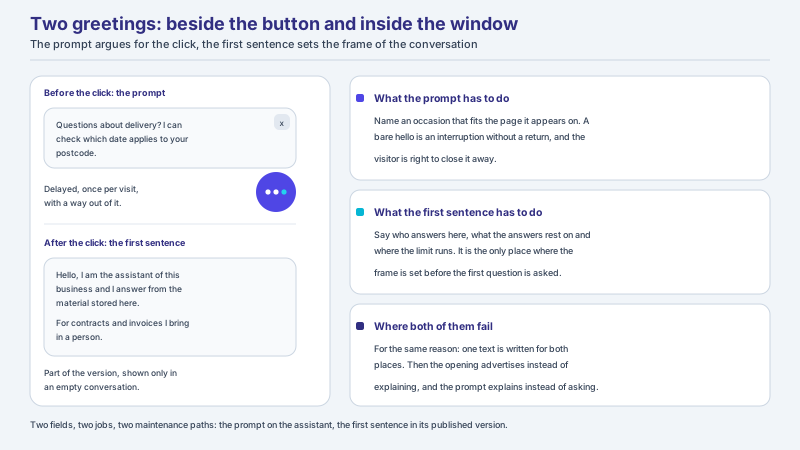
An assistant that dodges looks awkward. An assistant that names the limit and offers the next step in the same sentence looks responsible. The difference is in the wording. Not: I cannot say anything about that. But: the care level is determined by the care insurance fund after an assessment; I will note whether an application is already running, and our care manager will go through it with you tomorrow. The second version is just as restrained and still produces a contact.
The intake sheet that the conversation fills
Every home care provider has a sheet for the first contact, whether on paper, in the care software or in the manager's head. The fields are similar everywhere. An assistant that knows these fields asks the questions in the order in which they naturally arise in conversation, and delivers a completed sheet at the end instead of a message saying: please call back. That is the difference between a contact form and a lead assistant.
- For whom? Name or initials of the person needing care and the relationship of the person enquiring, so the manager knows who they are speaking to.
- Where? Town and district. That decides immediately whether the case falls inside the catchment area.
- What is needed? In everyday language: personal hygiene, medication, wound care, shopping, accompaniment, hourly companionship.
- How much and when? Number of visits per day or week, preferred time windows, weekends yes or no.
- Care level? In place, applied for, or not yet applied for. No assessment, just the state of play.
- From when? Desired start and the reason, for instance an imminent discharge.
- How to reach you? Phone number, time window for the callback, preferred channel.
Seven details spread across a conversation are easier for the person enquiring than seven mandatory fields in a form. They arrive one after another, each with a reason, and they can be skipped if someone does not know the answer. Anyone facing a form late in the evening under strain abandons it. Anyone who is asked, answers. The effect on the number of usable enquiries is the real commercial core, and it has little to do with technology and everything to do with format.
| Aspect | Website without an assistant | Website with an assistant |
|---|---|---|
| Enquiry in the evening | Sits there until the next working day | Answered from your own content |
| Catchment area | Relatives search the list of towns themselves | Location is asked for and matched directly |
| First contact | Form with mandatory fields, often sent half empty | Intake sheet emerges in the conversation |
| Care level | Vague entry in a free text box | State of play recorded cleanly: in place, applied for, open |
| Callback | Phone call without prior knowledge | Manager calls in the agreed window knowing the case |
| Declining | Unsuitable enquiries tie up time | Location and need show early what does not fit |
| Insight | Drop-offs stay invisible | Recurring questions reveal gaps on the website |
The availability gap is the commercial reason
Home care providers work around the clock; their office does not. The care manager goes out on the round in the morning, plans the schedule in the afternoon and answers enquiries in between. It is exactly in that situation that the enquiries arrive which can wait the least. The gap is not negligence, it is structural: a provider with a tight staffing situation cannot keep a phone seat free for prospective clients.
So the question is not whether an enquiry gets answered, but when. Whoever answers first leads the conversation; whoever calls back on the next working day conducts a review. We described this connection in general terms in the article on response time to enquiries. In care it bites harder than elsewhere, because the family is under pressure to act and writes to three other providers the same night.
An assistant that promises a place in the round in the evening has not admitted a client faster; it has taken a decision it was never authorised to take. The limit belongs in the concept, not in the clean-up afterwards.
Explaining entitlement law without advising
The most frequent questions are about money. That is delicate but not impossible. What matters is the distinction between general information and advice in an individual case. A statute applies to everyone; whether it applies to a particular case is decided by the care insurance fund. The assistant may repeat the first and must leave the second open. Crucially, both belong in the same sentence.
- Home nursing assistance: for people with care level 2 the entitlement covers services up to a total value of 796 euros per calendar month. The assistant names this frame and adds that the care insurance fund carries out the assessment.
- Relief amount: people receiving care at home are entitled to a relief amount of up to 131 euros per month. An often overlooked item through which companionship services can be billed.
- Respite care and short-term care: from care level 2 there is an entitlement to a joint annual amount of up to 3,539 euros per calendar year. The assistant explains the term and refers the individual case to the conversation with the manager.
- Care allowance instead of services in kind: 3.1 million people in need of care received only the care allowance and were cared for predominantly by relatives. Many families do not know that the two can be combined.
- Deadlines in the application procedure: the care insurance fund has to notify its decision on an application in writing no later than 25 working days after receipt. If no assessment has taken place within 20 working days of the application, a separate provision of the statute applies.
- Always attached: one sentence that marks the difference. This is the statutory frame; what is approved in your case is decided by the care insurance fund after the assessment.
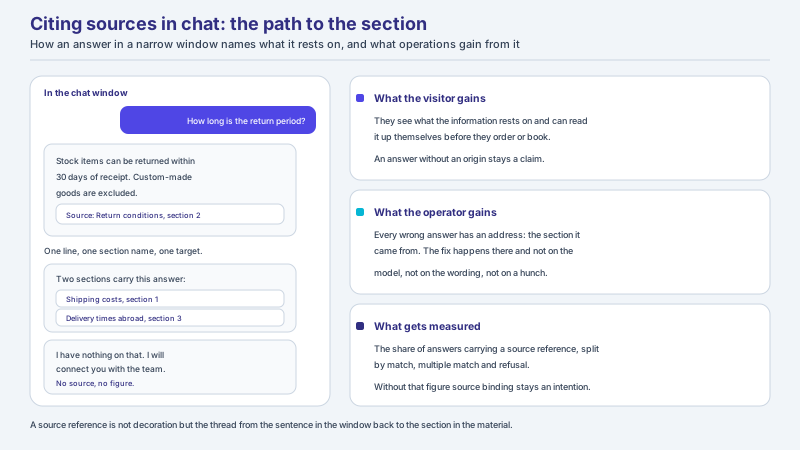
This form of information has a pleasant side effect: it makes your service the first address at which somebody understood something. With 15,500 outpatient care services in Germany that is a difference you cannot buy. What remains essential is the source situation. The assistant repeats only what is in your approved content or in the statute it cites, and names the source on request. Where that link is missing, answers emerge that sound plausible and are nevertheless wrong.
Health data in chat: sparingly rather than completely
The moment someone writes that their mother is being discharged after a stroke, health data is in the chat. The General Data Protection Regulation treats it in Article 9 as a special category: processing such data is prohibited in principle unless one of the exceptions listed there applies. For a website assistant this does not mean alarm, it means one simple principle. The assistant is not meant to ask for diagnoses. It does not need them. For scheduling rounds it is enough to know which help is needed and when.
In practice that means no fields for diagnosis, medication or hospital reports, no request for documents in the chat, no follow-up questions about the details of an illness. What someone volunteers cannot be prevented, which is why short retention, a clear route to deletion and a clear statement of where processing happens belong to the setup. At XICBOT the data is stored in Germany, and the answers are generated by a specialised model provider, also outside the EU on the basis of standard contractual clauses; how this is organised is set out on the page about privacy and hosting; the underlying questions are written up in the article on assistants and data protection.
The handover to the care manager
The assistant is not the goal of the conversation but the route to it. What matters is the moment it hands over. A good handover is not the dispatch of a form but an arrangement: the person enquiring knows who will get in touch, in which time window and what has been clarified by then. How such a handover is built technically and linguistically we described at length in the article on handing over to a human colleague.
- Define the triggers: capacity, care level, costs in an individual case, medical questions and anything that sounds like an escalation lead straight to a handover, regardless of how good the answer would be.
- Agree a time window: instead of a vague promise, a concrete offer - later today, tomorrow morning, tomorrow afternoon. A booking assistant turns that into an appointment request, which the manager confirms in their own view.
- Send the sheet along: the manager receives the seven details as a summary, not the entire transcript.
- Mark the urgency: an imminent discharge is something other than an enquiry for the month after next. The sorting happens on arrival, not in the follow-up.
- Close the loop: was there a call? Did a first meeting happen? Without that feedback it stays unclear what the whole route actually delivers.
Which questions come up often, which conversations break off and where answers are missing is shown by conversation analytics. In care this is particularly valuable, because the gaps are often not in the assistant but on the website: a missing district in the catchment list, an unclear description of companionship services, a weekend offering that is never mentioned. Every one of those gaps produces drop-offs, and every one can be closed in an afternoon.
Introduced in a few steps
The effort on your side is smaller than it sounds, because the content almost always exists already. What is usually missing is only the decision about which sentences apply as binding. For a home care provider the route usually looks like this:
- Collect the content: service descriptions, catchment area with districts, timing of the rounds, how intake works, contact people, existing explanations of entitlement law.
- Write down the blocked zones: assessment, cost coverage in an individual case, capacity commitments, medical opinion. Plus one sentence each that names the limit and offers the next step.
- Map the intake sheet: the seven details in the order of the conversation, with a clear marking of what is voluntary.
- Set up the handover: target mailbox or care software, time windows for callbacks, marking of urgent cases.
- Run the test cases: go through the typical enquiries once from start to finish, deliberately including the delicate ones - care level, costs, a free place, an acute deterioration.
- Look again after four weeks: which questions came, which stayed open, which page was missing. That is where the second version of the knowledge base comes from.
Whether an assistant fits your service can be judged fastest from the sector page practices and health; an overview of all fields of use is at industries. If you would rather talk the process through against your own content, a conversation about your intake process is the shortest route. We look at the website and tell you which content would be missing, which is a more honest answer than any general recommendation.
To put the scale in context, it helps to look at the overall care situation. Almost nine out of ten people in need of care, that is 86 percent or 4.9 million people, were cared for at home in December 2023. At the end of 2023, 78 percent of people in need of care were 65 years or older, and around a third, namely 34 percent, were at least 85. While around 11 percent of those aged 70 to 74 were in need of care, the care rate for those aged 90 and over was 87 percent. All three figures come from the Federal Statistical Office. Demand grows with the age of the population, and it meets providers whose office hours do not grow with it. That gap is precisely where an assistant is useful: it does not extend working hours, it extends availability. Anyone who sets up the route from the first question to the callback properly moves the work to where it belongs, into a conversation that starts with knowledge of the case.
Frequent questions
May a chat assistant answer questions about the care level?
It may explain the route, not anticipate the outcome. The assistant describes how an application is made, who carries out the assessment and which deadlines the statute sets. The care level itself is determined using a professionally grounded assessment instrument divided into six modules, and it is established by the care insurance fund. An estimate in chat, even as a mere tendency, would be a statement about a procedure the assistant does not know, and it would raise expectations your service would later have to disappoint.
How does the assistant handle health data?
It is not meant to ask for it. Diagnoses, medication and hospital reports are not needed for scheduling rounds; it is enough to know which help is needed and when. The General Data Protection Regulation treats health data in Article 9 as a special category whose processing is prohibited in principle unless an exception applies. What someone volunteers goes, like every message, to the model and into the stored conversation; it is handled sparingly through short retention and a clear route to deletion, hosting is in Germany, and the answers are generated by a model provider, also outside the EU on the basis of standard contractual clauses. At the start of the conversation there is a short note saying who processes, for what purpose and for how long.
What happens if someone describes an acute deterioration at night?
Then the information is meant to stop immediately. The assistant is instructed to give no medical opinion and to point unambiguously to the out-of-hours medical service or the emergency number, depending on what was described. It then offers to note the enquiry for the care manager so that someone gets in touch the next morning. This sequence is checked with test cases at acceptance, because it is the single most important case: it occurs rarely and must never go wrong.
Can the assistant say whether capacity is still free?
No, and that is deliberate. Whether a visit fits into a round depends on travel times, qualification and the duty roster, and it changes daily. The assistant records the desired start, the time window and the location and arranges a callback. That gives the manager a solid basis and the family a reliable statement about when they will have clarity. A commitment in chat would be faster and wrong in many cases.
How does the assistant know what our service actually offers?
From your own content. The basis is service descriptions, catchment area, timing of the rounds, how intake works and everything you explicitly approve. The assistant is instructed to answer only from that stock and names the source on request. If a piece of information is missing it usually says so and offers the handover instead of constructing a plausible answer. That is why maintaining this content is the real work, and at the same time the reason the answers fit your service rather than some generic provider.
Is this worth it for a small provider with few enquiries?
That depends less on the number of enquiries than on how they are distributed. If half of them arrive outside office hours and some of those go unanswered, even a small improvement has an effect. An assistant makes sense where there is a reliable stock of content, where callbacks actually happen and where somebody reads the handovers. If one of those conditions is missing, a better contact page will do more. We say so in the initial conversation rather than letting it emerge after the setup.
Ask it yourself, Assistant of this website
Automated assistant