Multilingual AI Assistant for Global Customers
A multilingual AI assistant detects the language of each enquiry and answers from one knowledge base. Reach customers abroad without duplicate upkeep.
In plain language
Many online buyers like to shop in their own language. The assistant reads the language from the text, not from where the person is. If someone switches language, it switches too. All languages use the same knowledge, so a price or opening time is up to date in all of them. In the shop it explains shipping abroad and returns in the buyer's language. Orders and bookings run through set functions, not loose text. Quality can vary with special terms and rare languages. Then it sticks to your content and hands over to a person.
German companies have long been selling and advising across borders, and their websites are visited by people who do not automatically speak German. Anyone visible internationally receives enquiries in French, Spanish, Italian, Polish or Turkish, often from customers who understand a German or English form but do not feel at ease with it. Around 76 percent (CSA Research) of online shoppers prefer to buy in their native language, and 40 percent (CSA Research) will not buy from websites in another language at all. A multilingual AI chat assistant solves exactly this problem: it detects the visitor's language from the text of their question, answers consistently in that same language and draws on the same knowledge base, maintained only once. This lets you answer enquiries from many countries without writing content twice, without a separate bot per language and without a multilingual team having to be on standby around the clock. This article shows how language detection works, why a single knowledge base is the decisive lever, what it means for shop and support and where the honest limits lie.

Labels in the illustration
- Habt ihr das in Größe M?
- DE
- Ja, Größe M ist verfügbar.
- Livrez-vous en France ?
- FR
- Oui, nous livrons en France.
- ¿Cuál es el precio?
- ES
- El precio es 49,90 €.
- Language detected: Spanish
- Type a message...
- Send
- One source, many languages
- Website
- Shop catalog
- FAQ + docs
- Knowledge base
- Deutsch
- Reply DE
- Français
- Reply FR
- Español
- Reply ES
- English
- Reply EN
- The same content, in the visitor language
- Many
- languages
- on request
- 1
- knowledge base
- no double work
- 24/7
- available
- in every language
- International customers, no extra effort
Why Language Decides Enquiries and Sales
Language is not a nice-to-have but a buying condition. Someone who finds a website in a foreign language has to translate, guess and invest trust before a single question is even asked. This barrier is measurable. In a 2011 EU-wide survey by the European Commission, 9 in 10 (European Commission) internet users said that, given the choice, they always visit a website in their own language. Of the respondents who also used other languages online, 42 percent (European Commission) said they never bought online in a language other than their own. The common assumption that English suffices as a world language is misleading: English is the content language of 49.5 percent (W3Techs) of the websites analysed, yet a large share of internet users worldwide do not speak it. There is thus a large gap between the language on offer and the actual language needs of users, and it is precisely in this gap that enquiries and revenue are lost.
For small and medium-sized companies the classic answer is expensive: a fully translated website, maintained language versions of every subpage, multilingual forms and, ideally, staff who answer calls and emails in several languages. In practice it therefore often stays at German and perhaps English, and all other visitors bounce. An AI assistant changes this calculation. It carries the language load in the dialogue, exactly where concrete questions arise, and makes the full build-out of every language version unnecessary in many cases. The website stays in your main language, the conversation happens in the visitor's language. How such an assistant works in general is described on the page about the multilingual assistant.
Detecting the Visitor's Language Automatically
The first step is language detection. As soon as a visitor types their first message, the AI language model determines the language from the written text, not from a country code or an IP address. That matters, because location says little about the preferred language: four languages are spoken in Switzerland, millions of people in Germany have a different mother tongue, and anyone travelling abroad still wants to be addressed in their own language. If the assistant detects the language from the content, it makes the right choice even when the browser setting and the actual language diverge. If the visitor switches language mid-conversation, the assistant follows without them having to toggle a switch or click a flag.
Alongside automatic detection, manual choice remains possible. Anyone who prefers to switch themselves can actively select the language, and the assistant remembers the decision for the rest of the conversation. A greeting can also be pre-set, for example to match a campaign that deliberately targets a specific region. What matters is that detection happens quickly and unobtrusively: the visitor simply asks their question the way that feels natural, and receives an answer in the same language within seconds. This freedom from friction is where many rigid solutions fail, because they turn the language choice into a precondition instead of solving it in passing.
-
Detection from text
The assistant determines the language from the written message, not from location or IP. So it is right for travellers and in multilingual regions too.
-
Switch at any time
If the visitor switches language, the assistant follows within the same conversation, without them having to open a menu or start over.
-
Manually overridable
Anyone who prefers to choose the language themselves sets it actively. The assistant keeps that choice for the rest of the conversation.
The Same Content, Many Languages, Without Double Maintenance
The real efficiency gain lies not in translating individual sentences but in the architecture behind it. A multilingual XICBOT assistant keeps only one knowledge base: your website content, your product catalogue, opening hours, documents and frequent questions. From this single source it answers in every supported language. You maintain a price, a delivery condition or an opening time exactly once, and the information is up to date in all languages. This is the decisive difference from an approach that would require a separate bot with separate texts for each language. When something changes, there is no forgotten language version handing out outdated prices. How this central source is built and kept current is described on the page about the knowledge base.
Binding everything to a shared source has a second advantage: consistency. A customer who asks in German and a customer who asks the same question in French receive the same factual answer, only in their respective language. No contradictions arise between language versions, because there is only one factual truth. For you this means predictable effort: instead of multiplying the maintenance work with every additional language, it stays almost constant. In our own projects (project experience) this is precisely why companies with a limited team can appear multilingual at all, without permanently employing a translation agency.
One source, many languages
The core of a multilingual assistant is not the number of languages but the single knowledge base behind it. Maintaining content once and playing it out consistently in every language not only saves effort but also avoids contradictory or outdated statements between language versions.
International Customers Without Extra Effort: Shop and Support
In the online shop the benefit shows most directly. International prospects ask the same questions as domestic ones: availability, sizes and variants, shipping costs abroad, delivery time, returns. A multilingual shop assistant answers them in the customer's language, shows product cards with image, title and price directly in the chat and guides them into the cart. That lowers one of the most expensive barriers in cross-border trade: uncertainty. Around 70 percent (Baymard Institute) of online carts are abandoned, and high or unclear up-front costs for shipping, taxes and fees, slow delivery or an unsatisfactory returns policy are among the common reasons. Clearing questions about costs, delivery time and returns directly and in the right language means losing fewer buyers just before checkout.
In support, multilingualism relieves the team noticeably. A support assistant answers recurring questions around the clock from the knowledge base, in every supported language, and is meant to forward only the cases that truly need personal handling. For a small team this is the difference between reachable and overloaded: instead of laboriously translating a foreign-language call, the enquiry arrives already structured and in writing, together with the conversation; XICBOT does not provide a translation of it. Sensitive topics, complaints or legal questions are meant to be handed deliberately to a human, with full context, so that no one has to ask their question a second time.
| Aspect | Without a multilingual assistant | With a XICBOT assistant |
|---|---|---|
| Language choice | Fixed website language, often German only | Answer in the visitor's language |
| Maintenance effort | Separate texts and bots per language | One knowledge base for all languages |
| Availability | Bound to office hours and language skills | Around the clock in many languages |
| Currency | Language versions drift apart | Change once, up to date everywhere |
| Support load | Foreign-language enquiries block the team | Recurring automated, rest handed to humans with context |
More Than Translation: Actions in Every Language
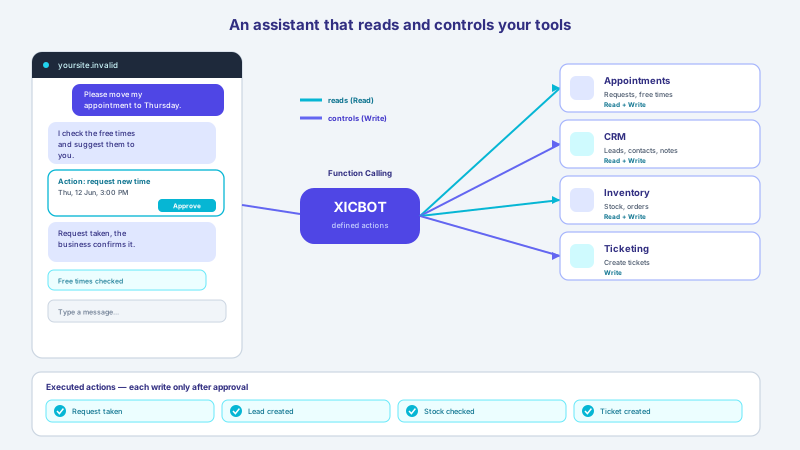
A multilingual assistant does not only answer questions, it acts. That is precisely what sets it apart from a pure translation tool. If a visitor asks about a product in Italian, the assistant puts together a cart with it on request, applies a voucher or leads on into the shop with “Continue”, exactly as in a German-language conversation. The underlying actions are language-independent: whether a product goes into the chat cart or an appointment request is recorded is decided by the function behind it, not by the language of the question. The language only becomes visible at the surface, in confirmations, labels and follow-up questions that the assistant phrases appropriately. This keeps tool control reliable in every language, because it is bound to defined actions rather than to freely worded text.
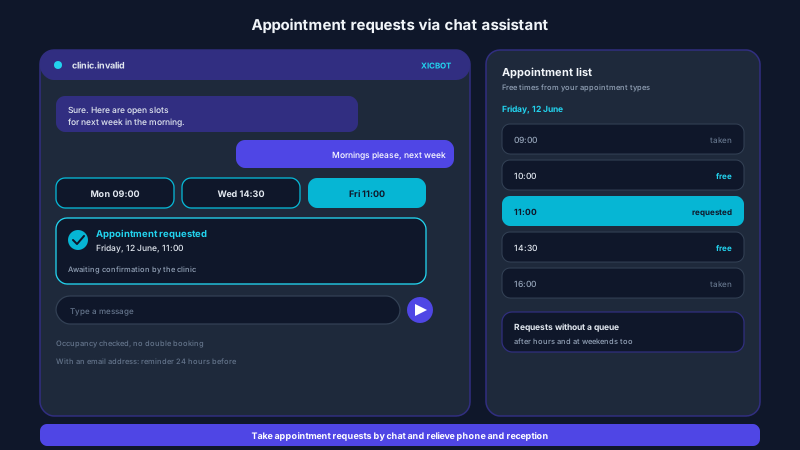
This applies across the full range of functions. A booking assistant suggests free times from the stored appointment types and takes the appointment request, no matter which language the enquiry comes in; a lead assistant pre-fills a contact form once the visitor confirms and hands the enquiry over to your inbox in a structured way; product cards with image, title and price appear directly in the chat. Prices and availability come from the same source as the text answers, so a French and a German enquiry see the same stock. For cases that go beyond the standard, custom functions can be defined, such as a configurator or a calculation that is likewise operable in every language.
-
Cart in the chat
The assistant puts together a cart, changes quantities and leads on into the shop with “Continue”, in the language of the enquiry.
-
Appointment requests
Suggesting free times and taking appointment requests works regardless of language; only the follow-up questions and summary in the chat switch along.
-
Capture leads
Once the visitor confirms, contact forms are pre-filled and handed over in a structured way, no matter which language is used.
From First Question to Checkout: A Shop Example
How this feels in practice can be shown with an illustrative sequence. Suppose a visitor from France lands on a German shop page via a search engine and asks their first question in French. The following flow is illustrative and describes no specific customer; it shows which steps a multilingual assistant typically takes.
- Detection: The assistant recognizes from the text that the question is asked in French and answers in French from the first second, without a language selector or flag menu.
- Answer from the knowledge base: For the question about availability and size, it draws on the same product catalogue a German-language answer would use, and states availability and price in French notation.
- Product card: Matching the enquiry, it shows a product card with image, title and price, including a button to add the product to the chat cart.
- Shipping question: For the follow-up about delivery and costs abroad, it answers from the stored shipping terms instead of guessing.
- Action: On request it puts together a cart with the product and leads on into the shop with “Continue”; the confirmation stays in French.
- Handover when needed: A question that cannot be answered reliably from the knowledge base, for example about individual customs handling, is meant to be passed to a human, with the conversation in the language it was held in.
The point of this flow is not the individual answer but its continuity. From the first question to the move into the shop the customer stays in her language without hitting a single barrier, and your team is only involved where it is genuinely needed. It is exactly this continuity that distinguishes a shop assistant from a mere translation feature that carries words across but triggers no action.
Data Protection for International Customers
Anyone advising and selling internationally processes personal data from many countries, and visitors rightly expect careful handling of it. A multilingual assistant changes nothing fundamental about that and can even improve the overview: because it bundles enquiries in one place instead of spreading them across various channels and inboxes, the data flow is easier to trace. XICBOT assistants are operated in Germany, a data processing agreement governs the cooperation, and the answers are generated by a specialised model provider, also outside the EU on the basis of standard contractual clauses. For enquiries from other EU countries the same GDPR framework applies, so no additional legal construction per country is needed. How hosting, contract and deletion concept look in detail is described on the page about privacy and hosting.
With multilingual enquiries in particular, the handover to humans is also important. Legal, medical or complaint-related questions should not be answered automatically but passed to a responsible person, regardless of the language. European or self-hosted language models are possible as a separate project by arrangement; they are not included in standard operation. This way multilingualism remains not just a convenience for customers but fits into a data-protection-compliant operation that holds up across borders too.
Quality, Limits and the Handover to Humans
Honesty includes naming the limits. An AI assistant can be wrong, and automatic translation is not always perfect with technical terms, legal phrasing or ambiguous questions. That is why a responsibly built assistant relies on two safeguards. First, it stays bound to your own content instead of inventing freely: it answers from the knowledge base and says when it does not know something, rather than fabricating a plausible but wrong answer. Second, there is the handover to a human with the conversation; it is not translated, so your team reads it in the language in which it was held.
This combination makes multilingualism dependable. Critical or sensitive topics can be configured so that the assistant hands over to a human early, while simple, recurring questions run reliably on their own. Which languages are covered how well, which topics the assistant answers itself and when it escalates is defined together during setup and can later be refined using the conversation analytics. This creates an assistant that takes international customers seriously without promising too much, and that fits your business more precisely with every conversation evaluated. How language detection and answers from one knowledge base work together is shown on the page for the multilingual assistant; which languages suit your case we clarify in a short initial call.
- Detect the language automatically from text and allow a manual switch at any time
- Maintain only one knowledge base and play it out consistently in every language
- Change prices, delivery times and opening hours once and have them up to date everywhere
- Clarify product questions and shipping terms in the shop in the customer's language
- Automate recurring support questions and hand sensitive cases to humans with context
- Continuously improve coverage and escalation using the conversation analytics
Frequent questions
How does the assistant detect which language a visitor speaks?
The assistant determines the language from the text of the first message, not from location or IP address. That is more reliable because the place someone is says little about their preferred language: in multilingual regions, for travellers or for people with a different mother tongue, location and language often diverge. If the visitor switches language mid-conversation, the assistant follows, and anyone who wants to can also select the language actively themselves.
Do I have to maintain separate content for each language?
No. The assistant draws on a single knowledge base, that is your website content, the product catalogue, opening hours and frequent questions, and answers from it in every supported language. You maintain a price or a delivery condition exactly once, and the information is up to date in all languages. Separate texts or a dedicated bot per language are not necessary, which keeps the maintenance effort almost constant instead of growing with every language.
How many languages can the assistant cover?
Modern AI language models cover a large number of common languages, so in practice answers can go well beyond the typical European languages. Which languages make sense for your case depends on your target group and is defined during setup. For critical topics or languages with lower coverage, the assistant can be set to hand over to a human earlier.
Is the quality in foreign languages as good as in German?
The quality is high in common languages but can vary with very specialized technical terms, legal phrasing or rare languages. That is why the assistant stays bound to your own content and is instructed not to invent answers, and for tricky cases there is the handover to a human, with the conversation in the language it was held in. This keeps multilingualism dependable without promising more than can be delivered.
How does a multilingual assistant help in the online shop?
International prospects ask the same questions as domestic ones, for example about availability, variants, shipping costs abroad and returns. The assistant answers them in the customer's language, shows product cards with price directly in the chat and guides them into the cart. Since around 70 percent (Baymard Institute) of carts are abandoned and high or unclear up-front costs for shipping, taxes and fees as well as the returns policy are among the common reasons, a quick answer in the right language helps keep buyers just before checkout.
What does a multilingual assistant cost?
Multilingualism is already included in the website assistant, because it emerges from the same knowledge base and requires no separate content per language. XICBOT assistants start with a one-time setup and a monthly operation including hosting in Germany; the right tier for shop, appointments or tool control depends on the scope. You will find the specific packages and prices on the pricing page, and every project begins with a free initial call.
Ask it yourself, Assistant of this website
Automated assistant