One Assistant, Many Locations: Answers per Branch
Opening hours, stock and holidays differ per branch. How an AI assistant settles the location before answering, and what is maintained for each site.
In plain language
Many firms have more than one location. So before the assistant gives a time, it first checks which place is meant. It can do that through the page the visitor is on, a choice in the chat or a short question. Without this step, any time it gives is only a guess. Some public holidays apply in just one city. So a calendar per state is not enough for a chain. Shopping Sundays are also set by the local council. Such exceptions belong in the knowledge base with their date.
When a business opens its second location, one thing changes for the assistant on the website – and it changes everything downstream: almost every answer now carries a condition. Opening hours, availability, contact people, directions and free appointment slots stop applying to “the company” and start applying to a branch. The German business register shows how common this is: for the 2024 reference year it records 3,844,055 (Destatis) local units against 3,543,865 (Destatis) legal units. This article describes how an assistant settles the location before it answers, which fields are maintained per branch, which values have to come from your own systems at the moment of the question, and how a handover reaches the right team.

Labels in the illustration
- “Are you open tomorrow?”
- “I am in Augsburg.”
- Which location do you mean?
- Augsburg, Ingolstadt or Fürth?
- “Augsburg.”
- Augsburg: Mon–Sat 9 am–7 pm.
- Closed on 8 August.
- 1
- Location settled
- Page context, picker or one question
- Before answering
- 2
- Field per branch
- Hours, holidays, team, directions
- Knowledge base
- 3
- Value from system
- Stock, slots, waiting time
- Tool control
- Without a location
- One answer that fits at most one of the branches.
- The question costs a sentence, the wrong answer a journey.
- 3,844,055
- Local units 2024
- 3,543,865
- Legal units
Why the second location gives every answer a condition
The business register separates two levels that tend to blur in everyday use. The legal unit is the entity – the limited company, the sole trader, the association. The local unit is the geographically separate part of it: the branch, the workshop, the practice in the next town. For the 2024 reference year the register counts 3,844,055 (Destatis) local units and 3,543,865 (Destatis) legal units across economic sections B to N and P to S. The gap of roughly 300,000 is the surplus of local units over legal units: a company with five branches contributes four of them and still counts as one legal unit. How many companies run more than one location is not shown by these two tables – that it is no fringe case is shown by the surplus all the same. For every one of those companies, a single set of opening hours on the website is not enough.
The gap is widest in retail. There, 659,860 (Destatis) local units stand against 557,277 (Destatis) legal units: a good hundred thousand more points of sale than there are entities behind them. For an assistant this is not an abstraction. It means the question “do you have that in stock?” cannot be answered without a location – and that an answer given anyway will, with some likelihood, be about the wrong shop. The same holds for practices with two sites, for workshops with a branch in the next town, and for studios that share a brand but offer different classes.
Settling the location comes before the answer
Settling the location is not an extra step at the end but the first move in the conversation – as soon as the question depends on the place. In practice there are three routes, and they do not exclude one another. The page context carries furthest: whoever is on the Augsburg branch page has already chosen the location; the assistant picks it up from the page address and names it in its first sentence so the assumption stays visible. The second route is a picker: a short list of locations that can be chosen with one tap. The third is a clarifying question in one sentence, when the first two yield nothing.
- Page context: the branch, region or landing page supplies the location identifier; the assistant confirms it visibly instead of setting it silently.
- Picker in the chat: a list with town and district, sorted by proximity to the page context, not alphabetically across a hundred entries.
- One clarifying sentence: “Which location do you mean? We have three in the region.” – asked before any time or stock figure is named.
- Switching mid-conversation: if someone names a different town later, the location is reset and the earlier answer is not quietly carried forward.
- No location needed: questions about the right of return, shipping options or payment methods are as a rule the same across branches and need no clarification.
The craft lies in restraint. A clarifying question that arrives with every second message feels like a form. The rule can be stated bluntly: ask only where the answer would differ by location. Whether a question falls into that class is not decided by the language model in the moment of the conversation but by the knowledge base – every field carries the flag for whether it is location-bound. How such a knowledge base has to be built so answers stay traceable rather than freely composed is described in the article on hallucinations and the knowledge base.
Which fields are maintained per branch
A location record is quickly listed and still rarely maintained in full. Six groups cover the bulk of the questions that actually arrive in multi-site businesses – and they are remarkably similar for a retailer, a practice and a workshop.
-
Hours and exceptions
Regular opening hours per weekday, plus dated exceptions: stocktaking, staff meeting, a shortened day before a public holiday. Exceptions with a date, not as a sentence in running text.
-
Holiday rule of the place
Which statutory holidays apply where the branch sits, and how the business handles them. This entry belongs to the town, not to head office.
-
Services and facilities
What this branch can do and what it cannot: workshop, collection point, advisory appointment, returns, step-free access, parking, payment methods on site.
-
Contact and mailbox
Who receives enquiries for this location, with address and availability. Without this field every handover lands in a shared inbox.
-
Directions and access
Address, entrance, floor, parking situation, nearest stop. These are the questions asked shortly before a visit and rarely looked up a second time.
-
Key for the systems
The identifier under which inventory, calendar and till system carry this location. Without it neither stock nor an appointment can be assigned cleanly.
The effort for these six groups is modest once and small on repeat – provided the fields are structured rather than written as a paragraph. A paragraph cannot be evaluated: the assistant can quote from it, but it cannot check whether 24 December appears in it. Which content belongs in a knowledge base, and in what form, is a topic of its own; for multi-site businesses only one column is added, namely the location identifier on every single field.
Holidays and hours: one business, many calendars
Opening hours are not purely an organisational matter, they are regulated – and the rules do not stop at the state border but in part at the municipal boundary. The federal frame is set by the German Shop Closing Act:
Sales outlets must be closed for business with customers at the following times: 1. on Sundays and public holidays, 2. Mondays to Saturdays until 6 a.m. and from 8 p.m., 3. on 24 December, if that day falls on a working day, until 6 a.m. and from 2 p.m.
The federal states have made their own rules to differing degrees. Bavaria passed its own shop closing act in 2025, and it shows how fine-grained responsibility becomes: the municipality decides on the exceptions. Under Article 6(1), municipalities may release “at most four Sundays and public holidays per year for the opening of sales outlets” by statutory order (Bavarian Shop Closing Act, translation; the German wording is the binding one). Under Article 7(1) they may additionally release “at most eight working days per year for the opening of sales outlets from 8 p.m. until midnight at the latest” (Bavarian Shop Closing Act, translation). The opening under Article 6 is limited to five consecutive hours between 10 a.m. and 6 p.m. For a chain with branches in several municipalities the result is plain: two neighbouring towns, two different calendars.
Values that only exist at the moment of asking
Part of the answers cannot be maintained at all, because they change by the hour. Stock, free appointment slots, waiting time at the counter, capacity in the workshop: these values arise at the moment of the question and belong at an interface, not in a knowledge base. The assistant fetches them with the location identifier and returns the result together with the location name. How an assistant controls tools and systems is in principle independent of the number of branches; running several locations simply adds one mandatory parameter – and that is exactly what tends to be forgotten when a single-site setup is extended.
- Stock per branch instead of a total across all warehouses – “in stock” without a place is worthless for the journey there.
- Free appointment slots per location and per resource, not per company.
- Collection and reservation status tied to the branch where the goods actually sit.
- Waiting time or utilisation only where it is measured – otherwise better left out than estimated.
- Prices and promotions where they differ regionally; otherwise marked explicitly as identical across branches.
- A defined behaviour when the interface does not respond: say that the value cannot be retrieved right now instead of inventing a figure.
The last point is where trust is either built or lost. An assistant that answers “yes, it is there” while the inventory system is down costs more, after a wasted journey, than no assistant at all. The clean form is unspectacular: name the outage, offer the fallback route, take the enquiry. How stock, appointments and prices are bound to your own systems through tool control in the Custom package, without the assistant sliding between two locations, depends above all on a clean key per branch.
The handover reaches the branch team
When the assistant cannot go further, the location also decides where the conversation goes. Handing over to a central address is the most common silent failure in multi-site setups: the enquiry arrives, but at the wrong team, and is passed on from there – a day later and without the conversation history. What works instead is a mailbox or queue per location, plus a fallback route for the case where the place stayed unknown. When a handover to a human is due at all is independent of the number of branches; the destination of that handover, however, depends on it directly.
| Question in the chat | Where the answer comes from | Where the handover goes |
|---|---|---|
| “How late are you open today?” | Knowledge base, opening hours field of the chosen location | no handover needed |
| “Do you have this item in stock?” | Inventory system, query with the location identifier | branch team, if the stock figure is disputed |
| “I need an appointment.” | Stored appointment types of the location, free times computed from them | appointment desk of the branch |
| “Are you open on 8 August?” | Holiday rule of the place plus dated exception | no handover needed |
| “My complaint from last week” | no automatic access to the case | team of the location where the purchase was made |
The last row is the reason why settling the location pays off even when the assistant cannot answer the question at all. It does not answer – but it puts the question to the right person, with the wording of the enquiry and the name of the location in the subject line. That is already a good part of the benefit, and it comes without any additional interface.
When the location stays unclear
There remains the case where the place is unclear: someone arrives from a search engine on a general page, names no town and still wants an opening time. Two answers are defensible here, a third is not. The clarifying question is defensible. So is an answer that states the frame and discloses the binding: “Most of our sites open at 9 a.m. on weekdays; for your town I can tell you exactly, as soon as I know which one it is.” What is not defensible is head office hours handed out as branch hours.
The arithmetic behind it
A clarifying question costs one sentence and a few seconds. A wrong opening time costs a journey, a phone call and, as a rule, a review that outlasts the mistake itself. Where several sites get the same standard answer, it fits at most one of them. Anyone who attaches the appointment flow directly shortens the path once more – what a clean appointment request inside the chat looks like is shown by the booking assistant.
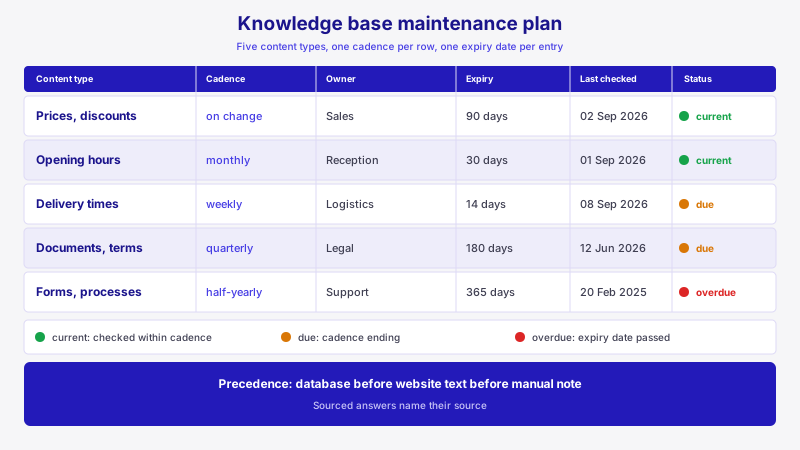
Upkeep: who enters a changed opening time
Location data ages faster than the rest of the knowledge base, because it hangs on local decisions: a shortened Saturday, a stocktake, a move to the side street. That is why every branch needs a named person who maintains its fields, and a date on which that upkeep is due. The upkeep process for the knowledge base applies unchanged here, but gains a second axis: not only “who maintains which topic”, but “who maintains which topic in which place”.
- Every branch has a named person for its fields – deputy included, otherwise upkeep stops during holidays.
- Deviating days are recorded with a date as soon as they are decided, and expire on their own after that date.
- The holiday calendar of the town is checked once a year, preferably in autumn for the year ahead.
- Sunday trading dates come from the municipal order and are stored with their source, rather than entered from memory.
- New branches are created before opening, with the opening date as the start of validity.
- Closed branches stay in the record with an end date and a pointer to the nearest location, instead of being deleted.
The effort is justified by demand. In a representative survey commissioned by the digital association Bitkom, 61 per cent (Bitkom 2023) of the online shoppers surveyed said they would like more retailers in their region to have an online offering. For a share of those people the assistant on the website is the first contact with the shop around the corner – and the first question is rarely strategic; it is whether the doors are still open today.
Acceptance: test cases that check the location
A multi-site assistant fails acceptance in different places than a single-site one. The test cases before go-live therefore get a block of their own that checks nothing but the location binding. It is short and, in our experience, still finds something.
- Ask the same question from three branch pages – do three different, each fitting answers come back?
- Switch the location mid-conversation – does the next answer move with it, or does it stay with the old place?
- Ask without page context – does the clarifying question come, or is head office quietly served instead?
- Query a dated exception day that affects one single branch.
- Switch off the inventory interface and check whether the assistant names the outage.
- Trigger a handover and check which mailbox it arrives in.
- Rename a location and check whether the earlier label is still recognised.
The first three cases uncover the bulk of the errors, in our experience. The fourth is the one that becomes most expensive later, because it concentrates on a single day in the year and then affects every enquiry that day. Shops face one more layer: the product data has to carry the location question as well, or a clean branch record alone helps little – the article on product data for the shop assistant describes which attributes and variants are needed for that.
What becomes measurable after rollout
After go-live the benefit can be read off three figures that need no extra tooling: the share of conversations in which a location was recognised or chosen, the share of handovers that arrived in the right mailbox, and the list of questions for which the assistant found nothing for a given place. The third figure is the most useful, because it names the next upkeep step instead of leaving it to guesswork. For providers with fixed dates the same mechanism applies with different vocabulary – the article on the assistant for course providers shows this for course venues and start dates.
That leaves the question of scale. A location model maintained on its own usually carries up to a double-digit number of branches; beyond that it pays to connect it to the system that holds the master data anyway, so opening hours and services are not maintained in two places. Such connections are part of integration. And where a multi-site business has particularities – sales territories, franchise boundaries, differing ranges – that belongs in custom functions rather than in a compromise inside the standard model.
Frequent questions
From how many locations onwards is a branch-aware assistant worth it?
From the second. As soon as two sites have different opening hours, services or stock, every answer without a location is a guess. The effort for the second location record is small, because the structure is already in place from the first. What gets expensive is retrofitting, when answers and interface calls were first built without a location key.
How does the assistant know which branch is meant?
From three sources, in this order: the page context (branch or region page), a picker in the chat and a clarifying question in one sentence. The recognised location is confirmed visibly so a wrong assumption can be corrected straight away. If someone names a different town later in the conversation, the location is reset and the earlier answer is not carried forward.
Do opening hours have to be maintained by hand for every branch?
Only as long as no system already holds them. If the hours sit in the inventory system, the till system or a branch directory, they are taken from there in the Custom package. What is then maintained by hand is, as a rule, only the dated exceptions that appear in no system: stocktaking, staff meeting, a shortened day before a public holiday.
How does the assistant handle holidays that apply only locally?
Through a holiday rule on the location record rather than a rule for the whole company. Such cases do exist: in the city of Augsburg, 8 August is a statutory public holiday as the Friedensfest (Bavarian Holidays Act), and for the Assumption of Mary the municipality announces locally whether it applies. A calendar per federal state is not sufficient for that.
What happens when the inventory system does not respond?
The assistant names the outage instead of estimating a value. In practice that means: it says that stock for this location cannot be retrieved right now, offers the fallback route by phone or callback, and takes the enquiry. An invented availability costs a wasted journey and is the most expensive way to end a conversation.
Where does an enquiry go when the location stays unknown?
Into a defined fallback route, not into some shared inbox. What works is a central queue that receives the conversation history as well, so the person there can ask for the town and pass the case on to the right branch. The case stays a single one, instead of starting over twice.
Ask it yourself, Assistant of this website
Automated assistant