Pre-Qualifying Property Leads With AI Chat
AI assistant for agents and property managers: answer property questions, pre-qualify leads by budget and arrange viewings. How to get started.
In plain language
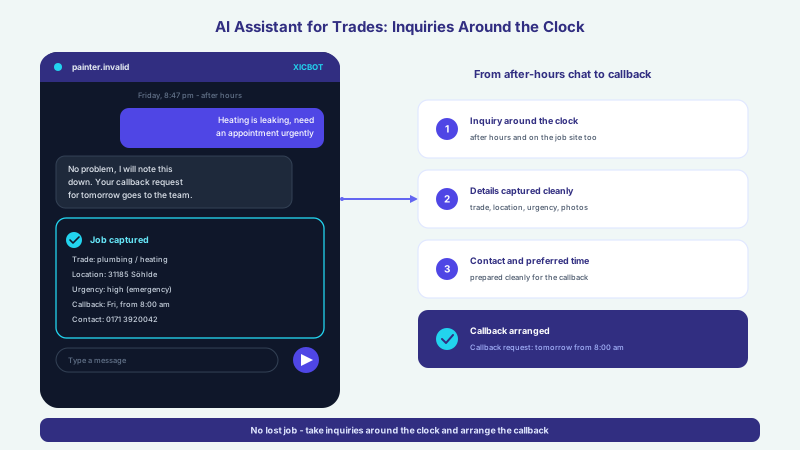
Many people search for a flat or a house online. They often do so outside office hours. An assistant answers questions on price, rent, rooms and location from the listing data. It asks about the property, buying or renting, budget, financing and timing. The questions come one by one, not as a rigid form. It takes a wished viewing date as a request. The team confirms the date. It gives no advice on financing, tax or law.
Most property seekers have long made up their minds before they pick up the phone: they found the listing online, studied the photos and checked the location. Around 70 percent (Bitkom) of those who have ever looked for a flat or house use the internet, fully or partly, to do so. For agents and property managers this means two things: the first enquiry arrives digitally, often in the evening or at the weekend, and it is usually just one of many competing for the same property. At the same time the market is tight, as only 41.9 percent (Destatis) of households in Germany lived in owner-occupied homes in 2022 while many others keep searching. Anyone who has to follow up and sort every enquiry by phone loses time to prospects who do not fit in the end. An AI assistant for real estate reverses this order: it answers property questions directly in the chat, pre-qualifies prospects by budget, financing and needs, and starts viewing appointments, without anyone from the team sitting at a front desk. This article shows which tasks a real estate assistant takes on, how pre-qualification works in the conversation, why the speed of the response decides the quality of the enquiry and where the assistant deliberately hands over to a human.

Labels in the illustration
- Is the 3-room flat still available?
- A
- Yes. Buy or rent, what budget?
- Buy, up to 420,000 EUR
- A
- Is your financing already sorted?
- Write a message
- Send
- Follow-up questions, not a form,
- answered around the clock
- XICBOT
- real estate
- assistant
- pre-qualifies
- Pre-qualified and forwarded
- Budget clarified
- Buy up to 420,000 EUR
- Financing checked
- Pre-approval in place
- Needs captured
- 3 rooms, new build, region
- Viewing appointment started
- Preferred slot handed to the agent team
- 70%
- use the internet for
- property search (Bitkom)
- Minutes
- count when answering
- new enquiries
- 40%
- of property sales
- go through agents (IVD estimate)
- Fewer unsuitable enquiries, faster response, more real viewings
Why Prospects Now Knock Digitally
Property search begins on the screen. About half of searchers, roughly 52 percent (Bitkom), look at large property portals, and many more go directly to the websites of agents and managers. And because just over two fifths (Statcounter) of page views in Germany came from smartphones in 2025, this often happens on the go, in a short free minute, outside office hours. Someone with a question at exactly that moment does not want to leave a callback request and wait three days, but to know now whether the property is still available, how high the running costs are or whether pets are allowed. If that question stays open, the next click is often the competing listing. The serial phone and the static contact form fit this behaviour poorly: one is only staffed during office hours, the other answers no single question but first demands effort.
The pressure to change something here is measurable in economic terms too. McKinsey estimates the value potential of generative AI for the real estate industry alone at 110 to 180 billion US dollars (McKinsey) or more and counts customer engagement, for instance through chat assistants that answer questions, among the four strengths of the technology. An AI chat assistant is the practical entry point into this potential: it complements phone and form with a third route that is available around the clock, holds any number of conversations at once and sorts the enquiry during the chat itself. It replaces neither the advice nor the viewing but ensures that the team mainly receives the enquiries where personal effort pays off.
What a Real Estate Assistant Takes On
In Germany a considerable part of marketing runs through agents: according to a 2019 estimate by the real estate association, around 40 percent (IVD) of property sales nationwide are handled by an agent. Accordingly, many first contacts land at agencies and property managers, and a high share of them revolves around the same, well-predictable questions. It is exactly this recurring routine that the assistant takes on, while advice and viewings stay with the people. What matters is the clear division of roles: the assistant clears facts and gathers the decisive details, the team runs the actual conversation. A detailed overview is on the page about the AI assistant for real estate agents.
-
Answer property questions
Availability, purchase price or rent, running costs, number of rooms, year of construction, energy certificate and features are answered directly from your listing data, seven days a week.
-
Pre-qualify prospects
With a few follow-up questions it captures budget, financing status, intended use and time horizon, separating serious enquiries from mere curiosity.
-
Start viewings
If the profile fits, the assistant records the preferred slot as a request and presents the team with a prepared case to confirm.
-
Explain location and surroundings
Transport links, schools, shopping and distances are answered from your stored details, without anyone repeating the same information again and again.
-
Answer in several languages
Prospects with a different first language receive the same information in their language, which widens the pool of enquiries for internationally sought-after locations.
-
Hand over to the team
Price negotiation, contract details, financing and legal questions are recognised by the assistant and handed over with the full conversation history to the responsible person.
Pre-qualify: Budget, Financing, Needs
The real strength of a real estate assistant lies not in the fact that it answers, but that it asks the right questions in the same conversation. Instead of passing every enquiry raw to the team, it clears the few details that decide whether a viewing makes sense at all. Usually four to five points are enough: which property it is about, whether purchase or rent is intended, what budget or price range is realistic, how financing stands and by when the move-in or purchase is planned. The assistant does not ask these as a rigid mask but one after another and each in keeping with the previous answer. Someone who writes that they are looking for a rental flat at short notice is not asked about a mortgage. From our own projects we know that well-placed, context-aware follow-up questions increase the number of usable enquiries without scaring off serious prospects (project experience).
- Property reference: which listing or type of property is the person interested in?
- Purchase or rent: which use is planned, own use or investment?
- Budget: which purchase price or rent is realistically in question?
- Financing: is a financing confirmation in place or still open?
- Needs and timing: how many rooms, which features and by when should it happen?
- Contact: through which channel and when is the person best reachable?
Pre-qualification is filter and service at once
A good follow-up question about budget works in both directions: it protects the team from appointments that lead nowhere, and it spares the prospect a viewing that does not fit from the start. Anyone who still needs to clear financing gets an honest note instead of a wasted appointment. This turns qualification into a service that saves both sides time, not a sieve. How to design such qualifying questions cleanly is deepened in the article qualifying leads via chat instead of long forms.
A First Contact Step by Step
An example makes what this feels like in everyday use tangible. On Sunday evening at half past nine someone opens an agent's website and types into the chat: is the 3-room flat on Gartenstrasse still available? The assistant understands this perfectly ordinary phrasing without the person having to click through a menu. It first answers the specific question from the listing, states rent and running costs, and then asks step by step the questions that qualify the contact. This ability to understand natural language and combine several concerns in the same window sets a website assistant apart from a rigid contact form.
- Greeting that suits the property and a question about the concern
- Answer availability and key facts directly from the listing
- Ask gently about purchase or rent, budget and financing status
- Clear the needs: number of rooms, features, preferred move-in date
- Capture contact details and, if interested, start a viewing appointment
- Hand complex or sensitive cases over to the agent team with the full history
The difference from a classic form lies in the in-between moments. If the person asks midway whether a parking space is included or from when the flat is free, the assistant answers from your details and then leads back to qualification. In the end there is no loose note in the inbox but an orderly case: name, contact, property reference, budget, financing status and preferred slot, neatly summarised. How this structured handover to your inbox or, in the Custom package, to your CRM works in real time is described on the page about tool control; the lead assistant bundles the matching scope of functions for qualified enquiries.
Start Viewings, Do Not Just Collect Enquiries
An enquiry is not yet an appointment, and an appointment with an unsuitable prospect is wasted time. The real estate assistant steps in exactly between the two: it turns qualified enquiries into concrete viewing requests and presents them to the team prepared. It suggests free times from the stored appointment types and takes the preferred slot in a structured way as a request, which the team confirms; a binding direct entry happens only through a set-up calendar integration (Custom package). The effect on response speed can be considerable: in McKinsey projects, home builders used agentic AI workflows to cut their response time to prospect enquiries by more than 90 percent (McKinsey), and gained additional home sales through AI agents that engage with buyers around the clock, including after hours. Anyone who answers in the moment of interest keeps the contact warm instead of losing it to the faster competing offer.
A good real estate assistant does not collect enquiries, it prepares appointments. It hands the agent not a list of names but qualified prospects with a clarified budget and an open calendar.
For an appointment to turn into an actual visit, the second underestimated function helps: the reminder. A reserved but missed viewing appointment blocks the slot and ties up staff without a result. Once the team has confirmed the appointment, the assistant sends an email reminder if an address is on file, and anyone who cannot make it is asked in it to cancel in good time. How an appointment request becomes a confirmed appointment is shown in the article on appointment requests via chat assistant and on the page about the booking assistant.
Portal Enquiry, Form and Assistant in Comparison
| Aspect | Portal enquiry or form | Real estate assistant in chat |
|---|---|---|
| Availability | Answer later during office hours | Directly in chat, around the clock |
| Property questions | Open until the callback | Answered directly from the listing |
| Qualification | Only in the follow-up call | Already in the conversation by budget and needs |
| Parallel enquiries | One after another | Many prospects at the same time |
| Result | Raw contact in the inbox | Prepared case with a preferred slot |
| Complex cases | Left lying | Handover to the team with full context |
Respond Faster: Why Minutes Decide the Lead
For sought-after properties it is often not the best offer that wins, but the fastest reply. A widely cited US study found that companies which try to contact a prospect within an hour of receiving the online enquiry are nearly 7 times (Harvard Business Review) as likely to hold a qualifying conversation with a decision maker as those who try only an hour later. Within that hour, too, the first minutes count: while the prospect is still in the middle of the search, a reply usually reaches them at the right moment. An assistant that replies in the chat around the clock does not squander exactly these critical minutes. It catches the prospect in the moment of interest, runs the qualifying conversation and hands over a prepared case before attention moves on. Much as a shop assistant recovers abandoned carts, a real estate assistant catches enquiries that would otherwise be lost in the busy signal or the overflowing inbox.
Data Protection: Guarding Prospect Data
In property brokerage, sensitive details are quickly touched: income, financing status, family situation or the reason for a move. That is why data protection belongs in the design from the start, not as an afterthought. A properly set-up assistant processes only the details needed for the respective concern and does not even ask for sensitive details in the open chat. At XICBOT, hosting is in Germany and the answers are generated by a specialised model provider, also outside the EU on the basis of standard contractual clauses; there is a data processing agreement, data sovereignty and a clear deletion concept. The assistant is also instructed to bind its answers to your checked property and company data instead of inventing information freely, and to pass uncertain matters to people. The contractual and technical foundations are summarised on the page about privacy and hosting; how an assistant can be operated in a GDPR-compliant way overall is deepened in the article on data protection and hosting of an AI chatbot.
In a Few Steps to Your Real Estate Assistant
The path begins with a short look at your most frequent enquiries, your typical property types and the topics that tie up first contact the most. On this basis the assistant is trained on your listings and content, embedded into the website and property pages with a short snippet and, if desired, connected to the calendar or CRM. A fixed rate cannot seriously be promised, because how many enquiries the assistant catches and how many viewings result depends on location, property, price and target group (project experience). What is dependable, however, is the mechanism: reachable round the clock, an answer in seconds, pre-qualification by budget, financing and needs and a protected handover to the team. An overview of functions and packages is given by the services; anyone who wants to run this through their own case can request a free demo for agents and property managers. Which tasks the assistant takes on in other sectors is shown on the industries page.
- Gather the most frequent property and organisational questions and the qualification criteria
- Define follow-up questions on budget, financing and needs without overwhelming prospects
- Bind answers to checked listing and company data for dependable information
- Set the handover to the agent team for negotiation, contract and sensitive cases
- Connect calendar or CRM to start appointments and hand over leads in a structured way
- Secure data protection and hosting in Germany contractually
- Keep sharpening via the conversation analytics where questions remain open
Frequent questions
Does an AI assistant for real estate replace the agent?
No, it relieves them. The assistant takes on the recurring routine around the clock: answering property questions, pre-qualifying prospects by budget, financing and needs, and starting viewing appointments. The actual advice, the viewing, the price negotiation and the contract conclusion stay with the human. For complex, sensitive or unusual cases the assistant is meant to hand over with the full conversation context to the team. This preserves personal contact while first contact and qualification run automatically.
How does the assistant pre-qualify a prospect?
It asks targeted follow-up questions in the conversation that build on the history so far, instead of asking everything at once. Usually four to five details are enough: property reference, purchase or rent, budget or price range, financing status and preferred time horizon. From these answers a clear picture emerges of whether a viewing makes sense. If the profile does not fit, the assistant points this out politely instead of producing a wasted appointment. If it fits, it starts the appointment and hands over a prepared case.
Can the assistant really book viewing appointments?
It takes them as requests. The assistant suggests free times from the stored appointment types, records the preferred slot in a structured way and presents it to the team to confirm. A binding direct entry happens only through a set-up calendar integration (Custom package). A connected CRM receives the prospect, not the appointment. Access runs through clearly defined actions with permissions, not through blanket full access. The assistant reminds of an appointment the team has confirmed, if an email address is on file, so fewer viewings fall through; the appointment can be moved in the same conversation.
Does the assistant give financing or legal advice?
No, it is not meant to, and that limit is deliberately built in. The assistant may ask about the financing status or possible deadlines to place the contact, but it is explicitly not meant to give financing, tax or legal advice. For anything beyond pre-qualification it points to the responsible people and hands over with the full history. Its answers are bound to your checked property and company data, so it states facts rather than phrasing freely.
Is capturing data in the chat GDPR-compliant?
Yes, when the assistant is set up properly. Because property brokerage quickly touches sensitive details, a good assistant captures only the organisationally necessary data and does not even ask for details such as full creditworthiness in the open chat. At XICBOT, hosting is in Germany and the answers are generated by a specialised model provider, also outside the EU on the basis of standard contractual clauses; there is a data processing agreement, data sovereignty and a clear deletion concept. Sensitive content belongs in the personal conversation with the team.
Which real estate businesses is such an assistant suited to?
In principle all where many first contacts arrive digitally and revolve around recurring questions: agencies for purchase and rent, property managers, developers and project developers as well as letting teams for larger portfolios. The more enquiries arrive per property and the more they can be sorted by availability, budget and needs, the more noticeable the relief. The assistant is trained individually on the respective business and its properties.
Ask it yourself, Assistant of this website
Automated assistant