Vet practice: emergencies and appointments in chat
Vet practice in chat: take routine visits as requests, give the out-of-hours number directly on emergency signs and explain GOT fees in advance.
In plain language
Many households keep a pet. Every animal needs jabs, check-ups and now and then urgent care. The chat is not meant to make a diagnosis or recommend a treatment. If there is a sign of real danger, it gives the number for urgent care right away. It then asks nothing more. Urgent care costs more at night and at weekends, and it says so first. For a normal appointment it asks about the kind of animal, its age and the reason. It only asks for what the appointment needs and points to the privacy notice of the practice.
Monday morning in a small animal practice: the line is busy. One owner wants to move her cat's vaccination, another asks whether the renal diet food is ready for collection, a further caller is looking for a neutering appointment. In between, someone is trying to get through whose dog has been breathing heavily since breakfast. Routine and emergency share the same number, and on the phone nobody can tell in advance which call can wait. A booking assistant on the website takes over the routine: it takes appointment requests, records concerns and notes pick-ups. It spots emergency signs without making a diagnosis and then gives the out-of-hours number directly instead of asking further questions. This article shows how that is set up, where the line runs and how the assistant explains the cost of out-of-hours care under the German fee schedule for veterinarians in advance.

Labels in the illustration
- Requests to the practice
- Vaccination for our cat, please
- Spaying our female dog, slot?
- Follow-up after the surgery
- Pick up food and medication
- Dog breathing heavily, help?
- Routine and emergency on the same line
- 33.4
- million pets in German
- households in 2025
- Source: IVH
- Booking assistant
- Visit types and length
- Practice emergency list
- Out-of-hours by time
- set up on your sources
- Routine visit requested
- Species, age and reason recorded
- Pick-up noted
- Food and medication, released by the team
- Emergency sign: the number at once
- No further questions, no diagnosis
- Out-of-hours service, § 4 GOT
- 50 €
- emergency
- service fee
- 2–4
- times the
- fee rate
- Regular: one to three times the rate (§ 2 GOT)
- When out-of-hours rates apply
- Periods under § 2(2) GOT
- daytime
- 0
- 8
- 18
- 24 h
- Night: 18:00 to 08:00
- Weekend: Fri 18:00 to Mon 08:00
- Public holiday: 00:00 to 24:00
Routine and emergency on the same line
In 2025, 33.4 million (IVH) dogs, cats, small mammals and pet birds lived in households in Germany, and 43 percent (IVH) of all households kept at least one pet. Cats lead in popularity with 15.7 million (IVH) animals in 24 percent of households, followed by dogs with 10 million (IVH) animals; one in five households had at least one dog (IVH). On top of that come 4.4 million (IVH) small pets such as rabbits and guinea pigs and 3.3 million (IVH) pet birds. The figures come from a survey representative of households with 5,000 respondents (IVH), carried out by the market research institute Skopos for the German pet supplies industry association IVH and the central association of pet trade businesses ZZF.
Behind these figures are recurring occasions: vaccinations, deworming, neutering, follow-up checks after surgery, dental checks, collecting diet food and long-term medication. These requests can be planned and they recur. Yet they run through the same phone number as the call where minutes matter. On the phone, the order in which callers get through decides, not urgency.
The practice therefore has two tasks that pull against each other. Routine requests should be handled quickly and completely, and the line should be free for emergencies. More speed on the phone does not resolve this. Instead, an assistant on the website takes routine off the line and sends emergencies recognisably to the right place. The team at the front desk spends less time on the phone with requests that can be settled without a conversation and has more room for the owners who really need help.
Triage without diagnosis
Triage here means sorting by urgency, not judging what is wrong with the animal. The assistant knows three tracks. Routine is taken as an appointment request. Anything unclear is meant to go to the practice team with a callback request. And where an emergency sign appears, the conversation ends with the out-of-hours number. No more tracks are needed, and every additional one would be a step towards an assessment.
What matters is what the assistant does not do. To the question "Is this serious?" it does not answer yes or no, but with the route by which the question gets answered: with these signs, please call right away; in all other cases, an appointment or a callback. This restraint is not a flaw. A chat window cannot see the animal, hear its breathing or feel its abdomen.
-
No diagnosis
The assistant names no illness and no cause, not even as a guess. When an owner describes symptoms, it only assigns them to a track: emergency sign, callback or appointment.
-
No treatment recommendation
It recommends no medicine, no dose and no home remedy. Questions about dosage, interactions or stopping a medicine go to the veterinary team with a callback request.
-
No all-clear
It does not say that something is harmless or can wait until tomorrow. The reassuring answer in particular would be an assessment it is not responsible for.
To keep the assistant within these limits, it is instructed to answer only from approved sources. The assistant's knowledge base contains consultation hours, services, information sheets and the practice emergency list, nothing else. How this is secured technically is described in the article on hallucinations and a clean knowledge base. Which questions are passed to a team member is decided by the practice in advance, not by the assistant during the conversation.
With an emergency sign, the conversation ends with a number
Every further question costs time at that moment. The assistant gives the out-of-hours number that applies at the current time, adds that the owner should call now and asks no more questions. It closes nothing, books nothing and does not ask for the animal's name. The person on the out-of-hours phone takes over the intake.
Spot emergency signs and pass them on without detour
Which signs count as an emergency is not decided by the assistant but by the practice. It supplies a list in the language owners write in, not in technical terms. That list becomes the rule by which the conversation switches:
- The list comes from the practice. Typical entries are breathing difficulty, seizures, heavy bleeding, suspected poisoning, a bloated abdomen with unproductive retching, accidents and animals that can no longer stand up. Which points are included is decided by the veterinary team.
- A match ends the intake. As soon as a description fits an entry, the assistant stops asking about age, weight or vaccination status. It gives the number.
- The number depends on the time of day. During consultation hours it is the practice number, after that the practice's own out-of-hours service, an animal hospital or the regional out-of-hours rota. The assistant reads this from the stored schedule, not from memory.
- When in doubt, the emergency route applies. If an owner describes something that is neither clearly routine nor clearly an emergency, the assistant points to the out-of-hours number and also offers a callback. It does not decide in favour of waiting.
- The assistant does not call anyone itself. It alerts nobody and does not promise a callback within a set time. It gives the owner the number and the advice to call right away.
Whether the assistant switches correctly shows not in a demo but in testing. Before go-live, the entries on the emergency list are played through with paraphrases, typos and half sentences, the way they are written in the middle of the night. How such a test is structured is covered in the article on acceptance testing before go-live. Agitated messages that match no entry are caught by a second rule: the assistant detects frustration and distress in chat and escalates instead of offering more appointments.
An assistant that still asks for the vaccination record when an animal is struggling to breathe is not thorough, it is in the way. The line is drawn before go-live, not after the first emergency.
Settle the out-of-hours cost question in advance
Without a hint, owners only learn from the invoice that out-of-hours care is billed differently from consultation hours. The rules are set out in the German fee schedule for veterinarians (Gebührenordnung für Tierärztinnen und Tierärzte, GOT). Under § 4(1) GOT, for services provided at night, at weekends or on a public holiday as part of a veterinary out-of-hours service, the single fee rates increase to twice (§ 4 GOT) and, as provided in § 2, up to four times (§ 4 GOT) the rate. In addition, the practice is entitled to an emergency service fee of 50 euros (§ 4 GOT).
For comparison: during regular consultation hours a fee is set at one to three times (§ 2 GOT) the fee rate. What counts as night, weekend and public holiday is defined in § 2(2) GOT: daily from 18:00 to 08:00 (§ 2 GOT) the following day, at weekends from Friday 18:00 to Monday 08:00 (§ 2 GOT) and on public holidays from 00:00 to 24:00 (§ 2 GOT). This time rule does not apply to services within regular consultation hours, including by appointment (§ 2 GOT). A practice that offers regular consultation hours in the evening therefore does not bill them under the out-of-hours rules.
| Item | Regular consultation hours | Veterinary out-of-hours service |
|---|---|---|
| Fee range | One to three times the rate (§ 2 GOT) | Two to four times the rate (§ 4 GOT) |
| Emergency service fee | Not charged | 50 euros on top (§ 4 GOT) |
| Several animals of one owner | Services per animal within the fee range | Services per animal, emergency service fee only once for the same matter (§ 4 GOT) |
| Period | Practice consultation hours, including by appointment | Night 18:00 to 08:00, weekend Fri 18:00 to Mon 08:00, public holiday 00:00 to 24:00 (§ 2 GOT) |
| Waiving the fee | Not applicable | Possible in a justified individual case (§ 4 GOT) |
What does the assistant say about this? It explains the rule, not the final amount. If an owner asks on a Saturday evening what out-of-hours care costs, it answers along these lines: under the fee schedule, an emergency service fee of 50 euros (§ 4 GOT) applies out of hours, and treatment is charged at two to four times the rate; the amount depends on the treatment and is set by the practice. It does not name a final amount because it cannot know it. Which services are needed only becomes clear with the animal.
Two things explicitly do not belong in the answer. The assistant is not meant to hold out the prospect of waiving the emergency service fee, even though the GOT allows it to be waived in a justified individual case (§ 4 GOT); that is for the practice to decide. And it is not meant to advise waiting until the next consultation for cost reasons. Anyone who describes an emergency sign is meant to get the number before money is discussed. The cost explanation is meant for owners who ask for it explicitly or want to know in advance what to expect. The practice writes the text once, checks and approves it; the assistant then uses it word for word.
Routine appointment requests with the complete case
For routine work, the assistant uses the practice appointment types. Each appointment type has a length, a time window and, where needed, a preparation note, for example surgery appointments only in the morning or follow-up checks at the interval the team specifies. How appointment request, confirmation and reminder work together in chat is shown in the article on appointment requests through a chat assistant.
Before taking the appointment request, the assistant asks for what the team at the front desk would otherwise ask:
- Species and breed, because appointment length, treatment room and sometimes staffing depend on it.
- Age and approximate weight, where the practice needs them for the appointment type.
- Reason for the visit in one sentence, for example vaccination, neutering, follow-up or dental check.
- Existing or new patient, so that the record is ready in advance or an admission form is prepared.
- Name and email address: once the practice confirms the appointment, confirmation email and reminder go to the given email address.
- Notes from the practice information sheets, for example to bring the vaccination record or to keep the animal fasted before surgery.
Pick-ups work in a similar way. Food and long-term medication are noted, not released: the assistant records the animal, the product and the preferred pick-up day and passes the request to the team. Whether a medicine is dispensed without a new examination is decided by the veterinarian. In the chat, the owner learns that the pick-up will be confirmed as soon as the team has checked the request.
| Item | Request by phone | Request via the booking assistant |
|---|---|---|
| Availability | Only during phone hours | Also in the evening and at weekends for routine requests |
| Line | Routine occupies the number that emergencies also come through | Routine runs through the website, the line is relieved |
| Animal details | Asked for at the front desk | In the overview before the appointment |
| Emergency signs | Depend on getting through | Lead directly to the applicable out-of-hours number |
| Cost question | Without asking, only comes up with the invoice | Rule under the GOT explained in advance |
Vaccination reminders that lead to an appointment
Vaccinations and repeat treatments are part of the plannable work of a small animal practice. But a reminder only helps if it leads to an appointment. The practice sends the reminder itself from its own system. The link in it can lead to the website, where the assistant names suitable times of the appointment type and takes the request. Once the team confirms it, the owner gets a confirmation email if an email address was given.
The data for the reminder comes from the practice system. If it is connected through the assistant's tool control, the assistant reads only the fields it needs in the conversation: animal and occasion due. Vaccination schedules and intervals are set by the veterinary team; the assistant does not recommend a vaccination.
Whether a reminder requires consent depends on the occasion and the channel. An appointment confirmation that an owner triggered is something different from a recurring message to all existing patients. How the assistant obtains and records consent in the conversation is covered in the article on consent in chat and contact data. The legal assessment for your own practice belongs in the hands of your data protection officer.
The handover to the practice team
Not every request becomes an appointment. Questions about findings, the wish to speak to the treating veterinarian and questions about medication go to the team. So that nobody there has to start from scratch, the assistant hands over the complete case. How such a handover to human agents is structured in general is described in a separate article. In a veterinary practice it includes:
- A one-paragraph summary, in the owner's words and without judgement.
- Animal details: species, age, existing patient and, with several animals in the household, the one concerned.
- Way back: phone number or message and the preferred time window for the callback.
- Course of the conversation, including the pointer to the out-of-hours number with the time, if it was given.
- Open question: what the owner wants to know and the assistant deliberately did not answer.
The time stamp on the out-of-hours pointer is not bureaucracy. If the assistant referred someone to the out-of-hours service in the evening, the team sees the next morning that and when the pointer was given and can follow up. Which requests come how often, at what times and where the assistant hands over is shown by conversation analytics. From that it becomes clear which information sheets are missing and whether an additional consultation slot is worthwhile.
Collect owner data sparingly
An assistant that asks everything that can be asked collects data nobody needs. The GDPR requires personal data to be adequate, relevant and limited to what is necessary for the purpose (Art. 5 GDPR). For a vaccination appointment that means name, contact channel and the animal details. The assistant is meant to ask for the owner's address or date of birth only if the practice needs them for that appointment type.
Where data is collected from the owner, they must be informed at the time of collection (Art. 13 GDPR). For this, the assistant points to the practice privacy notice before the first question. In the chat it is recognisable as an automated assistant; whether and how this has to be labelled is answered in our FAQ on labelling an assistant. Where conversation data is processed and how long it is stored is set out under privacy and hosting.
Introduced in a few steps
- Define appointment types. Which requests the assistant takes as appointment requests, with what length, in which time windows and with which preparation notes.
- Write the emergency list. The veterinary team phrases the signs at which the conversation ends directly with the number, in the owners' language.
- Store the out-of-hours schedule. Which number applies at what time, at weekends and on public holidays, including a regional out-of-hours rota.
- Approve the cost texts. The explanation of the GOT is written once, checked by the practice and then used word for word.
- Test and go live. Emergency signs, borderline cases and cost questions are played through before the start; after that the assistant first runs with close review by the team.
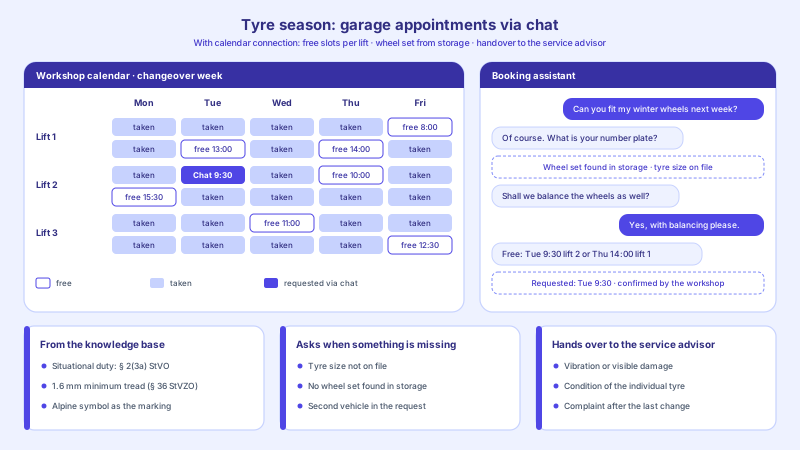
Healthcare providers have their own starting point: the assistant for practices combines appointment requests, knowledge base and handover. How human medicine deals with appointments and medical confidentiality is shown in the article on the AI assistant for medical practices. A related task from another sector is described in the article on workshop appointments in tyre season: there too, the aim is to take plannable requests off the line.
The assistant replaces neither the veterinary nurse at the front desk nor the veterinarian on out-of-hours duty. It takes the recurring requests off their hands and makes sure the urgent ones reach the right place faster. If you would like to see how this looks with your appointment types and your out-of-hours schedule, go through your emergency list with us.
Frequent questions
Does the assistant judge whether my animal is an emergency?
No, that is not what it is for: it is not meant to make a diagnosis or give a treatment recommendation. It compares the description with the practice emergency list. If it matches, it gives the applicable out-of-hours number directly and asks no further questions. When in doubt, it points to the out-of-hours number and also offers a callback.
What happens if someone describes an emergency sign at night?
The assistant gives the number that applies at that time according to the stored out-of-hours schedule, for example the practice's own out-of-hours service, an animal hospital or the regional rota, and asks the owner to call right away. It does not call anyone itself and books no appointment. The pointer is recorded with the time in the conversation log so that the team can follow up in the morning.
What does veterinary out-of-hours care cost under the GOT?
For services at night, at weekends or on a public holiday as part of the out-of-hours service, the single fee rates increase to twice and, as provided in § 2, up to four times the rate; in addition, an emergency service fee of 50 euros applies (§ 4 GOT). During regular consultation hours, one to three times the rate applies (§ 2 GOT). The final amount is set by the practice after treatment.
Is the emergency service fee charged for each animal separately?
No. Under § 4(2) GOT the emergency service fee may be charged only once for the same matter, even if several animals of one owner are treated during the out-of-hours service. The services for each animal, however, are charged individually. In a justified individual case the practice may waive the fee (§ 4 GOT); the assistant cannot promise that.
Which details does the assistant ask for before a routine visit?
Species, age and, where needed, approximate weight, the reason for the visit, whether the animal is already a patient, and name and email address. Once the practice confirms the appointment, confirmation email and reminder go to the given email address. Which fields are mandatory is set by the practice for each appointment type. It collects further data only if the appointment needs it.
Can the assistant send reminders for vaccinations that are due?
Not on its own. The practice sends reminders for vaccinations that are due from its own system; the link in them can lead to the website, where the assistant names suitable times and takes the appointment request. It only sends reminders itself for confirmed appointments, one day in advance and only if an email address was given. Vaccination schedules and intervals are set by the veterinary team; the assistant does not recommend a vaccination. Whether consent is needed depends on the occasion and the channel.
Ask it yourself, Assistant of this website
Automated assistant