Shipment Questions in Freight: What a Chat Answers
How an AI chat in freight explains collection times and pallet sizes, gives shipment status with a connected ERP and leaves liability with your team.
In plain language
Many calls are about where a shipment is. The answer is already in a system. So in the Custom package the assistant can tell it, with place and time. Pickup and ramp times sit in its knowledge for each site on its own. For dangerous goods it names the rule and the papers you need. Whether goods count as dangerous is decided by a person in the firm. Questions about pallets, weight and customs can be sorted out in the chat before pickup. Liability, damage and freight prices belong with a person.
In a freight forwarding business the phone rarely rings because of a new order. It rings because someone wants to know where their shipment is right now, by when they can still book it in today, and whether the driver will even take the pallet in that shape. These questions are short, they repeat, and they tie up exactly the people who are planning tours at the same time. An AI assistant on the website and in the customer area can take over this part, provided it is connected to the right sources and provided it is settled in advance which answers it never gives. This article covers both: the enquiries that can be automated cleanly, and the limit at liability, damage reports and binding freight prices.

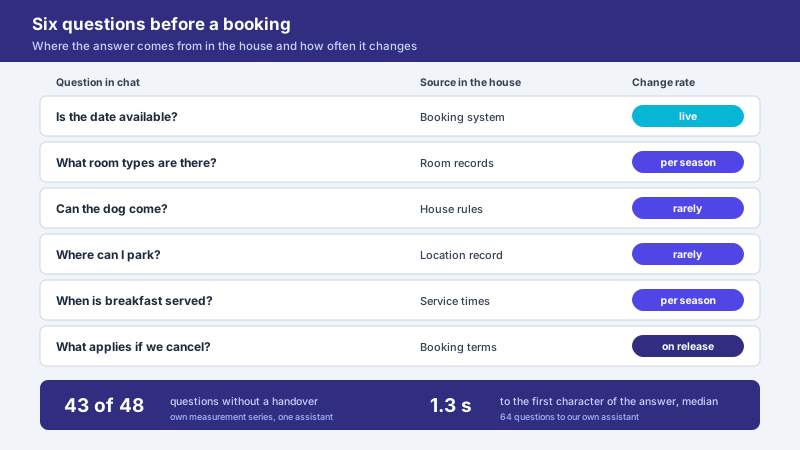
Labels in the illustration
- Enquiry in chat
- Source in the business
- Answer basis
- Where is my shipment?
- Transport system
- live
- What is the cut-off time?
- Branch opening times
- per site
- What counts as dangerous goods?
- Dispatch rules
- rule only
- Which pallet sizes work?
- Loading instructions
- fixed
- Which customs papers?
- Export checklist
- fixed
- What does the freight cost?
- Tariff and calculation
- person only
- 43 of 48
- questions without a handover
- own measurement series, one assistant
- 1.3 s
- to the first character of the answer, median
- 64 questions to our own assistant
Why status questions dominate the phone desk
A freight forwarder sells transport but spends the whole day answering questions about transports that are long under way. The consignor wants to know whether collection worked. The consignee wants to know whether to keep the dock free for the afternoon. The customer's accounting department is looking for the proof of delivery for a shipment from last week. None of these questions needs advice, all of them need a look into a system, and each one costs the dispatcher the minutes they currently need for tour planning.
On top of that, these questions do not fit office hours. Loading happens early, unloading happens late, and the customer checks in the evening whether the shipment has arrived. An assistant that looks around the clock at the same data as the dispatcher in the morning shifts this load out of the hold queue into a channel that occupies no shift. What matters is not speed alone but that the answer is the same as on the phone: same source, same state, same timestamp.
What the assistant answers from your own systems
The dividing line runs where an answer turns into a commitment. As long as the answer sits in a document or a record the business maintains anyway, it belongs in the chat. As soon as someone has to judge whether a date can be held, whether a claim will be settled or what a lane costs, it belongs to a person with responsibility. Which content is needed for this and how it has to be cut is described in Knowledge base.
- Shipment status: last recorded scan, delivery status and proof of delivery for a shipment, each with the time of recording, provided your ERP or transport system is connected
- Collection and cut-off: by when a shipment must be booked in for today and which times apply at which site
- Sites: address, gate access, dock hours and public holiday rules for the individual branch instead of one time for the whole business
- Packaging and dimensions: which load carriers are accepted, which stacking height applies and how a package must be labelled
- Dangerous goods: which goods the business carries, which papers must accompany them and who handles classification
- Customs documents: which documents an export needs, in which order they are created and who produces them
- Case data: whether an order has been created, a collection scheduled or a document filed, provided the assistant is allowed to read the system
The difference from a tracking page on the website lies in how an incomplete question is handled. A tracking page demands a consignment number and otherwise answers nothing at all. An assistant also accepts what the customer actually has to hand, that is order number, delivery note number, collection date and consignee location, and works from there to the shipment. If it cannot identify one unambiguously, it asks back instead of showing the most likely shipment. Why asking back matters more than a fast answer is set out in Preventing hallucinations.
-
Identify the shipment first
No status answer without a clear match. The assistant also accepts order and delivery note numbers and works from there to the shipment.
-
Answer with a timestamp
Every status answer states the state it refers to. A status without a time is wrong the next morning without anyone noticing.
-
Site, not head office
Dock hours, access and cut-off times differ by branch. The assistant answers for the site, not for the company as a whole.
-
Dangerous goods as a rule only
The assistant states what the business carries and which papers are required. It is not meant to classify a product.
-
Language of the enquiry
Consignor, consignee and driver are rarely in the same country. The assistant answers in the language the question came in.
-
Handover with the case
If the question turns into a case, the whole conversation including the shipment data goes to the responsible person, not just the last line.
Shipment status: a reliable answer through the connected ERP
The most frequent call starts with a number the caller reads off a delivery note and ends with someone opening a window in the transport system. This path can be put in order without a machine promising a delivery at the end. If your ERP or transport system is connected, the assistant leads the identification, reads the last recorded state and returns it with its time. What it does not do: derive an arrival time from a scan when no such time is in the system.
- Capture the identification: consignment, order or delivery note number, and if unclear also consignor, consignee location and dispatch date
- Resolve the shipment: determine the case unambiguously and ask back on multiple matches instead of taking the most likely one
- Read the state: retrieve the last recorded scan, status and location from the transport system without interpreting it
- Phrase the answer: state status, place and time of recording, plus the time of the query itself
- Offer the document: provide the proof of delivery or receipt if it is filed and released for this customer account
- Hand over deviations: if a scan is missing longer than planned or the customer reports a shortfall, the case goes to dispatch
Read access to the transport system is the point where an information path becomes a tool. Technically this runs through a controlled connection to the existing systems in the Custom package: the assistant may issue defined queries and receives defined fields in return. What it may not query, it does not see. Someone else's consignment number must not open someone else's data: for that, the query can pass on an email address or postcode alongside the number, which the connected system checks; XICBOT does not bring a binding to a customer account. What such a connection looks like in practice is described in Integration.
A status is information, not a promise
An assistant that reads out a scan says: this is what the system holds. It does not say: this is how it will arrive. Between the two lie traffic, docks, customs and weather. That limit belongs in the answer itself, not in a footnote under the chat window.
Collection times, cut-off and locations
The second most frequent question is a question of time: by when does a shipment have to be booked in today so that it still goes out? The answer sits in the tour plan and in the branch opening times, it differs by site and by lane, and it changes before public holidays. That is exactly why it ends up on the phone. The website usually shows one time for everyone, and whoever needs to be sure calls.
| Enquiry | Phone and email today | Assistant with system access |
|---|---|---|
| Shipment status | Call back after a look into the system | Last scan with place and time, if the ERP or transport system is connected |
| Proof of delivery | Search in the archive, sent by email | Document for the shipment, if released |
| Cut-off time | Answer depends on who picks up | Time for that site and that lane |
| Dock hours at a site | Transfer to the branch | Address, gate access and times |
| Pallet dimensions and weight | Question back to the dispatcher | Rule from the loading instructions |
| Freight price for a lane | Calculation in sales | Data captured, quote from a person |
| Damage report | Form and call back | Handover including the shipment data |
For this to hold, the knowledge base has to be separated by site and not by company. An assistant that quotes the same time for every branch is wrong faster than the old contact form. Which details have to be held per branch for this is described in the article on building a knowledge base.
Dangerous goods: state the rule, do not classify
Dangerous goods questions come in two forms. The first can be answered: does the business carry this kind of goods at all, which papers must accompany the shipment, which marking does the driver expect on the package, which acceptance points take such shipments. The second cannot: whether a specific product falls under dangerous goods law and into which class and packing group it belongs is decided neither by the consignor in a chat nor by an assistant, but by classification against the safety data sheet, in case of doubt by the person appointed for it in the business.
The benefit still sits with the assistant, because the answerable half is the more frequent one. Someone sending such a shipment for the first time does not ask about the class but about the procedure: which transport documents, which marking on the package, which notification, which cut-off time. These answers sit in the company's own dispatch rules, they rarely change, and they can be given with a source reference.
Pallet dimensions, weight and loading rules
The question of dimensions decides whether a shipment can be loaded at all in the shape the customer has built it. Overhang, stackability, weight per load carrier and the question of whether a pallet truck can reach the goods are settled far more cheaply before collection than at the dock. The assistant can lead this part because the rules are set in-house: they sit in the loading instructions and in the tariff, not in case-by-case discretion.
- Load carriers: which pallets and mesh boxes are accepted and what exchange arrangement applies
- Overhang: whether and how far goods may protrude beyond the load carrier and what that means for billing
- Stacking height: up to which height loading takes place and how a non-stackable shipment must be marked
- Weight: limits per load carrier and per shipment and from when a shipment counts as bulky freight
- Securing: which strapping, film or edge protection is expected so that the shipment is accepted
- Labelling: which labels belong on the package and where they have to be placed
Customs documents for export: explain the list, keep the paperwork in-house
In cross-border traffic the most frequent question is not a customs question but a question of order: which documents does the shipment need, who produces which of them, and what happens if one is missing. This information can be prepared because it is settled for the individual business. What the assistant does not do is classify goods under the customs tariff or state which duties will fall due in the country of destination.
- Commercial invoice: which details it must contain so that the shipment does not stop at the border
- Packing list: how packages, weights and contents are matched to each other
- Registration of the consignor: that an EORI number is needed, where it is applied for and who supplies it
- Export declaration: who lodges it, which data has to come from the consignor and how the exit note comes back
- Proof of preferential origin: when it is an option at all and which statements the consignor is responsible for
The assistant also takes over the part that runs by email today: it says which document is still missing before the shipment can be planned, and captures the details in a structured way instead of collecting them in a phone note. The documents themselves are still produced in-house. That separation is not a step back; it is the reason the information can be reliable at all.
Where the assistant stays silent: liability, damage, freight price
Three topics do not belong in the chat, and not out of caution but because the answer binds legally or commercially. The first is liability. What a carrier owes for loss or damage does not follow from a friendly answer but from the contract of carriage and from the law.
The compensation payable under Sections 429 and 430 for loss of or damage to the entire goods is limited to an amount of 8.33 units of account for each kilogram of the gross weight of the consignment.
Anyone who calculates this in a chat produces a figure that differs in the individual case: it depends on the gross weight, on whether only part of the consignment is affected, on agreed declarations of value and on whether there is qualified fault. The second topic is the damage report. It is not merely a form but a declaration with a deadline: for damage that is externally apparent, Section 438(1) of the German Commercial Code requires notice no later than at delivery; for damage that is not externally apparent, Section 438(2) provides for notice within seven days of delivery. An assistant that takes such a report and then leaves it sitting in a mailbox does more harm than an engaged phone line.
The third topic is price. A freight rate depends on the lane, weight, volume, load carrier, surcharges and on what the framework agreement says. A figure an assistant states is read by the customer as an offer, and that is what counts, not the disclaimer underneath. The clean route is capture: the assistant asks for the data sales needs for the calculation anyway, builds a complete request from it and says by which route the answer will come. How this works in a business customer setting is described in B2B quote requests in chat.
- Liability questions and cover confirmations for a specific damage case
- Amount of damage, compensation and the assessment of a complaint
- Binding freight prices, surcharges and discounts
- Promises about arrival and delivery times beyond the recorded state
- Classifying goods as dangerous goods and information on customs tariff classification
- Anything that would amend the contract: cancellation, rerouting, storage, cash on delivery
The limit belongs in the instruction, not in hope
An assistant keeps to a limit only if the limit is written as a rule and if there is a route for the case behind it. “Do not answer price questions” on its own produces an unfriendly dead end. “Capture the data for the calculation and hand over to sales” produces a case. How to write such rules is set out in System instruction and boundaries.
In a few steps to an assistant in freight forwarding
Whether an assistant is worth it in a business shows in two figures: how many questions stay without a handover to a person and how fast the first answer arrives. For our own assistant we have measured values. In our own measurement series 43 of 48 questions stayed without a handover to a person; this was measured on a single assistant on our own knowledge base, not on customer projects, and a figure from live operation is not yet available.
The second figure is the wait until the first character. In our own measurement series the time to the first character of the answer was 1.3 s at the median, across a coverage of 64 questions to our own assistant, not to customer projects. For a status question that is the difference between a quick look and a phone call. How to measure this time cleanly is set out in Measuring response time; the raw values are under Measurements.
Before going live, the disclosure has to be settled. Anyone running an assistant on a website must inform users that they are speaking to an AI system. Article 50(1) of the AI Act requires systems intended for direct interaction with natural persons to be designed so that the persons concerned
are informed that they are interacting with an AI system
- Review the last two hundred calls and emails in customer service and note which question came how often and which detail was missing to answer it
- Collect the times per site: cut-off, dock hours, public holiday rules and how the branch can be reached
- Put dispatch and loading rules in writing: load carriers, overhang, stacking height, weight limits, labelling
- Set up read access to the transport system, tied to the customer account and limited to the fields that may appear in an answer
- Define the output format: status, place, time of recording and time of the query, in that order
- Fix the blocked list in writing and name, for each entry, the route by which the case reaches a person
- Sign off test cases before the assistant goes on the website, including the cases in which it must say nothing: Acceptance and test cases
- After four weeks, review the conversations and close the gaps in the documents that become visible: Analysing conversations
Frequent questions
Can an AI assistant give binding information about shipment status?
If your ERP or transport system is connected in the Custom package, it can state the last recorded state from it, with the place and time of recording, plus the time of the query. That is not a promise about arrival, because between the last scan and delivery lie circumstances nobody can read out of the record. The clean phrasing states the state and leaves the forecast out.
How does the assistant know which shipment is meant?
Through the consignment number, alternatively through the order or delivery note number and, if that is missing too, through consignor, consignee location and dispatch date. If several matches remain, it asks back instead of showing the most likely one. So that someone else's number does not open someone else's data, the query can also pass on an email address or postcode, which the connected system checks; XICBOT does not bring a binding to a customer account.
May the assistant answer dangerous goods questions?
The procedure yes, the classification no. It can say which goods the business carries, which papers must accompany them, how a package must be marked and which acceptance points take such shipments. Whether a specific product is dangerous goods and into which class it falls is decided by classification against the safety data sheet by the person appointed for it.
What happens if a customer reports damage in the chat?
Then the information part is meant to end and the case to go to a person. The assistant confirms that the report was taken, records shipment data, time and description, and hands over. It is not meant to assess the damage or name an amount. The statutory notice periods run regardless: Section 438(1) of the German Commercial Code requires notice of externally apparent damage no later than at delivery, and subsection 2 provides seven days for damage that is not apparent.
Can the assistant quote a freight price?
No, and that is a deliberate decision. A rate depends on the lane, weight, volume, load carrier, surcharges and the framework agreement; a figure from a chat is still read by the customer as an offer. Instead the assistant captures the data sales needs for the calculation, builds a complete request from it and says by which route the answer will come.
Which documents does a freight forwarder's knowledge base need as a minimum?
Site data with times, the dispatch and loading rules, the list of export documents and the company's own dangerous goods rules are enough to start with, provided they are held separately per branch. Added to that, in the Custom package, is read access to the transport system for status and documents. Everything else follows from the conversations of the first weeks, because that is where it becomes visible which question went unanswered.
Ask it yourself, Assistant of this website
Automated assistant