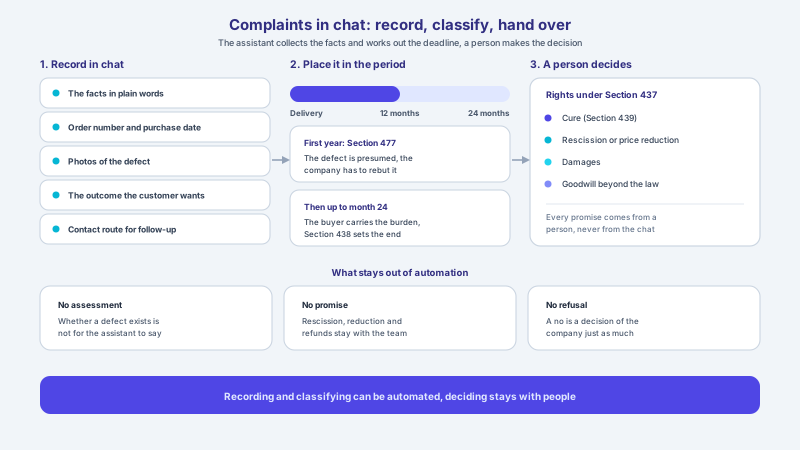
WhatsApp Customer Service: What an Assistant Can Do
Automate customer service on WhatsApp: an AI assistant answers service enquiries in the messenger around the clock, resolves routine and hands off tricky cases.
In plain language
Many people use WhatsApp every day. Messages there are usually read. Unlike a chat on a website, the chat stays on the customer's phone. They can answer a question hours later. A well set up assistant handles many simple questions itself, such as opening hours and bookings. If your stock system is linked, it can also give the status of an order. Nobody may be sent messages there without agreeing first. Hard cases are meant to go to a person with the whole chat, and how much work it takes off you cannot be promised.
In 2026, customer service has moved to where people already message all day: the messenger. A considerable share of conversations with AI assistants now runs over WhatsApp, and messages in the messenger are generally opened far more often than classic emails. No wonder: with around 3 billion (Meta) monthly active users, WhatsApp is the obvious way for a large share of customers to get in touch. Anyone whose customer service still relies solely on email, phone and a contact form is giving away exactly the channel on which enquiries now arise. An AI assistant on WhatsApp answers recurring questions about opening hours, prices, availability or, once your inventory system is connected, order status in seconds, captures appointment requests and other enquiries in structured form and passes on anything that needs a person. This article shows why customer service is shifting to WhatsApp, what a good assistant can automate there, where its limits lie and what you need to watch for on data protection and consent.

Labels in the illustration
- Replies in seconds
- Your assistant
- Wednesday, 8:47 pm
- Do you have a slot free
- tomorrow?
- Yes, 2:30 pm tomorrow is
- free. Shall I request it
- from the team for you?
- Opening hours
- Request a slot
- Yes, please
- Enquiry resolved
- Topic: appointment Wednesday
- Reply: in seconds
- Channel: WhatsApp
- Handover to team: not needed
- Slot: requested
- Type a message
- From WhatsApp to a resolved enquiry
- 1
- Message around the clock
- answered after hours and at the weekend too
- 2
- Trained on your content
- opening hours, prices and availability
- 3
- Routine solved at once
- standard questions without staff
- Hand tricky cases over
- to your team with full context
- Customer service in the messenger - answered around the clock, in seconds
Why Customer Service Happens on WhatsApp
The most important reason for the move to the messenger is simply customer habit. With around 3 billion (Meta) monthly active users, WhatsApp is one of the most widely used messengers, and the WhatsApp Business App, which businesses use to stay in touch with customers, already had more than 200 million (Meta) monthly users in 2023. For many people, a short message is far lower-effort than a call during business hours or a formal email: they type the question in passing, but also expect a fast answer. This expectation is the real challenge, because a message answered only on the next working day feels far slower in the messenger than the same delay would in an email.
On top of this comes the sheer reach of the channel. That a considerable share of interactions with conversational AI now runs over WhatsApp shows how strongly the conversation between businesses and customers has shifted into the messenger. Messages there are also generally read, while emails are often opened only in the low double-digit percentage range (project experience). For customer service this means two things. First, you reach your customers more reliably on WhatsApp than via almost any other channel. Second, this also increases the volume of enquiries waiting to be answered - and they arise not only during office hours, but around the clock.
From Website Widget to the Messenger
Many businesses so far know an AI assistant only as a chat window in the bottom-right corner of the website. That is valuable, but it only works while the visitor is on the page. On WhatsApp the logic shifts: the conversation lives on in the customer's address book, even after they have long since closed the website. An answer reaches them as a push notification, a follow-up question can be answered casually hours later, and the whole history stays in one place. For customer service this means shorter paths and fewer abandoned contacts - provided someone or something replies promptly. This is exactly where the assistant steps in, because it keeps the conversation going even when no one at the business is at the desk. How a continuously reachable support around the clock relieves the team is shown in detail by the linked article.
A typical flow on WhatsApp follows a simple pattern that feels like a natural conversation for the customer and creates a clean record for the business:
- The customer writes the request in their own words, often outside business hours
- The assistant understands the question, replies in your tone and offers fitting options
- Recurring matters like opening hours, prices or availability it resolves at once itself
- For appointments or orders it captures the necessary details in structure in the chat
- If a case needs a person, it hands over with the whole conversation history to your team
- The record lands where your service works: the inbox, the ticket system or the CRM
In this way a single assistant covers the path from the first message to a resolved or handover-ready enquiry, without anyone at the business having to answer every routine question by hand. Which building blocks XICBOT provides for website and shop is bundled in the scope of the assistant; it does not include a messenger channel.
-
Reachable around the clock
The assistant replies in the evening, at the weekend and in peak season, when no one at the business can watch the phone or the inbox.
-
In the familiar messenger
Your customers write in the app they use daily anyway, instead of fighting through a form or a phone queue.
-
Capture requests in structure
Appointment, order number or enquiry type sit cleanly in the chat before a person takes over. No laborious asking in the follow-up.
-
Trained on your content
The assistant answers from your website, your service descriptions and your knowledge base, not from general half-knowledge.
-
Handover to people
As soon as things become personal, delicate or complex, it is meant to pass the conversation with full context to a responsible person.
-
Data-minimal and GDPR-compliant
With clean opt-in, clear purpose and hosting in Germany, it asks only for the details needed to handle the case.
Which Enquiries the Assistant Resolves on WhatsApp
The greatest lever in customer service does not lie with the rare special cases, but with the same standard questions over and over, which together eat up most of the time. Well set-up assistants typically resolve a considerable share of these recurring matters without staff - exactly the questions every team member answers several times a day. Because the assistant is tied to your own content, it does not answer out of thin air but from your maintained sources. This relieves the team noticeably and at the same time ensures consistent, correct information in the messenger. On a website, this role is taken at XICBOT by the support assistant, which answers standard questions from the knowledge base and hands over to your team.
- State opening hours, directions, availability and location on request
- Answer common product and service questions from your knowledge base
- Suggest free times, capture preferred times and turn them into appointment requests that your team confirms
- Explain order status from the connected inventory system, delivery time or return route and forward on
- Qualify enquiries and capture contact data for the callback in structure
- Reply multilingually where needed, without your team having to switch
Around orders the questions repeat especially strongly - where is my delivery, how do I send something back. How an assistant catches this routine in shop support, and why the order status needs a connected inventory system, is shown by the article on order status and returns in chat. If the assistant replies to enquiries from abroad, a multilingual setup helps every message arrive in the customer's language. And where a service enquiry turns into real buying interest, the ability to qualify leads directly in chat takes hold, instead of losing the contact to a form.
| Aspect | Email and form | AI assistant on WhatsApp |
|---|---|---|
| Reachability | Reply in business hours, often the next day | Around the clock, reply in seconds |
| Whether the answer is read | Only part of emails get opened | Messages in the messenger are generally read |
| Standard questions | Every message ties up staff | A considerable share runs without a person |
| History and context | Scattered across inboxes, hard to find | Whole history in one place in the chat |
| Follow-up questions | New email exchange, days later | Clarified at once in the same conversation |
| Handover to the team | Forwarding without context | With full history to the responsible person |
Speed: Why Seconds Decide Retention
In the messenger the expectation of speed is especially high, and speed pays off measurably. A well-known study on handling online enquiries shows: anyone who reacts within an hour is nearly 7 times (Harvard Business Review) as likely to turn the enquiry into a meaningful conversation as someone who answers just an hour later - and compared with a reaction after a whole day or longer the chance is even more than 60 times (Harvard Business Review) as high. What holds for sales enquiries carries directly over to customer service: an immediate, friendly answer keeps the customer in the conversation, while a late reaction has, in case of doubt, already sent them looking elsewhere. The assistant does not waste these critical first minutes, because it responds promptly - at night too.
The customer who sends a quick question at ten in the evening does not expect an answer in three working days. Whoever reacts in the moment the request arises stays top of mind - and a question in the messenger becomes a retained customer instead of a lost contact.
How this immediate reaction can be used as a competitive advantage in its own right is explored by the article on speed-to-lead and response time to enquiries. The core holds across all channels: the first contact that replies quickly, factually and aptly wins attention and trust. On WhatsApp, where messages are read almost without exception, this effect is especially strong, because the answer does not vanish in an overflowing inbox but arrives as a visible message.
Limits and the Handover to People
A good WhatsApp assistant does not replace your team, it relieves it. It takes on the routine and knows when to stop: as soon as a case becomes personal, delicate or truly complex, it hands the conversation over with full history to a responsible person, instead of inventing an uncertain answer. This restraint matches what users want. When there is a problem with an order, 62 percent (Bitkom) of online buyers want to turn to a quickly reachable, human contact, while a chatbot is wanted by 36 percent (Bitkom). The two are not mutually exclusive: the assistant catches the fast, simple cases and ensures the people on the team have time for the requests that really need hands. How a clean handover to a staff member works technically and in tone is shown by the linked article.
Be honest about expectations
An AI assistant works with the content it is trained on and can be wrong. A properly set-up assistant therefore ties its answers to your own sources, identifies itself clearly as automated help and passes anything uncertain to a person instead of guessing. This transparency is not a drawback but a trust signal: customers accept an automated first answer far more readily when it is clear that a person can take over at any time.
Data Protection, Consent and Opt-in
Customer service on WhatsApp is not a legal free-for-all, but it is well manageable. The most important point is consent: a business may not message a customer on WhatsApp unsolicited but needs a clean opt-in, for example when the customer starts the contact themselves or actively agrees to be looked after via the channel. Likewise a clear notice belongs to it that an automated assistant is answering here and which data is processed for what purpose. Data minimalism is not mere formality here but at the same time a trust signal: those who ask only for what is really needed to handle the case typically raise the willingness to provide details. How an assistant can be run GDPR-compliantly with hosting in Germany is covered by the article on data protection and hosting for the AI chatbot.
In practice this means: where chat content is hosted and processed must be disclosed, a transfer to a third country needs appropriate safeguards such as standard contractual clauses, it needs a data processing agreement, a clear deletion concept and data sovereignty over the conversations. European or self-hosted language models are possible as a separate project by arrangement; they are not included in standard operation. This way the convenient channel for the customer also remains a cleanly set-up process for the business that stands up to scrutiny, instead of becoming a data protection risk.
A Few Steps to Your Own WhatsApp Assistant
The path to your own WhatsApp assistant begins with a short look at your most common service enquiries, your opening hours and the answers your team gives every day anyway. On this basis the assistant is trained individually and adapted to your tone; for the messenger it needs a connection via the official WhatsApp Business Platform. After that it answers enquiries in the messenger while your team works on other tasks, and is meant to hand over what needs people. A fixed relief rate cannot be seriously assured, because how many enquiries the assistant resolves on its own depends on your offering, your customer base and your knowledge base. What is reliable, by contrast, is the mechanism: reachable around the clock, reply in seconds, routine automated and tricky cases handed over with context. XICBOT runs in the website chat today; it does not come with a connection to WhatsApp. If you would like to start with the same standard questions on your own website, the website assistant is the place to begin; for an overview of packages see the pricing and packages.
- Collect the most common service enquiries and define the fitting answers from your knowledge base
- Arrange opt-in and consent for the WhatsApp channel cleanly and communicate them transparently
- Clarify which matters the assistant resolves itself and where it hands over to people
- Define the connection to inbox, ticket system or CRM so records land where you work
- Secure data protection, data processing and hosting in Germany contractually
- Keep refining via conversation review where enquiries break off or are handed over often
Frequent questions
Does the WhatsApp assistant replace our service team?
No, it relieves it. The assistant takes on the recurring standard questions that eat up most of the time in customer service and captures appointments or requests in structured form. As soon as a case becomes personal, delicate or complex, it is meant to hand the conversation over with full history to a responsible person. This gives the people on the team time again for the requests that really need hands and judgement, while the routine runs by itself in the messenger. The personal contact stays intact; it is merely freed from needless repetition.
Which enquiries can the assistant answer itself on WhatsApp?
Usually the common standard questions: opening hours, directions and availability, recurring product and service questions, appointment requests, delivery times and return routes, order status once the inventory system is connected, plus capturing contact data for a callback. Because it is tied to your own content, it answers from your website, your service descriptions and your knowledge base, not from general half-knowledge. Which matters it takes on exactly and where it is meant to hand over to your team is set by the business in the assistant's rules.
Is running an AI assistant on WhatsApp GDPR-compliant?
Yes, when it is set up cleanly. What matters is a clear opt-in for the channel, a transparent notice about the automated answer and the purpose of the data processing, plus data minimalism. At XICBOT, which runs in the website chat today, hosting is in Germany and the answers are generated by a specialised model provider, also outside the EU on the basis of standard contractual clauses; there is a data processing agreement, data sovereignty and a clear deletion concept. The assistant is meant to ask only for the details needed to handle the case. European or self-hosted language models are possible as a separate project by arrangement; they are not included in standard operation.
How does the assistant even get onto WhatsApp?
A WhatsApp assistant is connected via the official WhatsApp Business Platform, not through unofficial workarounds. Your customers write to a number set up for it, and the assistant answers there in your tone. So that contacts start via the channel, an entry point can be built in, such as a link or button on the website, in the email signature or on receipts. The customer opens the conversation themselves, which at the same time cleanly reflects consent. XICBOT does not come with this connection; the XICBOT assistant runs in the website chat today.
Does the same assistant also answer on the website and in the shop?
Yes. The assistant uses the same knowledge base, whether it answers in the website widget or in the shop; XICBOT does not come with a WhatsApp channel. Maintain a piece of information once and it is current on all channels. This saves double work and ensures consistent answers, regardless of where the customer asks. So no second, separately maintained bot arises, but one continuous assistant that carries your customer service on website and shop, with the same ability to hand over to people.
How much effort does this create for us in day-to-day operations?
The ongoing effort is low, because the assistant answers from your existing content. At the start it is mainly about defining the most common service enquiries and the fitting answers and clarifying the handover rules. After that the assistant answers the routine independently; your team only steps in on the handed-over cases. From reviewing the conversations you regularly see which questions come up often and where it is worth expanding the knowledge base. This way the assistant becomes more accurate over time, without the business having noticeably more work.
Ask it yourself, Assistant of this website
Automated assistant